No handheld moisture meter measures the water content of a wall. The resistance-type meter measures a resistance, the capacitance-type meter an apparent permittivity, and each returns its quantity on a manufacturer-specific scale. The “80% moisture” that fills signed reports is therefore a unitless number to which a % sign has been added.
The essentials in thirty seconds
- A gravimetric moisture content has a physical ceiling: at saturation, concrete stays around 6% and solid brick around 17%. 80% is never a real water content for masonry or dense plaster.
- A resistance-type and a capacitance-type moisture meter do not measure the same thing, and their figures cannot be compared.
- A pin resting on the surface measures its own contact, not the wall. Between a pin driven in and a pin resting on the surface, the resistance is multiplied by nearly 60.
- Only a weighed sample (gravimetry, calcium carbide test) gives a quantity of water. A defensible report answers three questions: which instrument, which unit, relative to what.
This article is written for experts. It goes back to the physics of each measurement to show where four common errors come from: the invented percentage, the confusion between resistance-type and capacitance-type meters, pins resting on the surface, and the surface reading taken for the state of the wall.
The number that does not exist
A gravimetric moisture content has a physical ceiling: complete saturation of the pores. This ceiling can be calculated. For masonry and dense plasters, 80% far exceeds it.
Gravimetric moisture content is the mass of evaporable water over the dry mass. At saturation, all open pores are full:
where φ is the open porosity and ρdry the dry bulk density of the material.
| Material | Dry bulk density (kg/m³) | Open porosity (%) | Water content at saturation (% by mass) |
|---|---|---|---|
| Ordinary concrete | 2,300 | 13 | about 6 |
| Cement-lime mortar | 1,800 | 28 | about 16 |
| Solid brick | 1,800 | 30 | about 17 |
| Ordinary gypsum plaster | 1,200 | 48 | about 40 |
| Lightweight plaster | 900 | 61 | about 68 |
| Aerated concrete | 500 | 80 | about 160 |
The input values are typical orders of magnitude, to be replaced by those of the actual material. For a concrete, a mortar, a brick or a plaster, the conclusion does not change: even saturated to the core, the material stays below 80%. And this saturation is only reached in the laboratory. In a wall in place, trapped air limits filling well below it.
The last row shows that the ceiling is not universal. Aerated concrete, timber or fibrous insulation soaked with water can exceed 100% by mass, because their dry mass is low. A water percentage therefore only makes sense when accompanied by the material and the basis of calculation.
At the other end of the scale, a sound plaster in equilibrium with the air of a dwelling contains well under 1% free water. In a rendered masonry wall, the whole useful range for diagnosis lies between a fraction of a percent and a few tens of percent.
The 80 comes from elsewhere. Four origins are possible, and none is a water content:
- a relative scale in digits, from 0 to 100, without unit;
- the instrument’s timber scale, used by mistake on plaster or brick;
- a reading in wood moisture equivalent (% WME), taken for a percentage of the wall;
- the relative humidity of the room air, read on a hygrometer and attributed to the wall.
Manufacturers say so themselves. The Trotec BM30 manual, for a common capacitance-type meter, states that its values from 0 to 100 are dimensionless digits, and not a water content as a percentage by mass or volume.
Resistance-type and capacitance-type: two physics, two languages
The resistance-type meter responds to the ionic conduction of pore water, the capacitance-type meter to the dielectric polarisation of a volume of wall. Their readings have neither the same cause, nor the same sampled volume, nor the same scale.
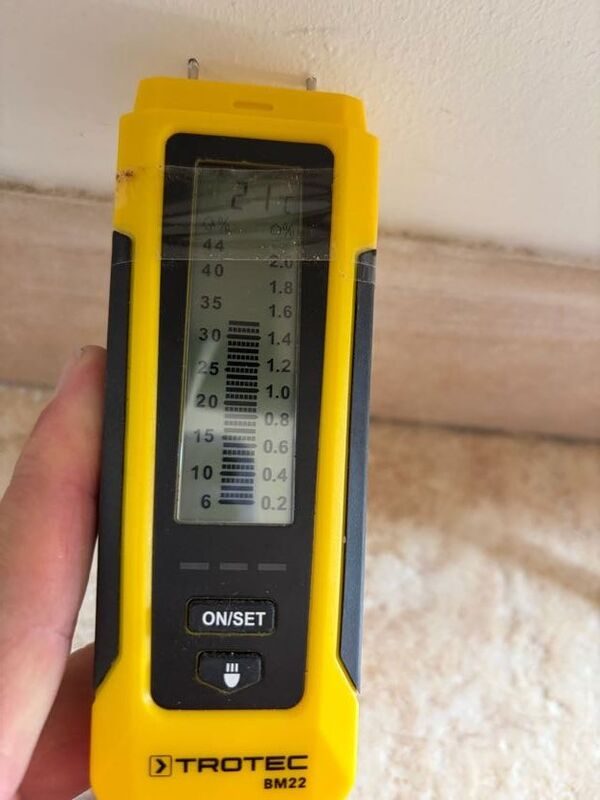
What a resistance-type meter measures
The dry mineral matrix is an insulator. Current flows through the ions dissolved in the pore water, provided that this water forms a continuous path. Archie’s law, established for porous rocks, gives the framework for reasoning:
where σ is the conductivity of the material, σw that of the pore solution, φ the porosity, S the degree of saturation, and a, m, n constants specific to the material. The exponent n is often close to 2. Archie himself presented his equations as approximate relations, and a plaster is not a sandstone. At low saturation, the surface conduction of clays or gypsum takes over, which the Waxman-Smits model describes: the curve depends even more on the material. The law nevertheless shows what the signal depends on. Four consequences follow.
- Salts weigh at least as much as water. The signal is the product of σw by a power of S. With n = 2, doubling the conductivity of the solution has the same effect as multiplying the saturation by 1.4.
- The two variables are linked. At a fixed amount of salt, the solution becomes more concentrated as the wall dries, which offsets part of the drop. As long as the salt stays dissolved, the signal roughly follows S, not S².
- The response is not linear. Between a dry and a wet material, the resistance varies by several decades. The instrument compresses this range onto a logarithmic scale, and sensitivity collapses near saturation.
- Each material has its own curve. The constants a, m and φ change from one material to another. On timber, a resistance-type meter calibrated by species estimates a water content correctly. The same scale is meaningless on plaster.
Temperature also plays a part, but a small one. The conductivity of an ionic solution increases by about 2% per degree: a wall at 8 °C conducts about a quarter less than the same wall at 20 °C. That is a little over a tenth of a decade, far behind the effect of the contact described below.
What a capacitance-type meter measures
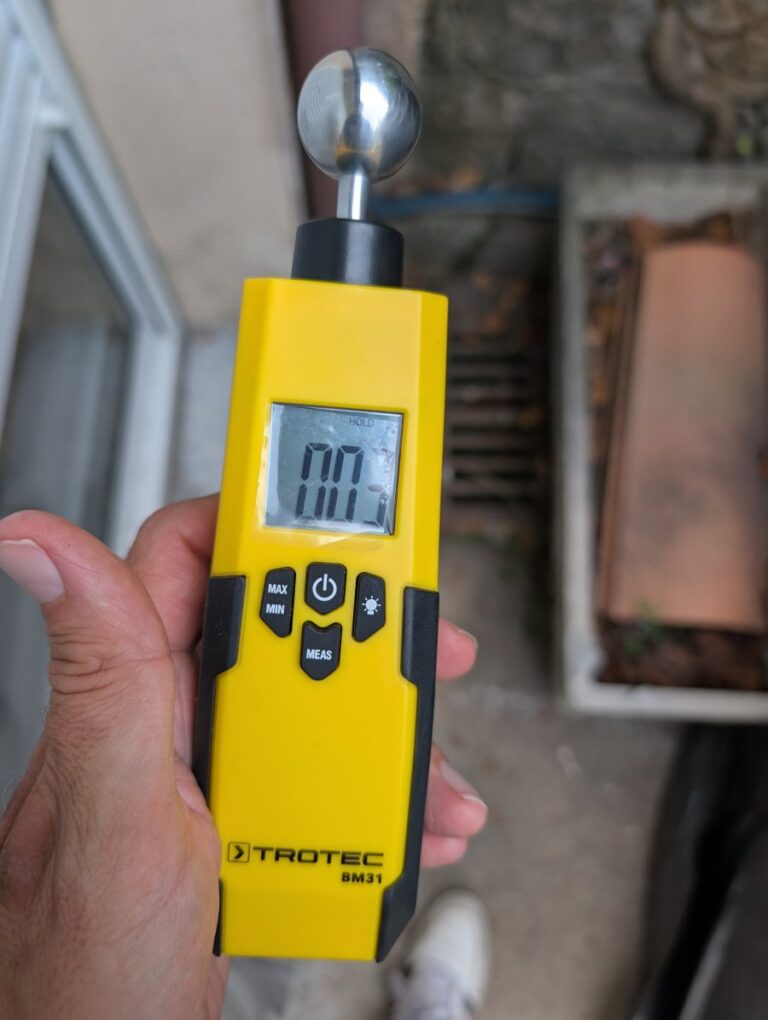
The electrode and the wall form a capacitor, supplied with alternating current. The instrument measures the effect of the wall on the stray field of this capacitor. The signal rests on a contrast: the relative permittivity of water is about 80, that of air 1, that of a dry mineral a few units.
- The sampled volume is weighted. The field decays quickly with depth. The reading averages one to a few centimetres of wall depending on the instrument, with a dominant weight for the layers near the surface.
- Density distorts the reading. More material in the field means a higher apparent permittivity. At equal moisture, a concrete reads higher than a plaster.
- Salts count too. Ionic conduction adds to polarisation and inflates the reading. The effect is somewhat smaller than on a resistance-type meter, but it exists: the Building Conservation Directory 2024 places both instruments among those that respond to both water and salts.
- Contact matters. An air gap under the electrode, on a rough plaster, acts in series and lowers the reading.
- Geometry gets involved. Metal in the wall, a wall corner, a thin partition: anything that enters the field changes the value. The Trotec manual asks for a distance of more than 8 to 10 cm from corners.
Why the two cannot be compared
| Resistance-type | Capacitance-type | |
|---|---|---|
| Quantity | Resistance between two pins | Apparent permittivity under the electrode |
| Signal carrier | Ions of the pore water | Water dipoles, mass of the material, ions |
| Sampled volume | A few millimetres around each pin | One to a few centimetres under the electrode |
| Main interferences | Salts, contact, temperature | Density, metal, salts, air gap, geometry |
| Scale | % timber, % materials or digits, depending on the mode | Manufacturer-specific digits |
| Good use | Measuring precise points, monitoring drying | Scanning a surface to locate an area |
No function converts one reading into the other, because the two do not depend on the same variables. A salty, slightly damp wall raises the resistance-type reading more than the capacitance-type one. A dense, dry concrete does the opposite.
Worse, on a wall with a gradient, the two instruments can rank two walls in opposite order. The resistance-type meter reads what surrounds its pins, the capacitance-type meter integrates over a wider volume. “45 on the capacitance-type meter yesterday, 20 on the resistance-type meter today, so the wall has dried”: this sentence has no physical content.
Pins must be driven in
The resistance read between two pins is played out almost entirely in the first few millimetres around each pin. A pin resting on the surface therefore measures its own contact, not the wall.
Resistance concentrates around the electrode
Current leaves a small electrode and spreads into a large volume. The current density is highest at the metal contact, then drops very quickly. For a hemispherical electrode of radius a in a medium of resistivity ρ, the cumulative resistance up to distance d is:
Half of the total resistance lies between a and 2a, and 90% within 10a. For a cylindrical pin, the concentration is less abrupt but of the same nature.
Two practical consequences. The pin spacing matters little: the measurement is the sum of two local measurements. And the layer touching the metal decides almost everything.
Resting or driven in: the order of magnitude
Two classical formulae, in a homogeneous medium, are enough to quantify the gap. The first, due to Dwight, gives the resistance of a rod of radius r driven in over a length L. The second is that of a flat contact of radius a resting on the surface.
| Situation | Assumptions | Resistance per pin (Ω, with ρ in Ω·m) |
|---|---|---|
| Pin driven in fully | r = 1 mm, L = 10 mm | about 43 × ρ |
| Pin barely engaged | r = 1 mm, L = 2 mm | about 86 × ρ |
| Pin resting on its tip | a = 0.1 mm | 2,500 × ρ |
Between the pin driven in and the pin resting on the surface, the resistance is multiplied by nearly 60, almost two decades on a logarithmic scale. That is enough to make a wet wall pass for a dry one.
Three precautions when reading this:
- The rod formula assumes L is very large compared with r. The second row falls outside this domain and is only valid as an order of magnitude.
- The contact term ρ/4a is half of Holm’s constriction resistance ρ/2a: only one side of the contact resists here, the wall.
- The contact radius is the assumption that weighs most. With a = 0.5 mm, the ratio falls to 12. The gap remains greater than a decade.
Reality is worse than the calculation, for three reasons.
- The real contact is smaller than the apparent contact. On a granular material, the metal touches only a few asperities. The pin driven in crushes the plaster around it and creates intimate contact along its whole length.
- Paint acts in series. A paint film is an insulator placed exactly where the resistance concentrates. With a pin resting on the surface, one measures the film.
- The skin is not the material. The first millimetre is dried by the room air or wetted by condensation. It is this layer that surrounds the tip of the pin.
Added to this is the hand: a pin resting on the surface changes its contact area with pressure. A reading that varies with the thumb is not a measurement.
The technique, and what it guarantees
- Drive the pins in fully where the material allows it, perpendicular to the surface, to a constant depth. Otherwise, work with pilot holes and suitable electrodes, and note it. The contact area is then the same from one point to another, which makes readings comparable. It is also the manufacturer’s calibration condition.
- Do not wobble the instrument. An enlarged hole leaves an air gap around the metal, and the contact becomes point-like again.
- Drive both pins into the same material. Straddling a crack, a joint or a patch of render, one measures the discontinuity.
- Do not force on a hard substrate. A pin that does not penetrate remains a pin resting on the surface, and this is the case on most masonry. One drills pilot holes for suitable electrodes, or changes method.
- Read at the delay prescribed by the manual. Depending on the type of measuring current, the electrodes can polarise and the reading can drift.
Bare pins, insulated pins
A bare pin conducts along its whole driven length. The layers crossed behave as conductances in parallel, and the most conductive one prevails. On a wall that is wet at the surface and dry beneath, the bare pin reads the surface, even when driven in fully.
To measure at a given depth, pins with an insulated shaft are needed, of which only the tip conducts. It is the only way to establish the beginning of a profile with a resistance-type meter.
The surface is not the wall
The moisture of a wall is a profile, not a value. The two instruments read only the beginning of it: a few millimetres for the resistance-type meter, one to a few centimetres for the capacitance-type meter, on a wall twenty to fifty centimetres thick.
Four mechanisms decouple the surface from the core.
- The drying front. A wall dries through its surface. The core follows with a delay, and this delay grows roughly as the square of the thickness: doubling the thickness means quadrupling the time. After a few days of heating or dehumidification, the skin reads dry on a wall that is still loaded.
- Surface condensation. It appears as soon as the surface falls below the dew point of the indoor air, that is 12 °C for air at 20 °C and 60% relative humidity. A thermal bridge or a cold corner is enough. The skin reads wet on a sound wall.
- Hygroscopic salts. A salt takes up water vapour from the air as soon as the relative humidity exceeds its deliquescence threshold: about 75% for sodium chloride, close to 50% for calcium nitrate. A wall contains mixtures, which become deliquescent at a lower humidity than each pure salt. The wall then conducts without any water ingress, and the reading varies with the weather.
- The applied lining. On a plasterboard sheet bonded or screwed in front of insulation, both instruments measure the board. The masonry remains out of reach.
The salt trap has long been documented. BRE Digest 245 points out that salts accumulate in old walls even without any moisture problem, and that a high moisture meter reading does not allow a conclusion on its own.
The answer of the same guide is the sampling profile, described in its annex.
- Drill in a vertical series. The depth stays the same from one point to another. The dust goes into a sealed container, and the drill bits are alternated so as not to heat the sample (Building Conservation Directory 2024).
- Weigh, dry, reweigh. This gives the real water content of each sample.
- Condition at 75% relative humidity, then weigh again. This gives the hygroscopic moisture content, the one that the material and its salts retain without any water ingress (same source).
The excess of the first over the second indicates water ingress. A high hygroscopic moisture content, above about 2%, indicates heavy salt contamination (Wellesley-Smith, 2024). This is an indicative threshold: it varies with the material. Safeguard Europe summarises the method in two parts, hygroscopic and capillary, measured on each sample. No surface instrument makes this distinction.
What the standards say
Standardisation places the resistance-type and capacitance-type meters in the same family, that of relative methods, and reserves the quantity of water for methods on samples.
NF EN 16682 is written for built heritage. Its scope covers timber and masonry: brick, stone, concrete, plaster, mortars. According to the public summary of the standard, it defines four absolute methods and three main relative methods, and reviews ten others.
| Family | Methods | What they deliver |
|---|---|---|
| Absolute | Gravimetry, calcium carbide (CM) test, Karl Fischer titration, azeotropic distillation | A quantity of water, measured on a sample |
| Relative | Electrical resistance, capacitance, equilibrium relative humidity | A reading relative to a reference |
Two absolute methods are used in building expertise.
- Gravimetry. The sample is weighed, dried to constant mass, then reweighed. The standard ISO 12570 governs the drying, and the temperature is set according to the material: about 103 °C in the general case, lowered for materials with bound water such as gypsum and cement (60 °C according to Wellesley-Smith, 2024). For gypsum, still lower temperatures are discussed below.
- The calcium carbide (CM) test. The crushed sample reacts with calcium carbide in a sealed flask. Free water produces acetylene, and the pressure read gives the mass of water. The result is available on site. It gives the total water, without separating the hygroscopic part.
Plaster calls for particular attention. The water of crystallisation of gypsum represents 20.9% of its mass, of which 15.7% is lost as soon as it passes to the hemihydrate. A plaster dried at about 105 °C loses part of it, and the result overestimates the moisture by several points. Even at 40 °C, very dry drying air is enough to strip off bound water (Wilkes et al., 2007).
Manufacturers reason in the same way. The BM30 manual presents the instrument as a means of locating, without destroying anything, where to sample for the carbide measurement.
A report that states a water percentage without sampling therefore states something other than what it claims.
The rules of the game: eight rules for a defensible report
A defensible moisture report follows eight rules, and each follows directly from the physics above.
- Name the instrument. Make, model, resistance-type or capacitance-type technology, selected mode. Without this, the number has no scale.
- Give the real unit. Digits, % WME or % of the manufacturer’s materials scale. Never just “% moisture”.
- Measure a reference. A dry area of the same material, in the same building. A relative method only speaks through differences.
- Drive the pins in fully, or work with pilot holes and suitable electrodes, and say so. State the type of pins, bare or insulated, as well as the depth reached.
- Record the surface temperature of the wall, and the air temperature and relative humidity. The three together tell whether the surface is below the dew point and whether the hygroscopic salts are active.
- Map. Low, middle, high, and up to the return to the reference value. It is the shape of the profile that points towards an origin.
- Never mix instruments. Monitoring is done with the same instrument, the same mode, at the same points. The capacitance-type meter locates, the resistance-type meter specifies, and their figures do not share a column.
- Write down the reservations. Salts, metal, applied lining, drying in progress, and the fact that the measurement is limited to the surface.
As soon as the stakes justify it, whether a dispute or major works, one samples at depth and weighs.
The next time a report announces a wall at 80%, three questions are enough: which instrument, which unit, relative to what? Without an answer, the figure is worth nothing, and neither are the works it justifies.
A moisture report states a percentage? Have it reviewed.
We are an independent building expertise firm: we review a measurement report, we check the instrument, the unit and the reference, and we give a written second technical opinion. We sell neither works nor treatment. Free quote within 24 h, first quick opinion by video call at €45.
These rules, applied in our case studies
Our case studies detail the instrument, the measurement points, the conditions and the reference area, with the values recorded. Three anonymised cases, whose municipality is fictitious, on moisture:
- Origin of dampness at the base of a wall: 13-page report, measurements at several heights and a control wall;
- Non-decent rental home: 15-page report, readings and thermal surveys by zone;
- Widespread mould in a flat: 24-page report, hierarchy of causes.
To see what a complete deliverable contains, see the sample building expert report. For the day-to-day method, read the measurement protocol at 30, 60 and 90 cm (in French), the analysis of soluble salts (in French) and our expertise equipment (in French). For a full diagnosis, see moisture and rising damp (in French) and the page moisture in the home (in French).
Glossary
- Gravimetric moisture content
- mass of evaporable water over the dry mass of the material. It is the reference quantity, and it is measured on a sample. The volumetric moisture content (m³ of water per m³ of material) also exists and can also be written as a percentage.
- Saturation
- state in which all the open pores of the material are filled with water. It sets the ceiling of the gravimetric moisture content: about 6% for ordinary concrete, 17% for solid brick.
- Digit
- relative, dimensionless unit, from 0 to 100 on many instruments, specific to each manufacturer. A number in digits is not a water percentage.
- % WME
- reading in wood moisture equivalent: instrument scale calibrated on timber, with no water content value for a plaster, a brick or a mortar.
- Relative permittivity
- quantity on which the capacitance-type moisture meter relies: about 80 for water, 1 for air, a few units for a dry mineral.
- Relative method and absolute method
- a relative method (electrical resistance, capacitance, equilibrium relative humidity) delivers a reading relative to a reference; an absolute method (gravimetry, calcium carbide test, Karl Fischer, azeotropic distillation) delivers a quantity of water on a sample.
- Hygroscopic moisture content
- water that the material and its salts retain without any water ingress, measured after conditioning at 75% relative humidity. Above about 2%, it indicates the presence of salts.
- Deliquescence
- relative humidity threshold above which a salt takes up water vapour from the air: about 75% for sodium chloride, close to 50% for calcium nitrate.
- Dew point
- temperature of the moist air at which vapour condenses. A surface colder than this temperature condenses: the dew point is 12 °C for air at 20 °C and 60% relative humidity.
On reading wood rather than a wall: wood moisture and roof frame pests: reference points by range.
Frequently asked questions
Does a moisture meter measure a percentage of moisture in a wall?
No. A handheld moisture meter, resistance-type or capacitance-type, gives a relative reading on a manufacturer-specific scale (digits, % WME or % of a materials scale), not a gravimetric moisture content. Only a sample-based method, such as gravimetry or the calcium carbide test, gives a quantity of water.
What is the difference between a resistance-type and a capacitance-type moisture meter?
The resistance-type meter measures the resistance between two pins, hence the conduction of the ions of the pore water, over a few millimetres. The capacitance-type meter measures an apparent permittivity under the electrode, over one to a few centimetres. Their scales differ and their figures cannot be compared: the capacitance-type meter is used to locate, the resistance-type meter to specify a point.
What water content is possible in a masonry wall?
It is bounded by pore saturation. At complete saturation, ordinary concrete stays around 6% by mass, solid brick around 17% and ordinary gypsum plaster around 40%. A sound plaster in equilibrium with the air of a dwelling contains well under 1% free water. An “80%” in dense masonry is therefore not a water content.
How can the moisture of a wall really be measured?
By sampling at depth: one drills in a vertical series, weighs the sample, dries it and reweighs it (gravimetry, ISO 12570), or uses the calcium carbide test. By conditioning at 75% relative humidity, the hygroscopic part, linked to salts, is separated from the water ingress. NF EN 16682 describes these methods for built heritage.
What should a defensible moisture report contain?
The name of the instrument and its mode, the real unit of the reading, a dry reference area, the type and depth of the pins, the air temperatures and relative humidity, a low, middle and high map, monitoring with the same instrument at the same points, and the reservations (salts, metal, lining, drying in progress). Three questions are enough to test it: which instrument, which unit, relative to what?
References
Standards and guides, checked online on 14 November 2026 on the pages cited. The full text of the two standards and of Digest 245 is paywalled and was not consulted.
- NF EN 16682:2017, methods of measuring the moisture content of materials of built heritage. Standard confirmed in 2022. The content described in this article (four absolute methods, three relative, ten others reviewed) comes from the public summary published by the standards bodies, not from the full text.
- ISO 12570:2000, determination of moisture content by hot-air drying, with its amendments of 2013 and 2018. Standard confirmed in 2024. The text of the standard was not consulted: the drying temperatures quoted in this article come from Wellesley-Smith (2024) and Wilkes et al. (2007), referenced below.
- BRE Digest 245, Rising damp in walls: diagnosis and treatment, P. Trotman, 2007, 12 pages.
- Safeguard Europe, Assessment of Dampness in Buildings, for the summary of the sampling method.
- Matthew Wellesley-Smith, “Measuring Moisture in Masonry”, The Building Conservation Directory, 2024, buildingconservation.com, for the effect of salts on both instruments, drilling and conditioning at 75%.
- Trotec BM30 manual, for digits, dielectric constant, density, distance from corners and locating before carbide measurement.
- K. Wilkes, J. Atchley, P. Childs, A. Desjarlais, “Effects of Drying Conditions, Phase Transformations, and Carbonation Reactions on Measurements of Sorption Isotherms of Building Materials”, Journal of ASTM International, vol. 4, no. 8, 2007. doi:10.1520/JAI100459, for the drying of gypsum.
Classic references, bibliographic records checked online:
- G. E. Archie, 1942, “The Electrical Resistivity Log as an Aid in Determining Some Reservoir Characteristics”, Transactions of the AIME, vol. 146, pp. 54-62. doi:10.2118/942054-G
- H. B. Dwight, 1936, “Calculation of Resistances to Ground”, Transactions of the AIEE, vol. 55, no. 12, pp. 1319-1328. doi:10.1109/T-AIEE.1936.5057209
- R. Holm, 1967, Electric Contacts: Theory and Application, 4th edition, Springer. doi:10.1007/978-3-662-06688-1
The unsourced orders of magnitude (porosities, bulk densities, temperature coefficient, deliquescence thresholds, pin dimensions) are usual values, to be checked against the data of your materials and instruments.
Survey carried out by Frédéric Faucouneau, independent building expert, Antibes, Alpes-Maritimes (06), Var (83), Bouches-du-Rhône (13). Last updated: 14 November 2026. Find out more
Last updated 14/11/2026 - Cassini Expertise, independent building expert, departments 06, 83 and 13.