The essentials. A Cassini report is not an opinion: it is a written, dated, measured document that answers a precise question and shows how it answers it. Here, section by section, is a real damp-diagnosis report (13 pages), anonymised: the question posed, the method, the measurements, the reasoning, the recommendations and the limits.
What you receive
- A written report, signed, dated and numbered, forming one indivisible whole that you can pass to your insurer, your lawyer or the contractors you consult.
- Verifiable findings: time-stamped, located photographs and measurements taken point by point.
- A reasoned diagnosis: each hypothesis is examined, then retained or ruled out, with its reasons.
- Recommendations in the order they should be carried out, and what you should not do.
- The limits of the assignment, set out in black and white.
Free quote within 24 hours; report generally within 2 to 5 working days after the visit. In the example below, the first version arrived about two weeks after the visit, because samples had to be analysed; a second version added a further visit in the rain.
The question posed, and the answer
The client, owner of a property being renovated, sees the plaster deteriorating at the foot of an interior wall. Before continuing the works, they want to know: where does this damp come from? At the head of the report, a summary answers the questions they are asking, in order:
| Question | The report’s answer |
|---|---|
| Is the wall damp today? | No. Capacitive meter: 0 to 8 out of 100; pin meter: 16 to 20 in wood-equivalent (at most 0.8% materials); values comparable to the control wall. |
| Is it condensation? | Ruled out. Surfaces at 22.7-23.8 °C for a dew point of 14.4 °C: at least 8 °C of margin. |
| Is it rising damp (the ground)? | Not demonstrated. No profile decreasing with height and no nitrates in the samples. Not excluded in wet periods: a check is planned. |
| Is it a leak or an infiltration? | Yes. Party wall, neighbouring bathtub right behind the zone, a sealing defect stated by the neighbour on site, water with no salts, maximum residual damp at mid-height. |
| Can the works resume? | Not the replastering until the neighbouring seal and the outside foot of the wall are treated and the wall is checked dry. |
The method, step by step
- Scoping. Quote accepted, written assignment, the client’s request and photographs received before the visit.
- Visit. Ambient conditions (temperature, humidity, dew point), then two walls are marked out: the affected wall and a control wall with no defect, with measuring points at 30, 60 and 90 cm from the floor.
- Cross-checked measurements at each point: moisture by the capacitive method (non-destructive), moisture by resistance between pins, surface temperature.
- Samples and salt analysis. Four plaster samples (3 × 3 cm scrapings), dissolved and analysed at the office: water that passes through the ground picks up nitrates, mains water does not.
- Outside inspection, then a further visit in the rain to see how the wall behaves in the very conditions where it causes trouble.
- Analysis. Each hypothesis (condensation, ground, leak, outside damp) is tested against the measurements.
- Report. Diagnosis, recommendations in order, points of attention outside the assignment, reservations.
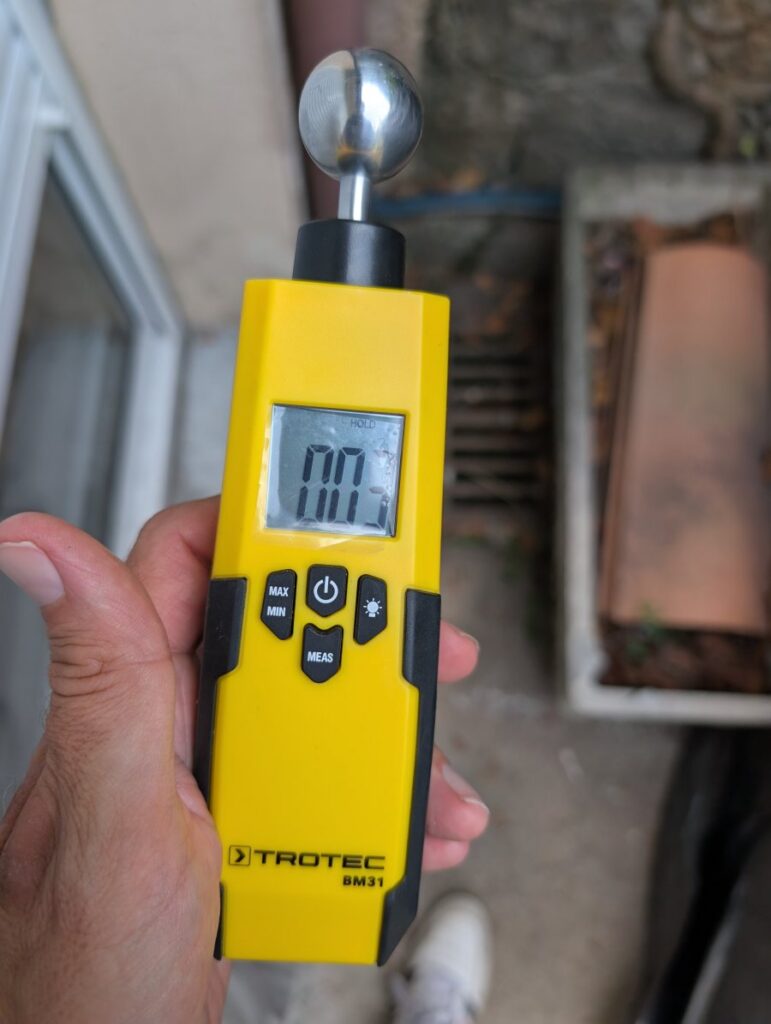
The equipment, and what it is for
| Instrument | What it measures | Why |
|---|---|---|
| Thermo-hygrometer | Air temperature, relative humidity, dew point | Ambient conditions; the threshold at which a surface condenses |
| Capacitive moisture meter | Moisture in materials, without damage, to a depth of 5 to 40 mm | Locate the damp, read the vertical profile, compare with the control wall |
| Pin-type moisture meter | Moisture in materials by electrical resistance, in wood-equivalent and in % of materials | Confirm moisture in the body of the plaster |
| Infrared thermometer | Surface temperature of walls | Compare it with the dew point to rule condensation in or out |
| Colorimetric salt analysis | Nitrates, nitrites, hardness, alkalinity, pH, chlorine | Tell where the water came from: ground or mains |
| Tape, rule, cutter, bags, smartphone | Marking out, sampling, time-stamped photographs | Mark the points and trace every sample |
Every value is comparative and indicative (field instruments, not laboratory-certified): the report says so, and interprets only the differences between points and with the control wall.
Anatomy of a report: what each part says
- Assignment: purpose, framework, limits, documents received.
- The property and the statements made: what was seen, what each person stated (reported as such).
- Method and equipment: the protocol and the instruments.
- Ambient conditions and marking out: where, and in what conditions, measurements were taken.
- Visual findings: photographs and description, wall by wall.
- Measurements: point-by-point tables, affected wall and control wall, and how to read them.
- Salt analysis: method, results, interpretation.
- Outside: inspection and further visit.
- Analysis and diagnosis: hypotheses examined, for and against, then the diagnosis.
- Recommendations: in order, with what to rule out.
- Points of attention outside the assignment: what was noticed in passing, to be checked.
- Reservations: what the report does not cover.
A few extracts
Important notes. The operations carried out constitute a private, one-sided, non-adversarial expert assignment. […] Cassini Expertise is independent of any damp-treatment or building company; no process or building service is offered.
Reading the measurements. All the surfaces measured are between 22.7 and 23.8 °C, 8 to 9 °C above the dew point (14.4 °C). Condensation is ruled out under the conditions of the visit.
Diagnosis. The origin of the defect is a leak from the neighbouring bathtub: intermittent water that has migrated into the party wall and run down to the foot, where the plaster has deteriorated. As an aggravating factor, the outside base of the wall is in direct contact with soil, with no drainage or protection. Condensation is not involved.
To be ruled out for now: injection of water-repellent resin at the foot of the wall (no rising damp demonstrated; a pointless and costly treatment until the origin is established).
That last extract sums up the value of an independent diagnosis: avoiding paying for a treatment that fixes nothing.
What the report does not do
- It is neither a quote nor a works specification: Cassini Expertise sells no building work and no process.
- It is a private, non-adversarial assessment: the neighbour and their insurer were not heard in a formal setting. If the point is disputed, an adversarial expert assessment can formalise it.
- The measurements describe the wall on the day of the visit (here, after a long dry spell): hence the further visit and the check after rain.
- It is neither a regulatory diagnostic nor a project-management assignment.
Depending on your question, another type of report
| Your question | The report that answers it | Example |
|---|---|---|
| Where does this damp come from? | Damp diagnosis (the one presented above) | Origin of damp at the base of a wall |
| Are these cracks serious? Where do they come from? | Crack diagnosis: survey, classification, cause, monitoring | Facade cracks and rainwater drainage |
| Is my rented home decent? | Survey of a rented dwelling: decency and sanitation | Non-decent rental home |
| I have just bought: did the defects exist before the sale? | Survey of structural defects: seriousness, age, progression | Structural cracks after buying a villa |
| The contractor claims the balance, nothing is accepted. | Adversarial survey of defects and unfinished works | Unfinished renovation and a balance claimed |
| Does my off-plan (VEFA) home comply with the permit and the specification? | Analysis of non-compliance and of the feasibility of putting it right | VEFA expert, French Riviera |
| Which of these two properties should I buy? | Comparative pre-purchase survey | Second-home purchase: comparing two properties |
| I need to prepare for, or challenge, an expert assessment. | Support for a party: observations, second opinion | Second-opinion building expert |
How to get a report
- Describe your situation by form, e-mail or phone.
- Free quote within 24 hours, with the written assignment and its scope.
- Visit, measurements and samples.
- Report: generally within 2 to 5 working days after the visit.
Not sure you need an expert assessment? A first video consultation (30 minutes, €45) frames the situation and tells you whether an assessment is worthwhile – or not.
Does your situation look like this case?
Every case is different. Describe yours: an independent building expert replies within 24 hours, with no obligation. A first consultation by video call is available.
Example taken from a real report: names, addresses, references and dates removed or replaced with relative markers; the measurements and the reasoning are those of the report. Provided for illustrative purposes only; not advice for your own situation.
On the rigour of moisture measurement: the measurement rules of a defensible damp report.
Last updated 14/11/2026 - Cassini Expertise, independent building expert, departments 06, 83 and 13.