The essentials. First-floor flat of about 100 m² in a co-owned building, Saint-Maurel (06). Widespread mould: ceilings, woodwork, cupboards, clothing, to the point of making the home unusable as it stands. In the wet rooms, the air extraction measured with the anemometer is 0.00 m/s with the cover in place. We find three causes of collective origin: a probable leak in the rainwater downpipe, likely condensation on the cold-water network, and virtually inoperative air extraction. Nothing observed points to misuse. These causes fall within common parts.
The context
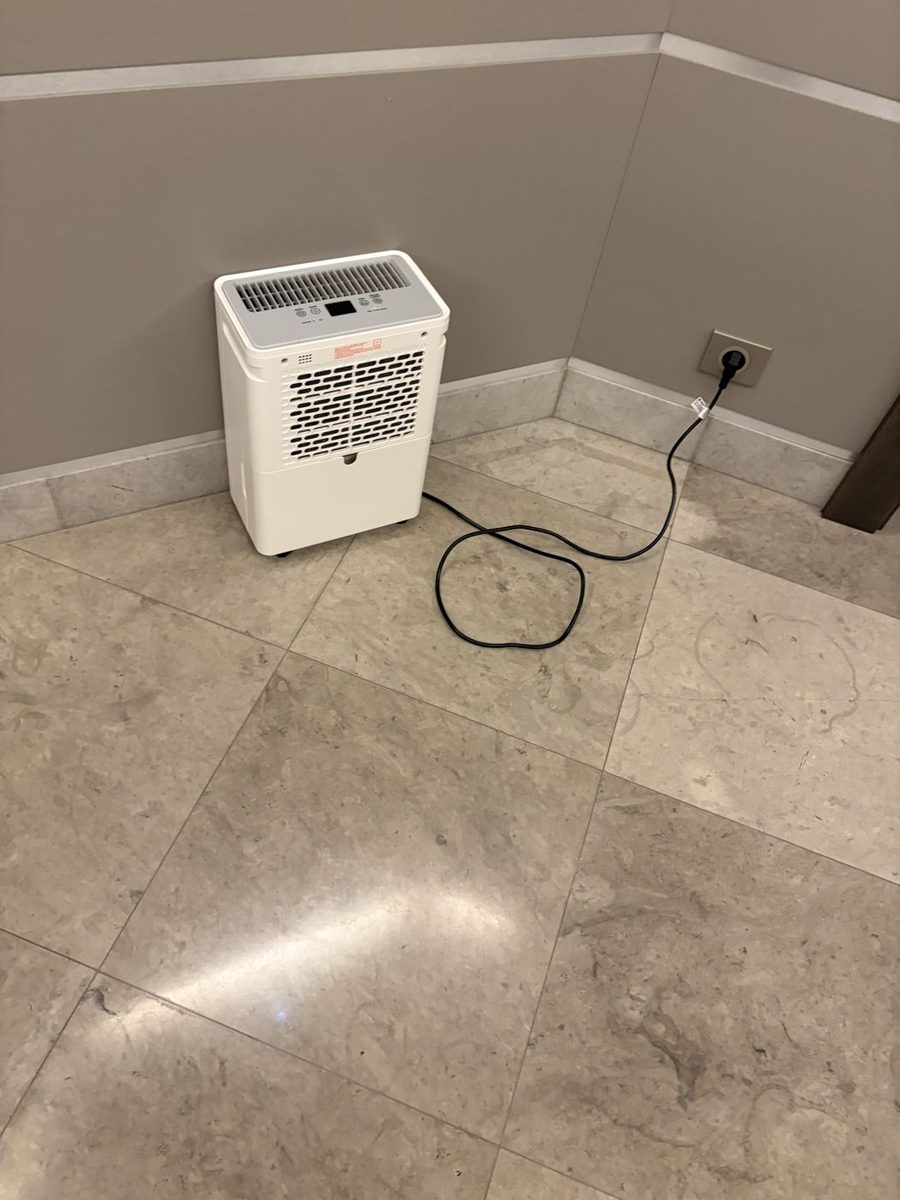
An owner discovers that his flat, on the first floor of a co-owned building, is covered in mould: diffuse speckling on the ceilings, brown spots around the access hatches and extract vents, black runs on the woodwork, and whitish mould on the textiles and luggage stored in the cupboards. A claim has been made to his insurer, and the agency has installed a dehumidifier and a portable heater as a stopgap. The home is no longer used as it stands.
The question posed
Where does this moisture come from? Is there a leak? Does the origin lie in the flat or in the building? We assist the owner (non-adversarial assignment): identify the origin, record and assess the damage (walls, ceilings, cupboards, furniture, textiles) and guide him in his next steps. One pointer from the outset: according to the building caretaker, all the first-floor flats suffer recurrent mould. Recurrence across a whole level points to a common cause rather than to a misuse specific to one home.
Method and instruments
Room-by-room visit in the owner’s presence, with the caretaker opening access to the upper terraces and to the shared plant room. Three instruments, used on a comparative and indicative basis:
- Vane anemometer (air speed in m/s): check of the suction at the ventilation extract vents, with the cover in place and then removed.
- Ball-type moisture meter (non-destructive dielectric measurement, depth of about 5 to 40 mm, index from 0 to 100): comparative probing of walls and ceilings. The report does not state the number of probing points.
- Electronic thermo-hygrometer (relative humidity and temperature): indoor ambient readings.
The rest of the examination is visual. No opening-up of any wall, no sampling and no watertightness test is mentioned. One reservation is made from the start: as the windows were open during the visit, the ambient humidity is not representative of normal occupancy conditions. Only the wall probing serves as a comparison.
Readings
Air extraction (vane anemometer)
The report converts the regulatory flow rates into air speeds according to the diameter of the vent:
At a vent working properly, the speeds commonly recorded are of the order of 1 to 3 m/s depending on the diameter and the flow rate set, according to the report.
Wall moisture and ambient conditions
Key findings
Mould even inside the cupboards
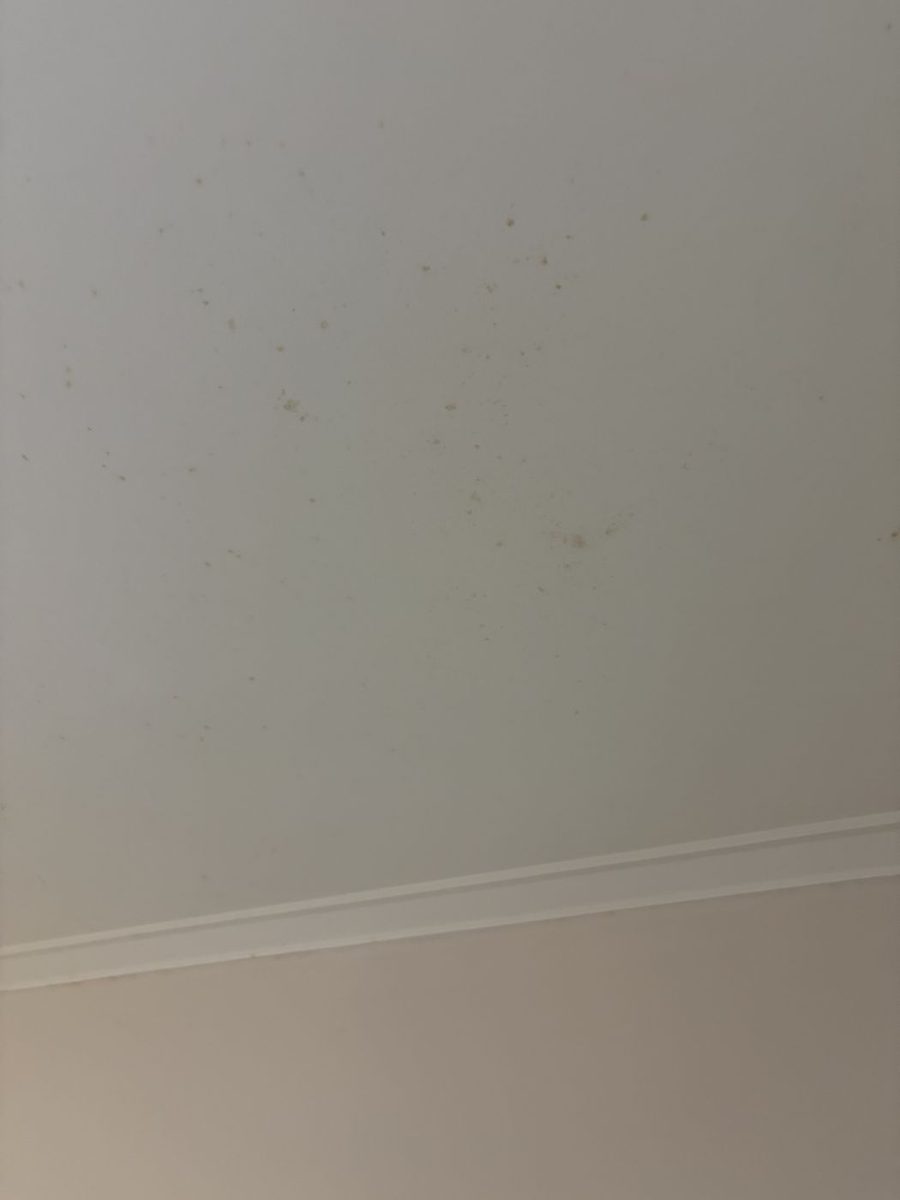
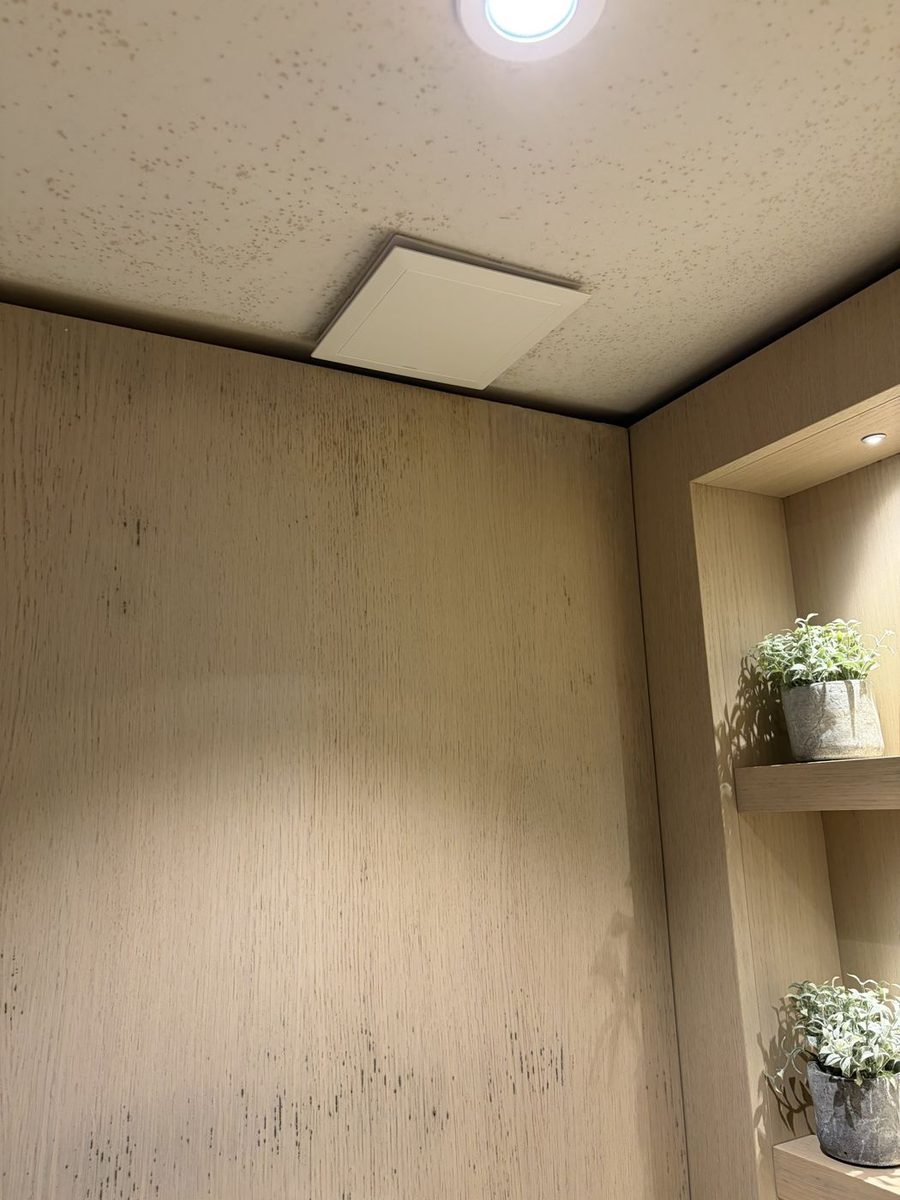
Fungal growth affects almost every room. In the north-facing bedroom, the ceiling is speckled over its whole surface and the fabric headboard bears greenish rings. In the wet rooms, the ceilings are studded with brown spots, more marked around the extract vents, with black runs on the timber facings. In the cupboards and the dressing room, whitish mould covers a sports bag, a jacket and clothes, a sign of air durably laden with moisture.
The rainwater lead: blocked weep hole, blackened timber
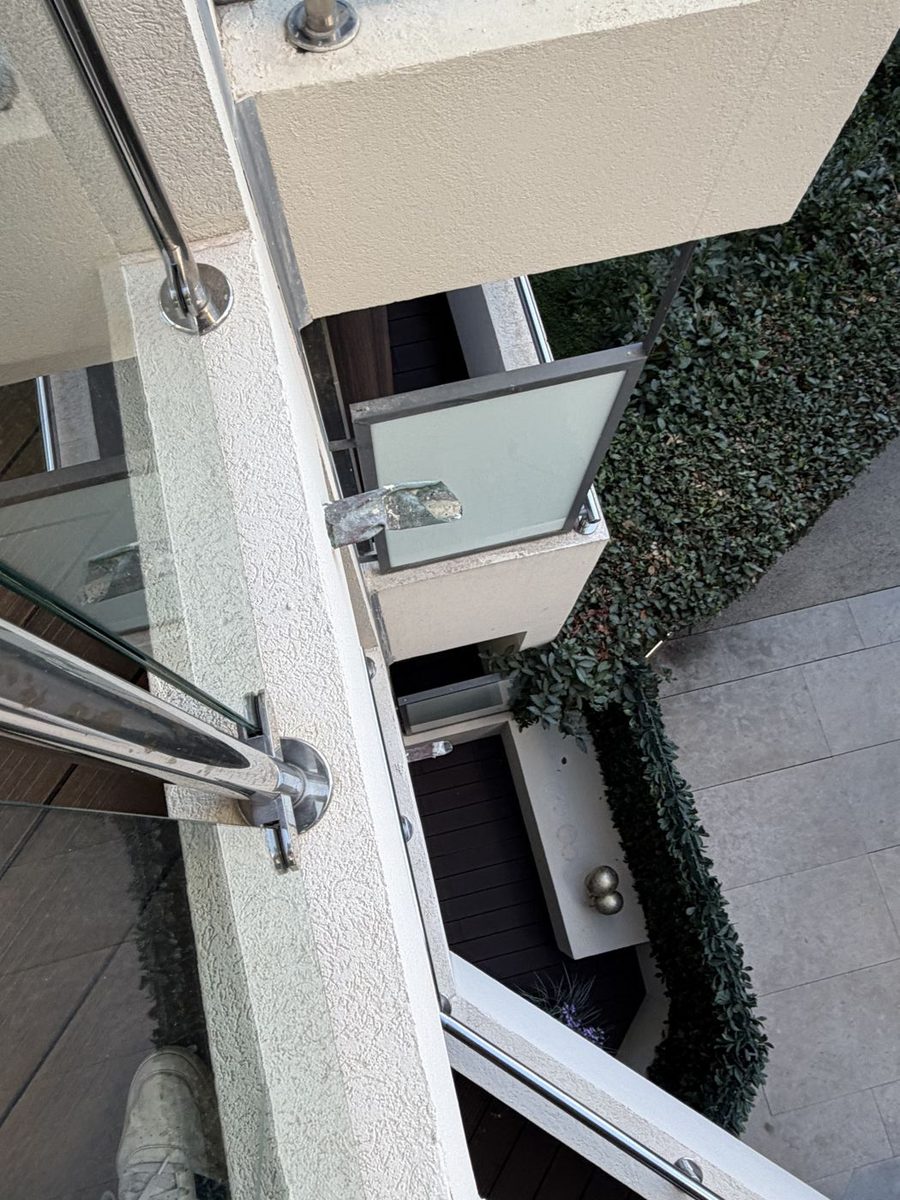
On the flat’s terrace, the rainwater drainage weep hole (barbacane) is blocked. The one on the neighbouring terrace is damaged and deformed, and no longer allows natural drainage. At the foot of the timber surrounds of the joinery, the wood is blackened and degraded: this deterioration points to recurrent standing water rather than an isolated episode. From the upper level, the rainwater downpipe examined at the weep hole shows a probable leak, with likely migration of water through the slab to the ceiling of the room concerned, the north bedroom.
Air extraction measured at zero
The decisive finding is 0.00 m/s at the WC extract vent, cover in place, that is, in the actual configuration of use. Air renewal in the wet rooms in real service is virtually nil.
Condensation on the collective cold-water network
In the shared plant room, three pipes of the cold-water network (chilled water), which serve the private areas including the flat, each show a significant mould mark. A cold pipe condenses moisture from the air when its insulation is missing, degraded or discontinuous: the report finds likely condensation and a probable insulation defect.
Technical and normative references
- Order of 24 March 1982 on the ventilation of dwellings: it requires minimum extraction flow rates in service rooms, of the order of 15 to 30 m³/h for a shower room or WC and 30 m³/h for a bathroom, depending on the size of the dwelling. Here, nil suction with the cover in place cannot achieve these flow rates.
- Ten-year warranty and structural damage insurance (dommages-ouvrage): the report points out that, on the information gathered, the ten-year period from acceptance of the works would have been exceeded by about one month. The effects of this period on the funding of repairs are for a lawyer to assess.
Reasoning
Three moisture inputs of common origin add up, and faulty extraction prevents them from being removed.
- Rainwater. Blocked weep hole, neighbouring weep hole deformed, blackened timber at the foot of the joinery: water stands on the terrace. The rainwater downpipe probably leaks at the weep hole and the water migrates through the slab, which durably wets the ceiling of the north bedroom, the support of the fungal growth observed.
- Condensation. Three significant marks on three cold-water pipes in the shared room indicate a chronic moisture input, which affects the whole level according to the caretaker.
- Extraction. With 0.00 m/s cover in place and 0.94 m/s cover removed, the moisture supplied by points 1 and 2 cannot be removed. According to the report, it condenses on the cold surfaces and sustains the mould, even inside the cupboards.
Hypotheses examined and ruled out
- Misuse or inadequate ventilation by the occupant. Ruled out at this stage: nothing observed indicates it, stopgap measures (dehumidifier, portable heating, ventilation) were in place, the home was no longer in use, and the caretaker reports mould in all the first-floor flats. This last point is a statement, not verified by us.
- Uniform moisture of the envelope. Ruled out by the ball-type moisture meter probing: marked differences between walls, with a dry reference wall at index 10, hence zones of localised wetting.
- Isolated rain episode. Ruled out by the condition of the timber at the foot of the joinery, blackened and degraded, which indicates recurrent standing water.
Analysis and deliverable
Our technical conclusion: the cause of the defects is external to the home. It stems from common works (rainwater downpipe and weep holes, collective cold-water network, collective ventilation), whose maintenance and repair fall to the co-owners’ association. We recommend asking the syndic, by registered letter, about a possible claim under the structural damage insurance, sending the report to the insurer so that adversarial expert assessments can take place, and taking advice before any intervention. The premises must be left as they are: the north bedroom ceiling, the main physical evidence of the link with the common works, must not be cleaned, scrubbed, repainted or drilled until the adversarial findings are made. As a protective measure: keep up ventilation and dehumidification, and ask the syndic to clear the weep holes, search for a leak on the downpipe, check the insulation and put the ventilation back into service. On deadlines, the ten-year warranty runs for ten years from acceptance, and its exact date must be checked by a lawyer.
Limits of the analysis
- Non-adversarial assignment, based on visual findings and non-destructive measurements on the day of the visit, comparative and indicative. The number of probing points is not stated and the values of the dampest walls are not quantified.
- The real humidity in occupation, with windows closed, was not measured; the report estimates it to be higher than the 56 to 57 % RH recorded. The flow rate of each vent calls for a measurement with a flow hood (cone).
- The downpipe leak is probable, observed from the upper level with no watertightness test mentioned. The condensation is likely, with no surface temperature measurement reported. No mould sampling is mentioned. The situation of the other flats rests on the caretaker’s statement.
- Recommended investigations: humidity logging over several days with windows closed, moisture mapping of the walls, flow rate measurement, leak search on the downpipe, check of the insulation.
- The legal characterisation of the loss and the choice of proceedings are matters for legal counsel, not for our technical assignment.
What this case illustrates
Faced with mould, intuition often points to the occupant: insufficient ventilation, living habits. Here the readings point elsewhere: a vent at 0.00 m/s, blocked weep holes and cold-water pipes marked with mould are facts located in the common parts. To go further: our damp and mould diagnosis, the article on a damp stain on the ceiling: common or private part?, and the related case study on finding the origin of damp at the base of a wall in Roquebellan.
See also: damp converted basement – Port-Larmoure · all case studies
Does your situation look like this case?
Every case is different. Describe yours: an independent building expert replies within 24 hours, with no obligation. A first consultation by video call is available.
Identity, address and sensitive data anonymised, photo metadata removed. Methodological illustration; not advice for your own situation.
“I would like to thank Mr Faucouneau for his professionalism, his seriousness and the quality of his work. Expert report received in French and in English.”
– Owner · Mould assessment in a co-owned building · November 2026
Send your documents (photos, reports, letters)
On the instruments used: the physics of moisture meters: unit, scale and reference of a reading.
Last updated 02/11/2026 - Cassini Expertise, independent building expert, departments 06, 83 and 13.