The essentials. Property undergoing renovation, Roquebellan area (06). Damp at the foot of an interior wall: plaster blistered, detached and crumbling over a strip of roughly 10 to 20 cm. Assignment: identify the origin by measurement. Wall dry on the day of the visit, surfaces at 22.7 to 23.8 °C against a dew point of 14.4 °C (condensation ruled out), no nitrates in four plaster samples (ground water ruled out). The most marked stain, at about 60 cm, is opposite the neighbouring property’s bathtub, whose leaking seal was acknowledged on site. Origin retained: an intermittent leak on the neighbour’s side, with an aggravating factor on the outside. A diagnosis by elimination, which avoids unnecessary treatments.
The context
An unoccupied property, undergoing complete renovation, shows plaster damage at the foot of an interior wall. The tiling and screed have been removed, the ground is exposed, and the partitions and sanitary fittings have been dismantled. The defects have been reported for several months, with a persistent musty smell. The wall concerned (labelled M) is shared with the neighbouring property; a control wall (labelled N), with no visible defects, was chosen on the opposite side. The owner fears paying to treat a problem that no longer exists, or missing an active one.
The question posed
Where does this damp come from? Four classic hypotheses arise: condensation (moisture in the air depositing on a surface colder than the dew point), capillary rise (ground water rising in the wall), an infiltration or a leak (water still entering, intermittently or not), or a past episode (water came in once, then left, leaving the marks).
Method and instruments
A private assignment, commissioned by the owner, unilateral and non-adversarial. The investigations are non-destructive, supplemented by light probing: 2 mm pin holes and plaster scrapings of 3 x 3 cm. The neighbouring property was not visited; its owner, present on site, was heard.
Fixed protocol: ambient conditions first, then two walls (affected and control) instrumented at three heights (30, 60 and 90 cm above the removed finished floor), with cross-checked measurements at each point, samples for salt analysis and an outdoor inspection.
Reading the values
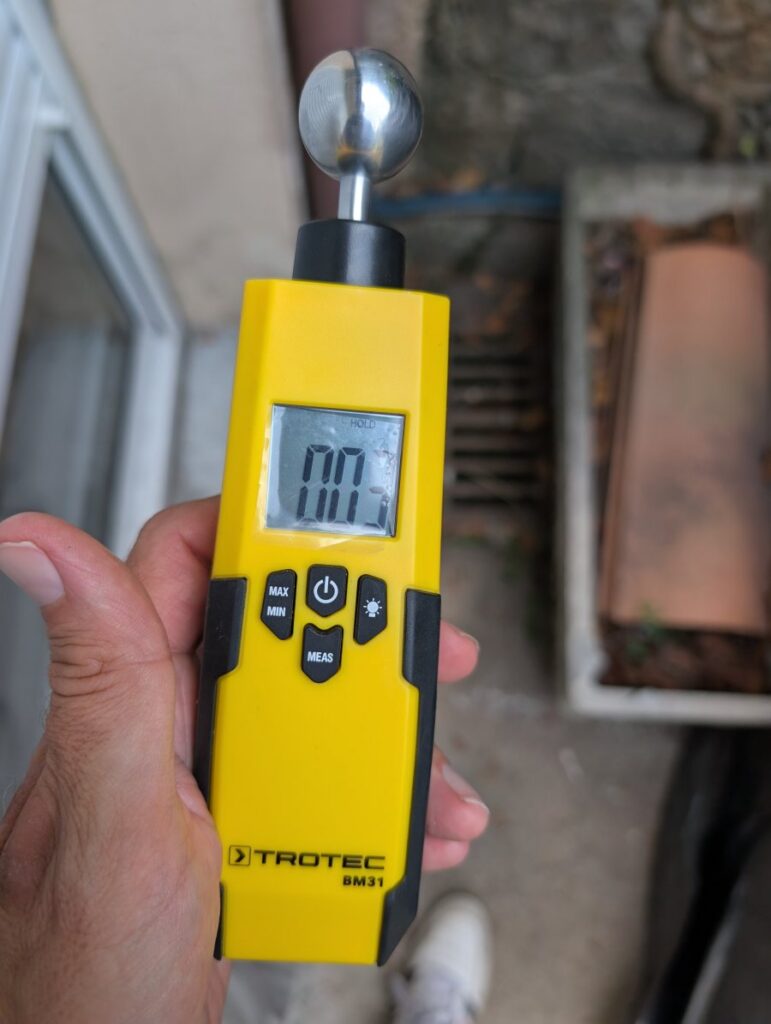
Capacitive: relative scale of 0 to 100, “dry” below 30 for a plaster; only comparisons between points and with the control are interpreted. Pin-type, in timber equivalent (usual convention): below 17 dry, 17 to 20 borderline, above 20 damp. A gap of more than 2 °C between surface temperature and dew point rules out condensation.
Readings
Ambient conditions
Any surface colder than 14.4 °C would condense.
Affected wall (M) and control wall (N)
On M, the capacitive gradient from 30 to 90 cm is +2 digits, and the timber equivalent goes from 16 to 17 then 20: no decrease with height.
Soluble salt analysis
Four plaster samples (M-30, M-60, M-90 and control N) were taken on site by scraping, over 3 x 3 cm and 1 to 2 cm deep. At the office, on 2 October 2026, each sample was dissolved in a constant volume of demineralised water, then decanted; reading against a colour chart at 60 seconds, with a control blank (water alone).
The very high hardness, identical on the affected wall and on the sound wall, comes from the nature of the plaster (gypsum, soluble calcium sulphate) and does not indicate an external input.
Outside face, 11 October 2026, in rain
Reasoning
A dry wall on the day of the visit
The capacitive reading on M is almost nil (0 to 8 digits out of 100) and the pin-type readings give 16 to 20 in timber equivalent (at most 0.8 % in materials), in the same range as the control wall (12 to 17). The wall is therefore not damp that day. A continuous rise or an active infiltration would make it damp; an intermittent cause remains possible.
Condensation: ruled out by measurement
All the surfaces measured are between 22.7 and 23.8 °C, that is 8 to 9 °C above the dew point (14.4 °C), for an exclusion threshold of 2 °C. The musty smell and high humidity reported are explained by a closed, unventilated property with bare ground on the soil: they worsen the atmosphere without causing the defect at the foot of the wall.
Capillary rise: not demonstrated
The values on M do not decrease with height and the lowest point (M-30) is the driest by capacitive reading: a profile incompatible with active rise. No nitrates or nitrites are detected, the control blank validating the method: the water did not pass through the ground. In its favour: a wall described as in contact with the soil, a low degraded strip with a sharp horizontal edge, a floor with no barrier. It is not confirmed, and not excluded in rainy weather, the visit having taken place after months of drought.
Leak from the neighbouring property’s bathtub: retained
The wall is shared and the neighbouring property’s bathtub sits opposite the zone. The neighbour, present on site, stated that this bathtub has a leaking seal. The dark stain, at about 60 cm, is localised, with no horizontal front; the most marked residual moisture is at mid-height rather than at the foot; the water is clean (no nitrates). Wall M is slightly warmer than the ambient air (21.8 °C) and than the control, which is consistent with heat coming from the neighbouring room (bathroom, hot water). Mechanism retained: each time the bathtub is used, water migrates into the shared wall and runs down to the foot, where the plaster deteriorates. This intermittent character explains the dry wall on the day of the visit.
Damp from the outside: an aggravating factor
The additional visit in rain shows an outside face that takes up water, soil in contact with the plinth with no drainage, a high-flow rainwater downpipe at the corner (inspection of 18 September, with dense climbing vegetation in contact) and earlier plaster repairs. This configuration does not explain the stain at 60 cm, but it keeps the foot of the wall damp in rainy weather, explains the earlier plaster repairs and would slow any drying after the neighbour’s seal is repaired.
Conclusions and order of operations
The damage originates in an intermittent leak from the neighbouring property’s bathtub, migrating through the shared wall to its foot; the outside plinth in contact with the soil aggravates the damp. Recommended order of operations:
- repair the watertightness of the bathtub on the neighbour’s side (joints, apron, trap, drain, supply pipes, filling test), after a joint inspection with the neighbour and the insurers;
- remedy the outside foot of the wall (soil in contact removed, perimeter drain, protection of the buried wall, draining backfill, rainwater downpipe connected);
- check the drying and repeat the measurements after normal use of the neighbouring bathtub and after a sustained rain episode, with a temperature and humidity logger in the room;
- ventilate the property, lay a ground-moisture barrier before the new screed, then redo the plaster (lime or remedial plaster, no waterproof cement render).
The report advises against injecting water-repellent resin at the foot of the wall as things stand: no capillary rise has been demonstrated.
Limits of the analysis
- The neighbouring property was not visited. The bathtub and its leaking seal rest on statements gathered on site and on the layout of the premises, without direct observation: the report establishes technical consistency, it does not record the leak.
- The measurements date from the end of a dry period and do not describe the wall in rainy weather: a check after rain is recommended.
- Field instruments, comparative and uncertified values; qualitative salt analysis, which cannot entirely exclude a past episode of ground origin, since washed out, though nothing points that way. The capacitive meter was not read on the control wall.
- Unilateral, non-adversarial assignment: an expert assessment with both parties and their insurers present (expertise contradictoire) would allow the findings to be formalised.
What this case illustrates
An investigation into origin proceeds by elimination: each hypothesis is tested by measurement, and only the cause that withstands every test is retained. Here, the temperature gap rules out condensation, the absence of nitrates and of a gradient rules out ground water, and the localisation together with clean water points to the neighbour’s leak. This approach avoids unnecessary treatments: treating the wall on the client’s side would have settled nothing while the leak continued. Cassini Expertise has no link with damp-treatment or building firms: its only product is the diagnosis. See also our article on the damp basement bedroom: condensation or infiltration, or tell us about your situation.
See also: damp converted basement – Port-Larmoure · mould in a co-owned building – Saint-Maurel · all case studies
Does your situation look like this case?
Every case is different. Describe yours: an independent building expert replies within 24 hours, with no obligation. A first consultation by video call is available.
Identity, address and sensitive data anonymised. A methodological illustration, not advice for your own situation.
On the instruments used: how to read a wall moisture measurement: pins driven in, salts and reference.
Last updated 14/11/2026 - Cassini Expertise, independent building expert, departments 06, 83 and 13.