The essentials. Detached house let to tenants, Lucéram (06), on a steeply sloping plot, water supply from a private spring. Eight disorders recorded, four of them direct health hazards: open sewage tank, never-tested drinking water, waterlogged walls, rodents. Survey against the French decency criteria (decree no. 2002-120): of six criteria examined, not one was met or evidenced.
The context
A detached house is rented in a village in the Nice hinterland, on a steeply sloping plot at roughly 670 m above sea level. Water comes from a private spring; drainage is individual, with a tank set in front of the main façade. The tenants – a family including vulnerable members – endure recurring water ingress, marked cold in winter, mice “everywhere”, and a water supply nobody knows is drinkable. No document was produced: no lease, no water analysis, no drainage inspection, no technical diagnostics.
The question posed
The occupants needed a technical record they could rely on: establish the disorders, look for their causes and connections, and assess the home against the decency criteria of the decree of 30 January 2002 and the sanitary rules. The practical stake: supporting a formal notice to the landlord, or a report to the competent authorities. The mission – non-destructive, without the landlord present – carefully distinguishes what is established, what is reported by the occupants, and what remains to be proven – by the landlord, in particular.
How the inspection went
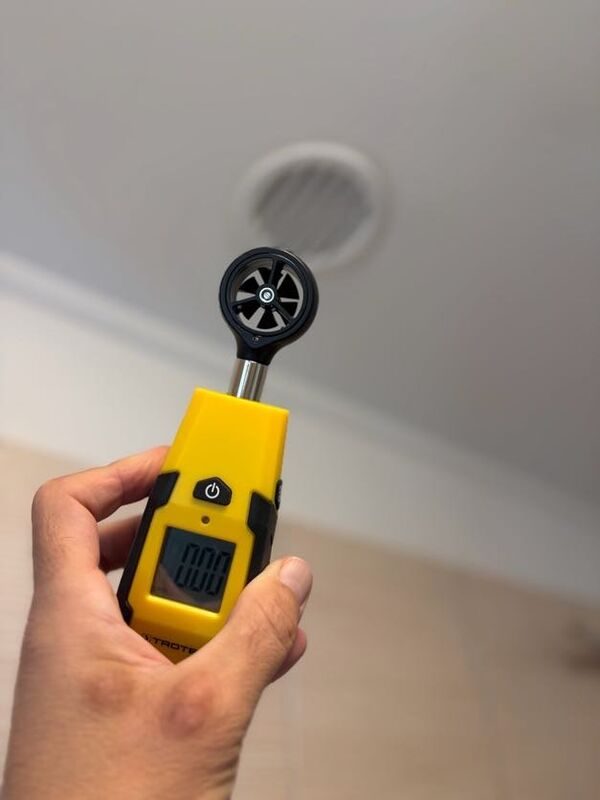
A morning visit in dry weather: every room, the façades, the roof, the surroundings and the drainage system. The instruments: two moisture meters – one with a ball probe, one with pins – always the same device across a comparative series; a vane anemometer for the extraction vents; an infrared thermometer for surface temperatures. Every reading is photographed, device against the material.
Key findings
Four disorders that directly affect health
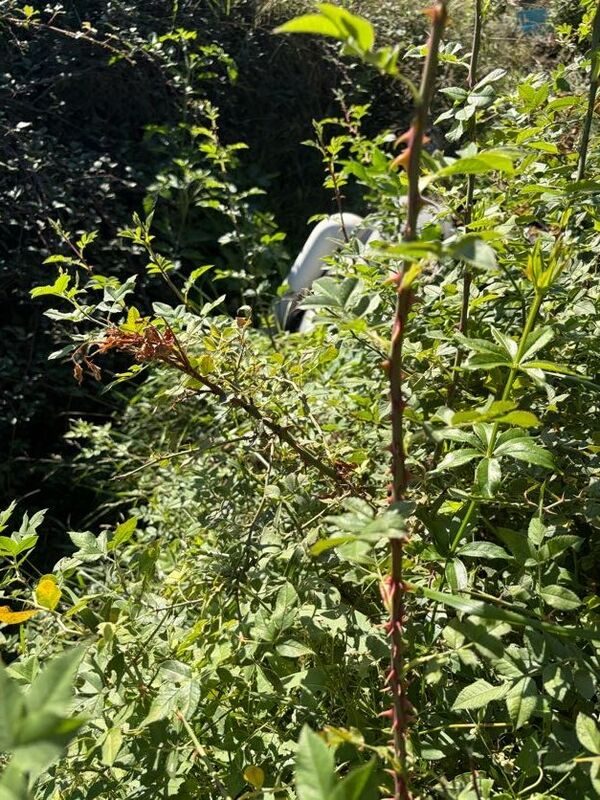
In front of the house, the sewage tank has an open lid, the ground is waterlogged around a pit, and the outlet pipe disappears into brambles: no drainage field, no filter, no outfall downstream. The survey suspects a leaking pipe and untreated effluent discharged straight into the ground – to be confirmed by dye tracing or camera inspection. The drinking water comes from a private spring for which no analysis exists: supplying potable water and declaring a private intake serving third parties are landlord obligations; until an analysis is produced, the decency criterion is not met. Add rodents – droppings in several places, open accesses in the masonry and under the skirting – and waterlogged walls.
Localised damp, measured point by point
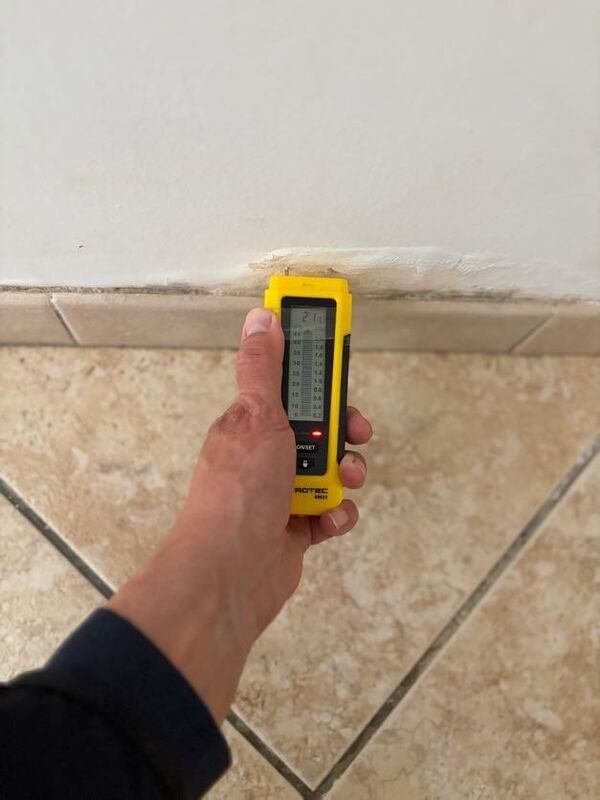
Between the shower room and the corridor, the base of the wall is saturated: white efflorescence – the salts water deposits as it evaporates – lifted plaster, a crack at the skirting junction. The measurements confirm the eye: the pin-type meter goes off the scale, and the surface index climbs from 0.03-0.05 on reference walls to 0.10-0.45 on degraded areas. A clear gap: this is not diffuse ambient damp but localised, long-standing wetting of the masonry at its base – efflorescence does not form in a one-off accident.
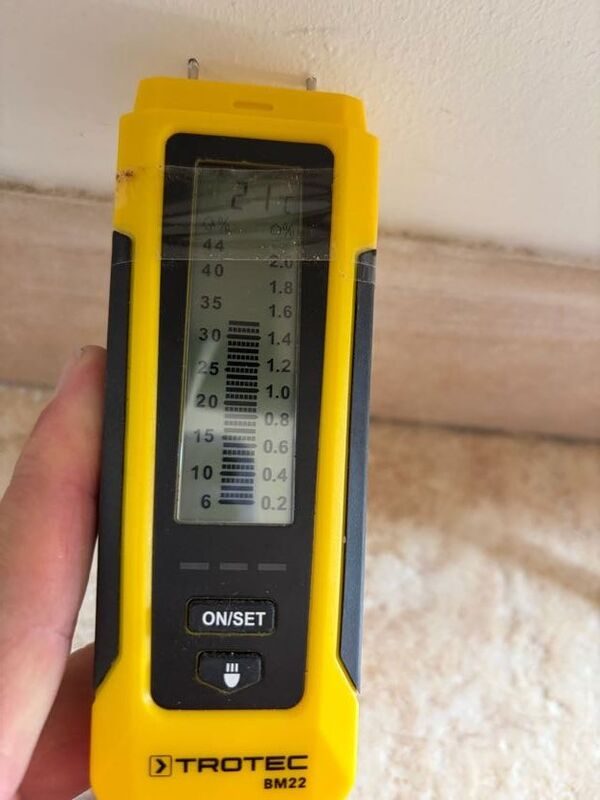
Three hypotheses remain open – rising damp with no visible capillary break, infiltration through a façade touched by vegetation and only partly protected by bituminous coating, or a leak from the adjoining shower room. The report names the investigations that would settle the matter, outside the non-destructive scope.
An envelope that no longer protects
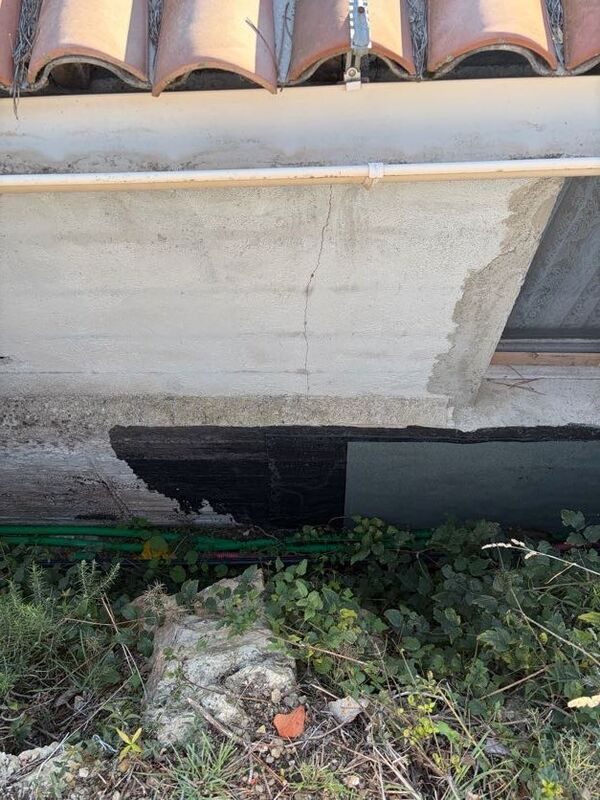
The façade is cracked below the roof edge, ridge tiles are displaced, and an annexe is roofed with corrugated sheets of fibre-cement appearance – a material liable to contain asbestos if pre-1997: the report forbids drilling, breaking or pressure-washing it before a survey. Indoors, floor surfaces in the living rooms measured 15.7 to 17.4 °C in mild autumn weather – a picture of the cold inertia of an uninsulated fabric – and the extraction vent measured with the anemometer delivered nothing.
Analysis and deliverable
The 15-page report classifies each disorder, maps it to the relevant articles of the decency decree and ranks priorities – first the risk to the occupants’ health, then the risk to the building. Of six criteria examined, three are not met (sound structure and weatherproofing, ventilation, waste-water evacuation) and three are not evidenced (heating, drinking water, absence of health risk) – the burden of proof resting with the landlord. Three protective steps brook no delay: secure the tank lid, stop drinking the spring water, start rodent treatment. The report also lists the documents to demand from the landlord: lease, water analyses, drainage inspection report, technical diagnostics.
What this case illustrates
Assessing decency is not a matter of opinion: it is a grid of criteria, each decided by facts – a measured flow rate, an analysis produced or missing, an open tank lid. By documenting every point with measurements, the survey hands tenants a solid file, and the landlord a precise list of what must be proven or repaired. See also our damp and mould diagnosis page and our second-opinion survey service.
See also: widespread mould in a flat – Antibes · damp converted basement – Villeneuve-Loubet
Does your situation look like this case?
Every case is different. Describe yours: an independent building expert replies within 24 hours, with no obligation. A first consultation by video call is available.
Names, address and sensitive data anonymised; photo metadata removed. Provided for illustrative purposes only; not advice for your own situation.
📅 Last updated 02/11/2026 - Cassini Expertise, independent building expert – departments 06, 83 and 13.