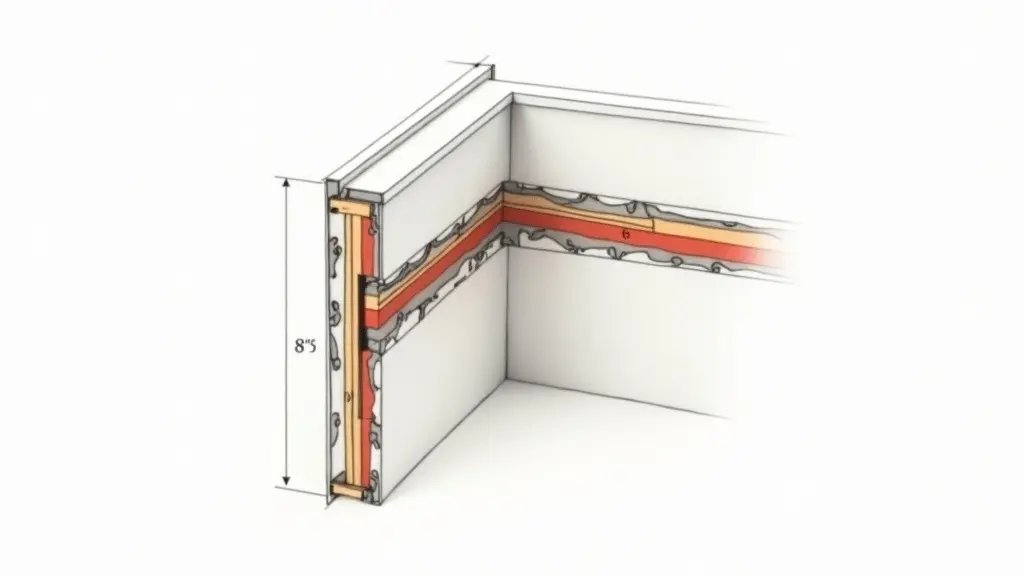
CONSTRUCTION — THERMAL
You have noticed a persistent damp patch at the top of your wall, in the corner of the ceiling, in your new or renovated apartment in Nice. In winter, it appears. In summer, it dries, sometimes leaving traces of mold. You have cleaned, aired, checked for leaks. Nothing works. What you see is the visible signature of a thermal bridge. In France, thermal bridges can account for up to 40% of heat loss in a poorly insulated home. The problem is not air humidity, but a cold spot in the structure.
What You See — and What It Really Hides
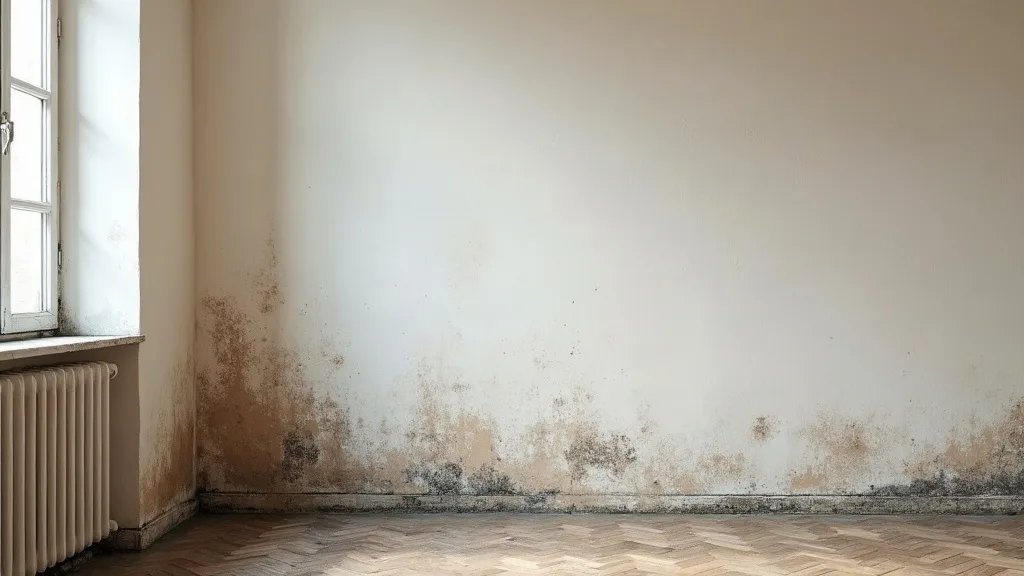
Condensation always forms on the coldest surface. You see water. The real question is: why is this corner colder than the rest of the wall? Frankly, in the cases I handle in the 06 (Alpes-Maritimes department), it is often at the slab-wall junction or at a partition wall that the defect hides. What no one says: the insulation may be perfect on the wall panel, but interrupted or poorly jointed at that precise spot. The warm, humid air of the room comes into contact with this cold wall, and water condenses. This is a pure physical phenomenon, described by the standard NF EN ISO 10211 on thermal bridge calculation.
The Temperature Factor Calculation That Does Not Forgive
The standard NF EN ISO 10211:2017 defines the method. To know if your thermal bridge in Nice is acceptable, we calculate the minimum surface temperature factor fRsi. The formula is: fRsi = (θsi – θe) / (θi – θe). θsi is the interior surface temperature at the coldest point (that’s what needs to be found or estimated), θe the exterior design temperature, and θi the interior setpoint temperature. Let’s take a concrete case measured last year in a residence in Nice. Interior temperature θi = 20°C. Exterior design temperature for Nice according to RT2012 (French thermal regulation 2012): θe = 8°C. With a precise infrared thermometer, we measured a surface temperature at the corner θsi = 14.2°C. The calculation gives: fRsi = (14.2 – 8) / (20 – 8) = 6.2 / 12 = 0.517. RT2012, in its decree of October 26, 2010, requires a minimum fRsi of 0.72 to avoid risks of critical surface condensation in climate zones H2a and H2b (which applies to Nice). Here, 0.517 is well below 0.72. What this means concretely: the surface temperature at this corner is too low, the thermal bridge is significant and non-compliant. Condensation is inevitable under normal humidity conditions in a bathroom or kitchen in Nice.
What Happens If You Do Nothing
Within 6 months, the damp patches will spread, mold (often black, type Stachybotrys) will appear. It’s not just aesthetic. Spores diffuse into the air. For sensitive people, this is a real respiratory problem. After 2 years, permanent moisture can migrate into the structure. On concrete, it can reach the reinforcement and initiate corrosion. On a plasterboard partition, it will deform it, make it bulge. The cost? A simple cosmetic repair (cleaning, antifungal paint): €300 to €500. But it will be temporary. Treating the thermal bridge itself, which often involves interior or exterior insulation work on the precise area, can go up to €2000-€4000 for one junction. And if moisture has damaged the structure, we are talking much more.
What I often observe is that occupants lower the heating to limit condensation. Mistake. This further lowers θi in the calculation, and the fRsi factor becomes even more unfavorable. The vicious cycle sets in: colder, more humidity, more damage.
Recourse and Guarantees: What You Can Demand
For a new home subject to RT2012, the builder is required to comply with the thermal regulations. The minimum fRsi of 0.72 is mandatory. If a thermal bridge causes condensation and mold, you can invoke the non-compliance with RT2012. The ten-year warranty (“garantie décennale”) may cover structural damage caused by moisture. The “dommage-ouvrage” insurance can cover repairs. For existing homes, if the work was done by a professional, the “assurance responsabilité civile professionnelle” may apply. In all cases, a thermal audit by a certified expert (e.g., “diagnostiqueur thermique”) is essential to quantify the problem. The report will serve as evidence for any legal action.
In Nice, the climate is Mediterranean, mild but humid in winter. The combination of mild exterior temperatures (average 8°C in winter) and high interior humidity (often >60% in bathrooms) makes thermal bridges particularly critical. The RT2012 requirement of fRsi ≥ 0.72 is designed to prevent condensation in these conditions. If your calculation shows a lower value, action is needed.
How to Fix a Thermal Bridge in Nice
Solutions depend on the location. For a slab-wall junction, the most effective is exterior insulation (“isolation par l’extérieur” or ITE) covering the junction, but this requires facade work. Interior insulation (“isolation par l’intérieur” or ITI) can be done by adding a layer of insulating plasterboard or rigid insulation on the inner face of the wall, extending onto the slab. For a partition wall, insulating the partition itself or adding a thermal break. In all cases, ensure continuity of insulation. A professional thermal engineer can design the solution. The cost in Nice ranges from €100 to €200 per linear meter for a simple interior insulation patch, up to €500 per linear meter for exterior insulation. But the investment avoids future damage and health issues.
If you are in a condominium (“copropriété”), the problem may be collective. The syndicate must be informed. In some cases, the thermal bridge is due to a design flaw in the building, and the entire facade may need insulation. There are subsidies in France (e.g., “MaPrimeRénov'”, “CEE”) for energy renovation, which can cover part of the cost.
In summary: the temperature factor fRsi is the key indicator. Calculate it or have it calculated. If below 0.72, act quickly. The longer you wait, the more damage and cost.
📅 Mis à jour le 27/07/2026 — Par Cassini Expertise, expert bâtiment indépendant 06 & 83. Devis gratuit : 04 22 46 06 04.
Questions fréquentes
What is the temperature factor for thermal bridges in RT2012?
The temperature factor (fRsi) is a dimensionless value that indicates the risk of surface condensation on a thermal bridge. In RT2012, it must be greater than or equal to 0.55 for most building elements, but higher values (e.g., 0.70) are recommended for better comfort and to avoid mold.
How to calculate the temperature factor for a thermal bridge?
The temperature factor is calculated using the formula fRsi = (Tsi – Te) / (Ti – Te), where Tsi is the interior surface temperature, Ti is the indoor air temperature, and Te is the outdoor temperature. It can be determined through numerical simulations (e.g., with software like THERM or Flixo) or using simplified methods from technical guides.
What is the minimum temperature factor to avoid condensation in Nice?
In Nice, with a mild winter climate, the minimum temperature factor to avoid condensation is typically around 0.50, but RT2012 requires at least 0.55 for all thermal bridges. However, to prevent mold growth and ensure durability, it is advisable to design for fRsi ≥ 0.70, especially in areas with high humidity.
Cassini Expertise
Expert du bâtiment indépendant — Antibes (06·83·13·40)
📅 Mis à jour le 19/09/2026 — Cassini Expertise, expert bâtiment indépendant (06·83·13·40).