CONSTRUCTION — THERMAL
You’ve noticed a persistent damp stain at the top of a wall, right at the ceiling corner, in your new-build or renovated apartment in Nice. It appears in winter. It dries out in summer, sometimes leaving mould marks behind. You’ve cleaned it, ventilated the room, checked for leaks. Nothing works. What you’re looking at is the visible signature of a thermal bridge. In France, thermal bridges can account for up to 40% of heat loss in a poorly insulated home. The problem isn’t air humidity — it’s a cold spot in the structure.
What you see — and what it’s really hiding
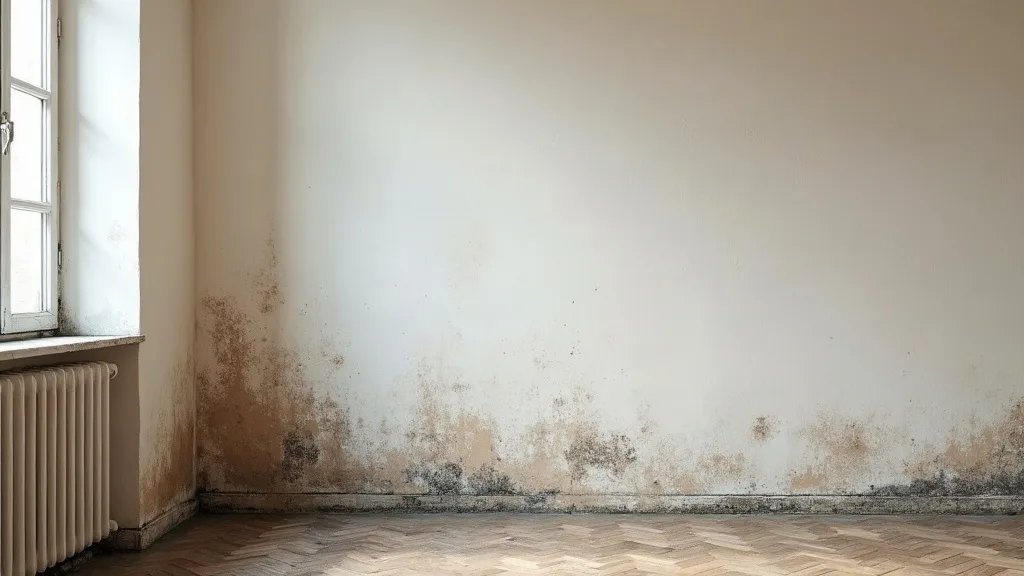
Condensation always forms on the coldest surface. You’re seeing water. The real question is: why is this corner colder than the rest of the wall? Frankly, in the cases I handle across the Alpes-Maritimes, the defect is usually hiding at the slab-to-wall junction or at a load-bearing partition. What nobody tells you: the insulation can be flawless across the main wall surface, yet interrupted or poorly sealed at this exact point. Warm, humid room air meets this cold surface, and the water condenses. It’s a pure physical phenomenon, described by standard NF EN ISO 10211 on thermal bridge calculation.
The temperature factor calculation that shows no mercy
Standard NF EN ISO 10211:2017 sets out the method. To find out whether a thermal bridge in your Nice property is acceptable, you calculate the minimum surface temperature factor, fRsi. The formula is: fRsi = (θsi – θe) / (θi – θe). θsi is the interior surface temperature at the coldest point (the value you need to find or estimate), θe the design outdoor temperature, and θi the target indoor temperature. Take a real case measured last year on a residential building in Nice. Indoor temperature θi = 20°C. Design outdoor temperature for Nice under RT2012: θe = 8°C. Using a precise infrared thermometer, the surface temperature at the corner was measured at θsi = 14.2°C. The calculation gives: fRsi = (14.2 – 8) / (20 – 8) = 6.2 / 12 = 0.517. RT2012, under the decree of 26 October 2010, requires a minimum fRsi of 0.72 to avoid critical surface condensation risk in climate zones H2a and H2b (which includes Nice). Here, 0.517 is well below 0.72. In practical terms: the surface temperature at this corner is too low, the thermal bridge is significant, and it fails compliance. Condensation is unavoidable under the normal humidity conditions of a bathroom or kitchen in Nice.
What happens if you do nothing
Within 6 months, the damp patches will spread, and mould (often black, Stachybotrys-type) will appear. This isn’t just cosmetic. Spores disperse into the air. For sensitive occupants, this becomes a genuine respiratory issue. After 2 years, the persistent moisture can migrate into the structure. In concrete, it can reach the reinforcement bars and trigger corrosion. On a plasterboard partition, it will warp and buckle it. The cost? A simple cosmetic fix (cleaning, anti-fungal paint) runs €300 to €500. But it’s only temporary. Actually treating the thermal bridge causing it — which usually means insulation work on the exact zone, from the inside or outside — can run €2,000 to €4,000 for a single junction. And if the moisture has already damaged the structure, you’re looking at considerably more.
What I see time and again is occupants turning the heating down to limit condensation. That’s a mistake. It lowers θi in the calculation still further, making the fRsi factor even worse. A vicious cycle sets in: colder, more moisture, more damage.
Remedies and warranties: what you’re entitled to demand
For a new-build property subject to RT2012, the builder is legally required to meet thermal bridge treatment requirements (RT2012 decree, article 4). Non-compliance is a construction defect covered by the ten-year structural warranty (garantie décennale). The process is straightforward: have a bailiff or an independent expert (such as our team based in Antibes) draw up a report, including calculations under NF EN ISO 10211. Send the builder a formal notice by registered letter (mise en demeure). If no corrective solution is offered, the matter can be brought before the Nice judicial court. For renovation work, the one-year perfect completion warranty or the two-year warranty (garantie biennale) applies instead. Don’t settle for a coat of paint. Demand the calculation and proof that the fRsi factor exceeds 0.72 once the work is done. It’s your right.
Frequently Asked Questions
How do I know if I have a thermal bridge in my Nice apartment?
Check the corners of exterior walls and the slab-to-wall junctions in winter. If you see a damp stain or mould that keeps coming back despite ventilation, it’s likely a thermal bridge. Condensation forms on the coldest surface — a sign that the insulation is interrupted at that point.
What does it cost to treat a thermal bridge in the Alpes-Maritimes?
It depends on the extent: for a localised point, expect €500 to €1,500 for interior insulation repair. If the thermal bridge is widespread (e.g. a poorly insulated slab), exterior insulation work may be needed, ranging from €5,000 to €15,000 depending on surface area. An accurate diagnosis is essential first.
What should I do if my new-build home has a thermal bridge that doesn’t comply with RT2012?
Contact the builder or developer: RT2012 requires a temperature factor fRsi ≥ 0.72 for Nice. If an infrared measurement shows a lower fRsi (e.g. 0.5), you’re entitled to demand corrective work. Have the defect documented by an expert and send a formal notice by registered letter.
How is the fRsi temperature factor calculated for a thermal bridge?
The formula is fRsi = (θsi – θe) / (θi – θe), where θsi is the surface temperature at the coldest point, θe is the design outdoor temperature (8°C for Nice under RT2012), and θi is the indoor temperature (20°C). An infrared thermometer is used to measure θsi. If the result is below 0.72, the thermal bridge fails compliance.
What are the risks of not treating a thermal bridge that’s causing condensation?
Left untreated, persistent moisture encourages black mould growth (Aspergillus-type) within 6 months, damages paint and render, and can affect indoor air quality. Over the long term, structural elements (timber, plasterboard) can deteriorate, leading to higher repair costs.
📅 Updated 22/08/2026 — By Cassini Expertise, independent building expert covering the Alpes-Maritimes (06) & Var (83). Free quote: 04 22 46 06 04.
Further reading:
Cassini Expertise
Expert du bâtiment indépendant — Antibes (06·83·13·40)
📅 Mis à jour le 26/09/2026 — Cassini Expertise, expert bâtiment indépendant (06·83·13·40).