A crack is not always a sign of danger. Distinguishing between a superficial crack (cosmetic) and a structural crack (affecting the building’s integrity) is essential to knowing when to act. This technical guide helps you analyse your cracks before calling in an expert.
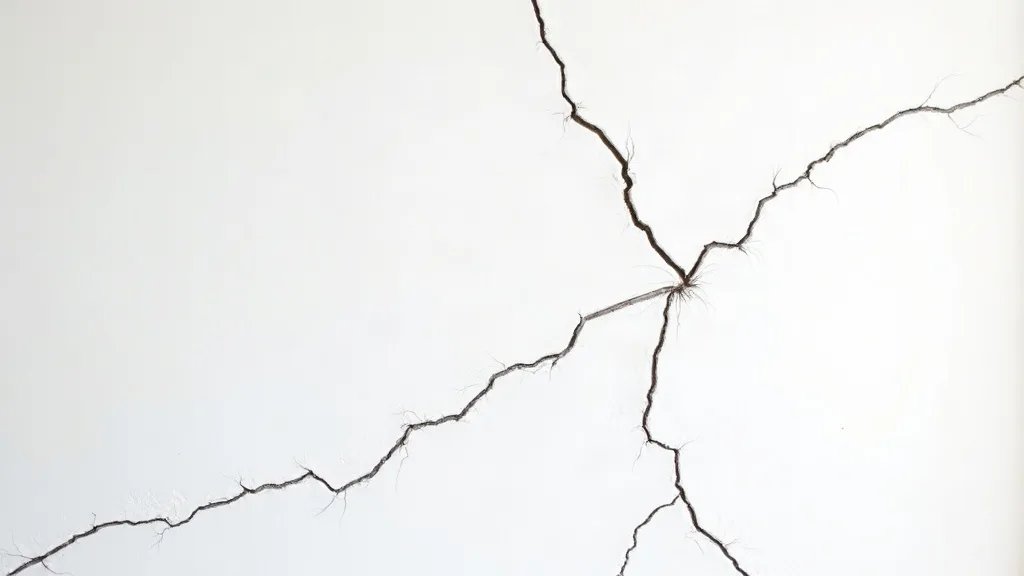
Staircase crack (differential settlement) Staircase crack (differential settlement)
The three levels of severity
The usual classification is based on the width of the opening:
- Micro-cracks (< 0.2 mm): generally superficial, linked to render shrinkage or thermal expansion. Not a cause for concern.
- Fine cracks (0.2 to 2 mm): worth monitoring. They can be harmless but sometimes signal an emerging foundation or structural issue.
- Significant cracks (> 2 mm): potentially structural. An investigation is required.
The telltale signs of structural cracks
Certain patterns should raise a red flag:
- Staircase crack in the masonry: a sign of differential settlement of the foundations.
- Through-crack (visible on both sides of the wall): the wall is cracked through its full thickness.
- 45° crack starting from window or door corners: shear stress, often linked to the soil.
- Vertical crack widening towards the top or bottom: foundation movement.
- Horizontal crack in a load-bearing wall: can indicate thrust or buckling.
- Slight lean of a wall or separation between walls: overall deformation.
Evolution over time: crack monitoring
A crack that has remained stable for years is less worrying than one that keeps evolving. Crack monitoring involves placing witness markers (plaster tell-tales or graduated crack gauges) on either side of the crack and taking regular readings of the opening. A rapid change (millimetres per month) points to an active phenomenon (clay shrink-swell, settlement, ground movement) that requires intervention. This monitoring, carried out over 6 to 12 months, is often required by insurers and court-appointed experts.
Causes to consider
The origin of a structural crack can be:
- Clay shrink-swell subsidence: differential settlement beneath the foundation. In the PACA region, clay soils present specific risks, particularly in south-facing areas such as Grasse or Nice, governed by a geotechnical survey in line with standard NF P 94-500.
- Foundation defect: insufficient depth, uneven soil composition.
- Water leaks: soil washout beneath the foundation, localised swelling.
- Vegetation: tree roots drawing water from the soil.
- Construction defect: missing tie-beams, poor wall bonding.
- Disputes with neighbours: nearby construction work or excavation.
When should you call a building expert?
Contact an expert as soon as a crack exceeds 2 mm, shows a structural pattern (staircase, through-crack, 45°), evolves rapidly, or is accompanied by related signs (deformation, damp, doors that stick). The expert carries out an objective diagnosis: precise measurements, analysis of the foundations and soil, identification of the causes, and costing of remedial works. Their report is a decisive document for pursuing a structural warranty claim, action against the builder, or a natural disaster (CATNAT) declaration.
Further reading
- Drought and clay shrink-swell 2026: subsidence risk in the Alpes-Maritimes and Var
- Foundations without a soil survey: consequences and warning signs (06 and 83)
- Structural diagnosis before buying: key checks for older properties (06 and 83)
📅 Updated on 01/09/2026 — By Cassini Expertise, independent building expert covering the 06 & 83 departments. Free quote: 04 22 46 06 04.
Further reading:
Frequently asked questions
What is the difference between a structural and a superficial crack?
A superficial crack only affects the render or paint, is generally fine (less than 2 mm) and does not go through the wall. A structural crack affects the building’s structure, is often wider, goes right through the wall, and shows signs of movement (offset, progressive widening). If in doubt, consult a professional.
When should I worry about a crack in a wall?
You should be concerned if the crack is wide (>2 mm), runs in a staircase pattern, goes through the wall, or is accompanied by door or window distortion. Active cracks (still widening) or signs of damp are warning signals. In these cases, get an expert assessment quickly.
How do I know if a crack is dangerous?
Monitor how it develops: place a witness marker (a piece of plaster) over it and check after a few weeks. If it widens, or is accompanied by settlement, subsidence or facade cracking, it may be dangerous. Call in a structural engineer to assess the risk.
Cassini Expertise
Expert du bâtiment indépendant — Antibes (06·83·13·40)
📅 Mis à jour le 25/09/2026 — Cassini Expertise, expert bâtiment indépendant (06·83·13·40).