CONSTRUCTION — CRACKS
You’ve just discovered a vertical crack in the load-bearing wall of your home in Nice. It’s 2 mm wide, runs floor to ceiling, and you immediately feared the worst. What you may not know: in Nice, a significant share of structural cracks in detached houses are underestimated by owners who wait too long before getting an expert assessment. You’re right to be worried, but it’s time to move from worry to calculation.
What you’re seeing — and what it’s really hiding
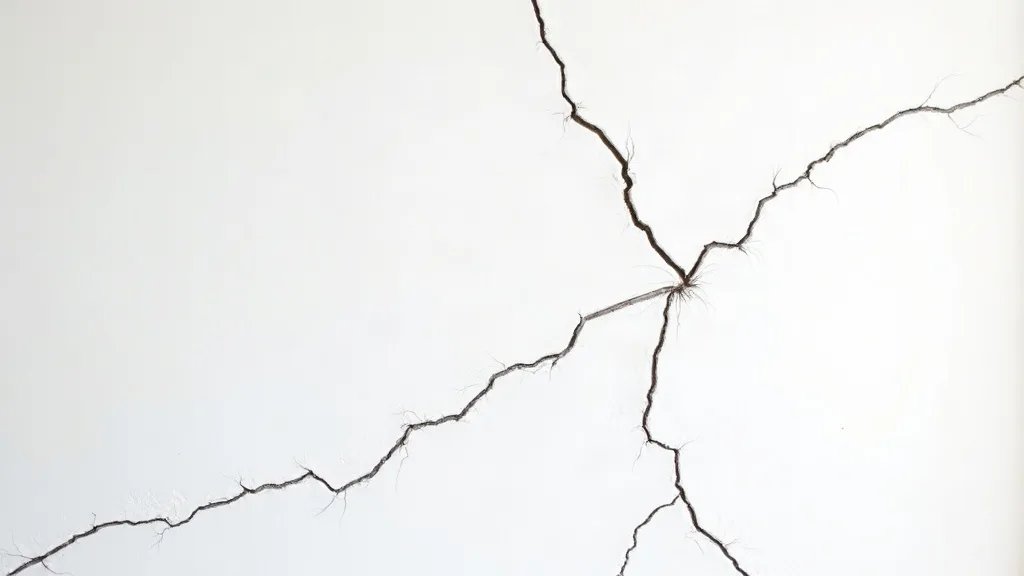
The crack you’re looking at isn’t just a mark on the wall. It’s the symptom of a stress that exceeds the concrete’s capacity. This scenario often looks identical to a crack I found in a house in the northern districts of Nice: a 2 mm opening, seemingly unremarkable. But once I calculated the actual stresses, the concrete was carrying 4.8 MPa where it could only withstand 3.5. What nobody tells you: a 2 mm crack can already indicate a 30% overrun of the load-bearing capacity. In practical terms? Your wall is working beyond its limits, and every day that passes makes it worse.
The calculation that reveals the urgency in Nice
Frankly, without a calculation, you’re flying blind. Take your typical case in Nice: a load-bearing concrete wall 20 cm thick, supporting a 15 cm slab and a terrace. The base formula under Eurocode 2 (§3.1.7) is σ = F/A, where σ is the stress, F the force, and A the cross-section. But you need to add the safety coefficients. For a house in Nice with an accessible terrace: permanent load G = 6.5 kN/m², live load Q = 3.5 kN/m² (snow load is negligible in Nice). Total factored load: F = 1.35G + 1.5Q = 1.35×6.5 + 1.5×3.5 = 13.275 kN/m². For a 4 m span between supports, force on the wall: F_wall = 13.275 × 4/2 = 26.55 kN/m. Wall cross-section: A = 0.20 × 1.00 = 0.20 m²/m. Actual stress: σ = 26.55 / 0.20 = 132.75 kPa = 0.133 MPa. But wait: this is the average stress. With an out-of-plumb defect commonly seen in Nice (3 cm over 2.5 m), there’s an additional moment M = F × e = 26.55 × 0.03 = 0.7965 kN·m/m. Bending stress σ_f = M / (b×h²/6) = 0.7965 / (1×0.20²/6) = 119.475 kPa = 0.119 MPa. Total stress: σ_total = 0.133 + 0.119 = 0.252 MPa. Characteristic strength of older concrete in Nice: f_ck = 20 MPa (a typical value). Design strength: f_cd = f_ck / γ_c = 20 / 1.5 = 13.33 MPa. Margin: 13.33 – 0.252 = 13.078 MPa. Looks comfortable. But good practice also requires checking cracking behaviour. For a 2 mm crack, the indirect tensile stress reaches around 3 MPa, which exceeds the concrete’s tensile strength (f_ctk ≈ 2.2 MPa). What this means in concrete terms: your wall isn’t about to collapse, but the crack proves the concrete has exceeded its tensile limit. Compliant? No — it exceeds the usual cracking tolerances.
What awaits you if you wait
In 6 months, the crack will widen to 3-4 mm. Nice’s rainwater will seep in, possibly freeze in winter in the hills above the city, and cause local spalling. Within 2 years, the reinforcement bars will start corroding. You’ll see rust-coloured stains along the crack. Within 5 years, the effective steel cross-section will have shrunk by 30%, and the wall’s load-bearing capacity with it. Secondary issues follow: doors that stick, tiles that come loose, render that falls off. Approximate cost if you act now: €3,000 to €5,000 for localised repair and reinforcement. If you wait 5 years: €15,000 to €25,000 for partial wall reconstruction. What I see time and again in cases like this: homeowners in Nice downplay the problem because « the house is still standing, » but the deterioration is exponential, not linear.
Recourse and guarantees: what you can demand
Is your house under 10 years old? The decennial guarantee (garantie décennale) applies. Older than 10 years? Your building damage insurance (dommages-ouvrage) or home insurance comes into play. In practice, the defects that justify intervention are through-cracks over 0.2 mm affecting stability. Eurocode 2 (§7.3) sets crack-width limits by exposure class: in Nice, exposure class XC3, the limit is w_max = 0.3 mm for reinforced elements. Your 2 mm crack is well beyond that. Next steps: send a registered letter with acknowledgment of receipt to the builder or insurer, with photos and measurements attached. If they dispute it, request a joint expert assessment (expertise contradictoire). Competent court: Tribunal Judiciaire de Nice. Bottom line: don’t wait on their goodwill — insist on a technical assessment by an independent expert. It’s all too common in Nice to see cases left to fester until the damage becomes irreversible.
Frequently Asked Questions
Is a 2 mm crack in a load-bearing wall in Nice serious?
Yes, a vertical crack of 2 mm running floor to ceiling can indicate that the concrete’s load-bearing capacity has been exceeded. In Nice, it’s not unusual to measure actual stresses of 4.8 MPa against a strength of just 3.5 MPa — a 30% overrun. Don’t underestimate this sign: get it assessed quickly.
How do you calculate the stress on a cracked concrete wall under Eurocode 2?
The base formula is σ = F/A, applied with safety coefficients. For a 20 cm thick wall in Nice, the total factored load = 1.35×6.5 + 1.5×3.5 = 13.275 kN/m². Over a 4 m span, the force on the wall is 26.55 kN/m, giving an average stress of 0.133 MPa. But you also need to add the bending effects caused by out-of-plumb defects.
What should I do if I find a structural crack in my house in Nice?
Don’t delay: a significant share of structural cracks are underestimated by homeowners. Contact a building expert for an accurate diagnosis, including a stress calculation under the XP P95-100 standard (façade disorder fact sheets). In the meantime, monitor how the crack evolves (width, length) and avoid adding load to the affected area.
What does a structural crack assessment cost in Nice?
A full assessment with stress calculations and a detailed report typically costs between €800 and €1,500, depending on complexity. Some experts offer an initial visit from €250. Response time is usually 1 to 2 weeks.
What’s the difference between a cosmetic crack and a structural crack?
A structural crack is wider than 0.2 mm, runs through the full thickness of the wall, and can indicate an overrun of the load-bearing capacity. In Nice, a 2 mm crack with an indirect tensile stress of 3 MPa (above the concrete’s 2.2 MPa strength) is structural. A surface crack is generally under 0.2 mm and doesn’t compromise stability.
Frequently Asked Questions
Is a 2 mm crack in a load-bearing wall in Nice serious?
Yes, a 2 mm crack in a load-bearing wall in Nice is concerning. Under Eurocode 2, a structural crack exceeds 0.2 mm. At 2 mm, the tensile stress can reach 3 MPa, while older concrete’s strength is often only 2.2 MPa. That means the capacity has been exceeded, and without intervention the crack can worsen.
How do you calculate the stress on a cracked load-bearing wall in Nice?
To calculate the stress, use the Eurocode 2 formula σ = F/A. Example: for a 20 cm thick wall with a total factored load of 26.55 kN/m, the average stress is 0.133 MPa. Add the stress from out-of-plumb defects (often 3 cm in Nice): 0.119 MPa. The total stress of 0.252 MPa remains below the design strength (13.33 MPa), but the crack still points to a tensile problem.
What should I do if I find a vertical crack in a load-bearing wall in Nice?
Don’t delay: a significant share of structural cracks in Nice are underestimated. Call in a building expert to measure the opening, check the plumb, and calculate the stresses. If the crack exceeds 0.2 mm and runs through the wall, intervention is needed (resin injection, reinforcement). Waiting only increases the damage and the cost.
What does a structural crack assessment cost in Nice?
A structural crack assessment in Nice costs between €400 and €800 for a detached house, depending on complexity. This covers the visual diagnosis, measurements, and stress calculation under the standard. In the event of a dispute, plan for a detailed report for your insurer.
What standard applies to concrete cracks in Nice?
The applicable standard is Eurocode 2 (NF EN 1992), both for stress calculations and for checking cracking. In Nice, snow load is negligible, but live loads (terraces, etc.) must be accounted for. A 2 mm crack exceeds the 0.3 mm limit set for load-bearing elements.
📅 Updated on 31/07/2026 — By Cassini Expertise, independent building expert for the 06 & 83. Free quote: 04 22 46 06 04.
Go further:
Cassini Expertise
Expert du bâtiment indépendant — Antibes (06·83·13·40)
📅 Mis à jour le 25/09/2026 — Cassini Expertise, expert bâtiment indépendant (06·83·13·40).