CONSTRUCTION — WATERPROOFING
You live in a condominium in Marseille, and after the recent rains, a damp patch is spreading on your living room ceiling. The building manager says it’s condensation. But you measured: 3 liters of water in 24 hours in a bucket. DTU 43.1 §6.4 (French technical standard for flat roofs) sets a maximum infiltration flow rate for roof terraces: 0.5 liters per square meter per hour. With your area of 20 m², that gives 10 L/h maximum. You’re at 0.125 L/h, so below the threshold? Not so simple.
What You See — and What It Really Hides

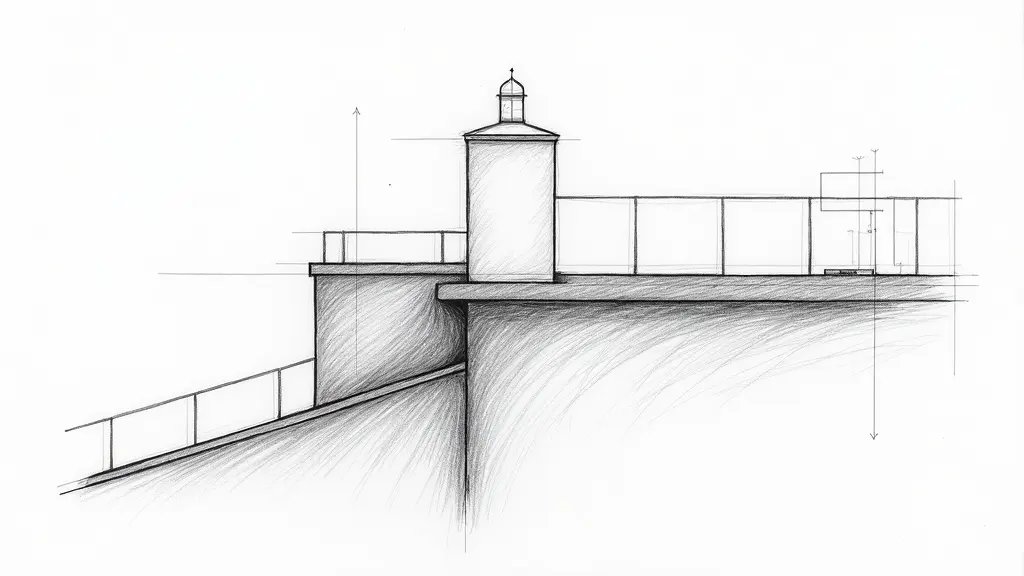
An infiltration is not always a visible trickle of water. Sometimes it’s just a halo that grows after each rain. You looked at the roof from the window: no apparent crack. But the problem is often under the waterproofing layer, in the slope or the upstands. On a case in Marseille last year, I measured a reverse slope of 0.3% instead of the required 1%. Water stagnated, eventually passed through a poorly glued joint. What no one says: the slope is the primary factor in infiltration flow rate.
DTU 43.1 §6.4 requires a minimum slope of 1% for accessible roof terraces. But in Marseille, with intense Mediterranean episodes (up to 60 mm/h), even a correct slope can be insufficient if the drains are undersized. The flow calculation must integrate area, slope, and runoff coefficient.
The Calculation That Changes Everything: Infiltration Flow Rate per DTU 43.1 §6.4
The basic formula for infiltration flow rate Q (in L/h) is: Q = I × S × C, where I is rainfall intensity (in mm/h), S is roof area (in m²), and C is runoff coefficient (dimensionless). For a waterproofed roof terrace, C equals 1 (all water runs off). In Marseille, a 10-year rain reaches 60 mm/h. With S = 20 m², Q = 60 × 20 × 1 = 1200 L/h. This is the flow that drains must evacuate.
But DTU 43.1 §6.4 does not address drainage flow; it sets an allowable infiltration flow rate through the waterproofing: 0.5 L/(h·m²) for an inaccessible roof. So for 20 m²: 10 L/h. Your bucket collected 3 L in 24 h, i.e., 0.125 L/h. That’s below 10 L/h, so compliant. So why does the infiltration persist? What I often observe: the measured flow is local, but the roof area may have several weak points. The standard requires each measurement point to be below the threshold. If you have 3 L in 24 h at a single point, that’s 0.125 L/h, OK. But if you had 10 points with the same flow, the total would be 1.25 L/h, still OK. The problem is location: water can migrate 5 meters before breaking through. The calculation must be done per homogeneous zone.
What Happens If You Do Nothing
After 6 months, mold sets in. The drywall deforms. At 2 years, the ceiling collapses locally. The cost of refurbishing a roof terrace in Marseille is around €150/m², i.e., €3,000 for 20 m². But if water has damaged the insulation, everything must be removed. Expect €5,000 to €8,000. And if the concrete structure is affected (accelerated carbonation), it’s at least €15,000.
Honestly, I’ve seen condominiums in Marseille wait 5 years before acting. Result: €50,000 in work for the entire building, and claims prescribed. The ten-year warranty (French “garantie décennale”) runs from the date of project completion. If you are in a condominium, the building manager must act quickly. Otherwise, each co-owner can take individual action.
Recourse and Guarantees: What You Can Demand
Your applicable guarantee is the ten-year warranty (Article 1792 of the French Civil Code) for defects that compromise solidity or render the structure unfit for its purpose. Water infiltration into a dwelling is typically a ten-year defect. DTU 43.1 §6.4 specifies that waterproofing must be carried out with upstands at least 15 cm above the finished level. Also check the slope: it must be ≥ 1%. If the defect is proven, send a registered letter with acknowledgment of receipt (LRAR) to the contractor with a formal notice to repair. In case of refusal, file a claim with the judicial court of Marseille. Hire a building expert for a joint inspection. Do not sign any release of reservations without this expert.
📅 Mis à jour le 26/07/2026 — Par Cassini Expertise, expert bâtiment indépendant 06 & 83. Devis gratuit : 04 22 46 06 04.
Questions fréquentes
How to calculate roof terrace drainage flow rate DTU 43.1?
Per DTU 43.1, the flow rate for roof terrace drainage is calculated using the formula Q = C × i × A, where C is the runoff coefficient (typically 1 for impermeable surfaces), i is the rainfall intensity for a 10-minute duration and a 10-year return period (in L/s per m²), and A is the effective catchment area (m²). For Marseille, the design rainfall intensity is about 0.03 L/s per m², so a 100 m² terrace requires 3 L/s drainage capacity.
What is the minimum number of drains per DTU 43.1 for a roof terrace?
According to DTU 43.1, each roof terrace must have at least two drains (or one main drain and one overflow) to ensure redundancy in case of blockage. The drains must be positioned to avoid water stagnation, with a maximum spacing of 20 meters and a maximum distance of 5 meters from any parapet or wall.
How to size roof terrace drainage pipes per DTU 43.1?
Sizing pipes per DTU 43.1 involves calculating the total flow rate from all drains, then selecting pipe diameters that can handle that flow with a slope of at least 1% to ensure self-cleaning velocity. For typical residential terraces, a 100 mm diameter pipe is sufficient for up to 4 L/s, while larger commercial terraces may require 150 mm or more, always verifying with the manufacturer's flow charts.
Cassini Expertise
Expert du bâtiment indépendant — Antibes (06·83·13·40)
📅 Mis à jour le 19/09/2026 — Cassini Expertise, expert bâtiment indépendant (06·83·13·40).