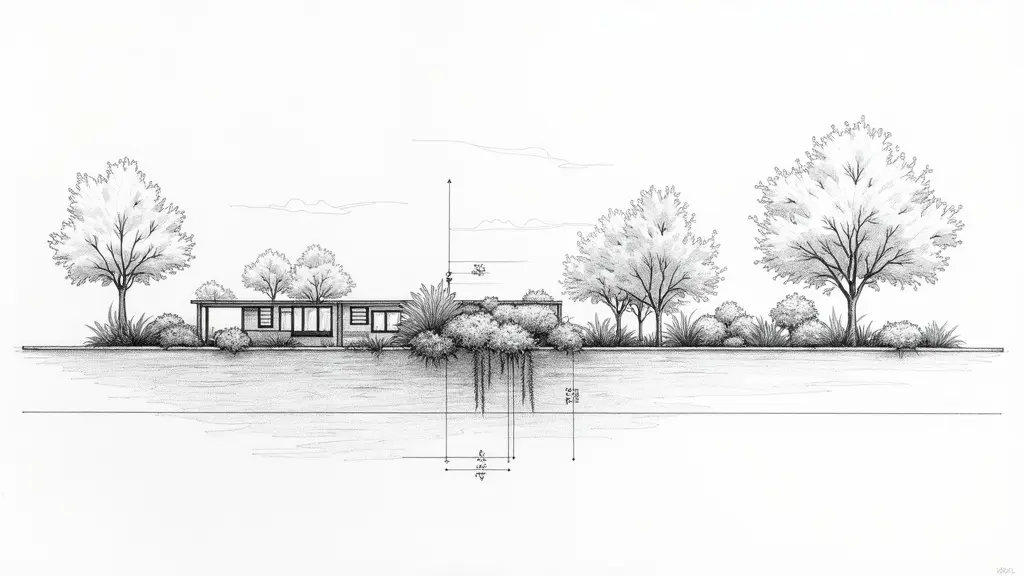
PROPERTY – FRENCH RIVIERA
You have developed your sloping land in Grasse with a natural terrace retained by a retaining wall. Everything seemed perfect, until the day your neighbour informs you that the wall encroaches 15 cm onto their plot. You checked with a tape measure, looked at the cadastre on Géoportail (French online mapping service), but nothing is clear. What I often see: a discrepancy of 10 to 20 cm between the cadastral survey and the actual terrain, especially on the hills of Grasse.
What You See – and What It Really Hides
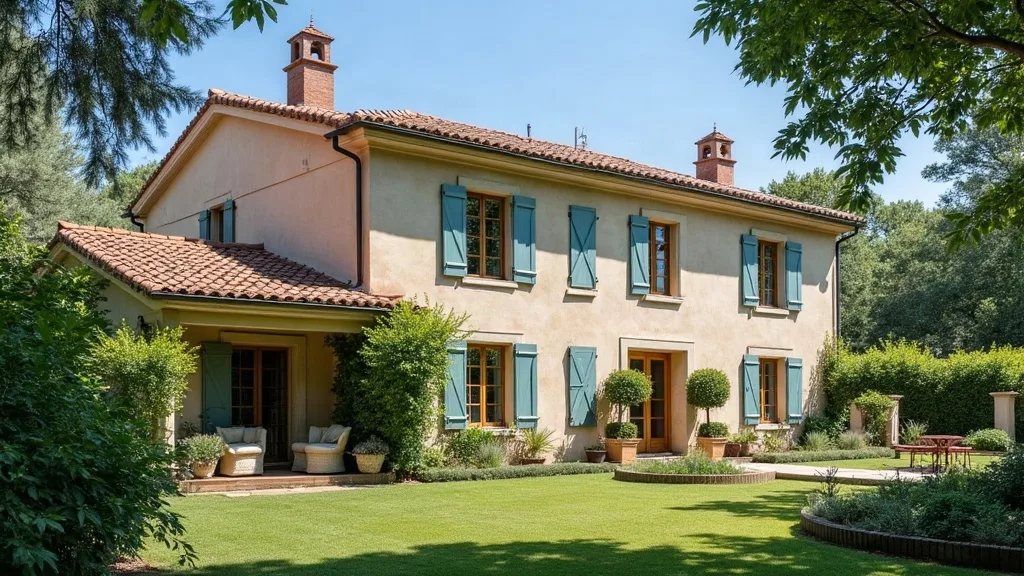
The wall seems well aligned on your property. But the neighbour brandishes a cadastral plan and a photo. The problem? Cadastral boundaries are not always reliable in hilly areas. On a case in Grasse last year, I measured an 18 cm difference between the cadastre and the actual topographic survey. The slope, settlement of clay soils, and old boundary marking errors create invisible discrepancies.
What no one says: the retaining wall alters the flow of rainwater. In Grasse, with intense Mediterranean rains, a 15 cm encroachment can be enough to destabilise the neighbouring land. I have seen cases where water infiltrated under the wall, causing a landslide two years after construction.
The Calculations That Change Everything: Earth Pressure and Stability
To determine if the encroachment is tolerable, you must calculate the earth pressure on the wall. According to Eurocode 7 (section 9.5.2), the active thrust is: Pa = 0.5 × γ × H² × Ka, with γ = 20 kN/m³ (clay-limestone soil of Grasse), H = 2 m (wall height), Ka = 0.33 (active pressure coefficient for drained soil). So Pa = 0.5 × 20 × 4 × 0.33 = 13.2 kN per linear metre of wall. Your wall is 8 m long: total load = 105.6 kN. If the encroachment reduces the effective width of the wall by 15 cm, the stress on the soil under the foundation increases from 80 kPa to 95 kPa. The clay soil of Grasse has a bearing capacity of 100 kPa (BRGM data, French geological survey). It is within the limit, but in seismic zone 3 (moderate seismicity, Alpes-Maritimes), the seismic coefficient of 0.12 g increases the thrust by 12%, bringing the stress to 106 kPa. This exceeds the capacity. In practice, the wall could become unstable during a moderate earthquake.
What Happens If You Do Nothing
Within 6 months, cracks may appear in the wall, especially after an intense rainfall event. At 2 years, the wall may tilt 2 to 3 cm, worsening the encroachment. Repairing or rebuilding a retaining wall is substantial work, which can only be quantified properly once the facts – boundary position, stability, drainage – are established.
The neighbour can also sue you for violation of Article 545 of the French Civil Code (right of property). The Grasse court often rules in favour of the aggrieved owner, with demolition of the wall at the expense of the builder of the wall.
Recourse and Guarantees: What You Can Demand
You must have a joint topographic survey carried out by a licensed surveyor (géomètre-expert). Eurocode 7 (section 2.4.1) requires a stability check including seismic actions. If encroachment is confirmed, you can negotiate an easement for overhang or move the wall. Send a registered letter with acknowledgement of receipt (LRAR) to your neighbour, then refer the matter to the Grasse judicial court if no agreement is reached. An independent expert can measure the encroachment with a total station (tacheometer) to within about 1 cm. An early boundary survey keeps every option open: negotiation, an easement agreement, or rectification works.
Frequently asked questions
A retaining wall on a property boundary: what does the law say?
In France, any party wall must comply with local planning rules (PLU). If it is built on the boundary, it must comply with the rules on party walls (Art. 653 of the Civil Code). In the event of an encroachment, the neighbour can demand demolition or compensation.
What can I do if my neighbour builds a wall that encroaches on my land?
First send a formal written notice to stop the works. If no agreement is reached, you can refer the matter to the judicial court to have the encroachment established and demolition ordered. A surveyor (géomètre-expert) can carry out a boundary survey to establish the exact limits.
Can a retaining wall be built without authorisation?
Under article R421-9 of the French Planning Code, a retaining wall more than 2 metres high requires a prior declaration (déclaration préalable), and beyond that threshold a building permit is required. Also check the Grasse local plan (PLU) for local rules.
See also: workmanship defects survey – Mandelieu · damp converted basement – Villeneuve-Loubet · clay soil, subsidence and cracks in Grasse – official data
Does this look like your situation?
An independent expert can measure the actual position of the wall and set out your options. Describe your situation: a reply within 24 hours, with no obligation.
Survey carried out by Frédéric Faucouneau, independent building expert – Antibes, Alpes-Maritimes (06), Var (83), Bouches-du-Rhône (13). Find out more
📅 Last updated 06/11/2026 - Cassini Expertise, independent building expert – departments 06, 83 and 13.