CONSTRUCTION — CRACKS
You’ve noticed a crack running across your living room wall. It’s thin, 2 mm, but it’s growing. Antibes, clay soil, the 2022 drought — the vast majority of detached houses on the Côte d’Azur are affected by clay shrink-swell. You’re right to be concerned.
What you see — and what it’s really hiding
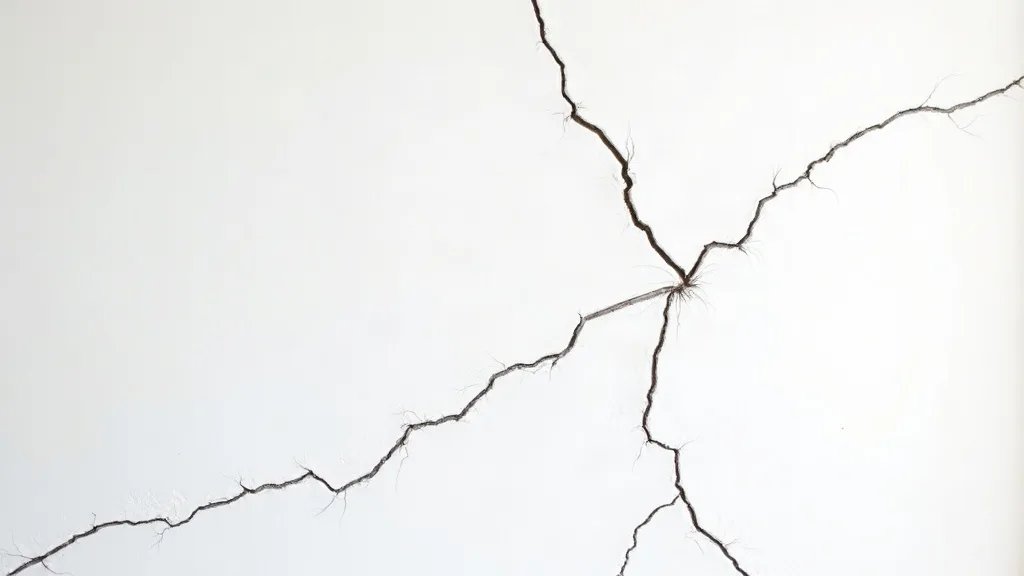
The crack is vertical, above a window. It looks superficial. But on closer inspection, it follows a masonry joint. The render has burst open. You measure it with a ruler: 2 mm at the top, 1 mm at the bottom. What nobody tells you: a 2 mm crack can indicate 5 mm of differential settlement under the foundation. It’s not unusual to measure 8 mm of settlement under the corner of a villa. One homeowner waited a year. The repair bill came to €45,000.
Clay soil shrinks when it dries and swells when it rains. This cyclical movement fatigues foundations over time. In Antibes, the BRGM (French geological survey) rates the Badine and Cap sectors as high risk. The map is clear: your house sits in a moderate-to-high exposure zone. But that’s not all — the slope of the plot, the orientation of the walls, and the depth of the foundations all play a key role. A quick glance is never enough.
The calculations that change everything: shrinkage vs bearing capacity
The phenomenon is mechanical. Stress under the foundation is σ = F/A. For a typical Antibes house (load of 150 kN per linear metre, 0.5 m wide footing), σ = 150 000 / 0.5 = 300 kPa. Dry clay soil has a bearing capacity of 200 kPa according to Eurocode 7 (section 6.5.2). 300 > 200: the soil creeps. Settlement is expressed as: s = (σ · H) / E, where H is the thickness of the clay layer (3 m) and E is the oedometric modulus (5 MPa). So s = (300 000 · 3) / 5 000 000 = 0.18 m = 18 cm. In reality, shrink-swell amplifies this settlement further. The BRGM clay map (interactive tool) shows a linear shrinkage potential of 2 to 4 cm per metre of depth. For a foundation at 1 m depth, vertical movement can reach 3 cm. What this means in practice: a 2 mm crack today can become 1 cm within 5 years if the soil keeps drying out. In practice, a 5 mm opening in a façade crack signals the need for prompt repair works. You’re below that threshold, but early diagnosis is critical.
What happens if you do nothing
In 6 months, the crack reaches 3 mm. In 2 years, 8 mm. Windows start sticking. Floor tiles lift. At 5 years, the load-bearing wall can develop a structural defect. Repair costs rise from €5,000 (resin injection) to €50,000 (micropiles). It’s not unusual to see a villa in Antibes Juan-les-Pins where the owner waited 3 years — the slab settled by 4 cm. Bill: €78,000.
Secondary problems are common: water infiltration through the cracks, mould, render detaching. On the Côte d’Azur, ambient humidity worsens the damage. And don’t forget the loss in property value: a cracked house loses a significant share of its resale value.
Remedies and guarantees: what you can demand
You’re covered under the ten-year structural warranty (« garantie décennale ») if the defect compromises the soundness of the building (10 years after handover). Eurocode 7 (section 2.4.2) requires a preliminary soil survey for any construction in a clay zone. If the developer didn’t carry one out, their liability is engaged. The XP P95-100 standard (protection and repair of concrete structures) documents repair methods. The process: send a registered letter with acknowledgement of receipt to the builder, then request a court-appointed expert assessment via the Grasse court. In the meantime, an independent expert diagnosis (like the one I offer) will let you quantify the damage and build your case. Don’t wait: the statute of limitations is 10 years from handover.
Going further
- 📅 Updated on 09/08/2026 — By Cassini Expertise, independent building expert covering the 06 & 83 departments. Free quote: 04 22 46 06 04.
To go further:
Frequently asked questions
What should I do about cracks in my Antibes home on clay soil?
If you have cracks caused by clay soil in Antibes, first monitor how they evolve and consult a building expert for a diagnosis. Solutions include underpinning the foundations, installing drainage, and controlling soil moisture.
How do I know if my cracks are caused by clay shrink-swell?
Cracks caused by shrink-swell are typically diagonal, located near corners, and worsen after dry periods. A geotechnical survey and soil study can confirm the cause.
What are the solutions for stabilising foundations on clay soil in Antibes?
Solutions include micropiles, expanding resin injection, or a reinforced raft foundation. It’s also essential to maintain consistent moisture around the house and keep large trees away from the foundations.
CECassini Expertise
Expert du bâtiment indépendant — Antibes (06·83·13·40)
📅 Mis à jour le 25/09/2026 — Cassini Expertise, expert bâtiment indépendant (06·83·13·40).