In brief. Home under renovation, Vence area (06). Damp damage on an interior wall at floor level: render deterioration, doubt about the cause. Assignment: identify the origin – condensation, rising damp, infiltration, or an old episode? Conclusion in three measurements: the wall is dry, condensation is ruled out, and the salt analysis rules out ground water. A diagnosis by elimination, which avoids unnecessary treatments.
Background
A home under renovation shows damaged render at the foot of an interior wall: flaking, marks. The owner wonders whether the wall needs treating, whether it needs waterproofing, or whether ventilation is the answer. Behind this practical question lies a real worry: paying to treat a problem that no longer exists, or missing an active one.
The question asked
Where does this damp come from? Four classic hypotheses arise: condensation (moisture from the air settling on a cold surface), rising damp (ground water climbing up the wall), an active infiltration (water still getting in), or an old episode (water got in at some point – a leak, building work – then went away, leaving the marks).
How the visit went
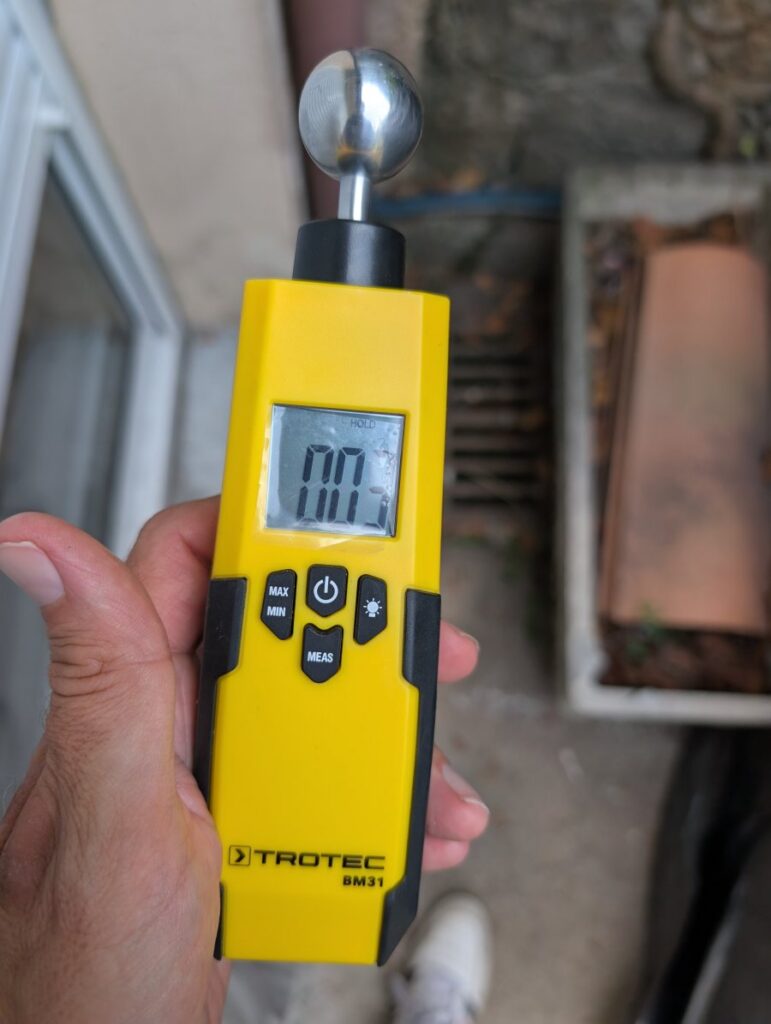
The survey combined observation (condition of the render, height of the damage, context of the room) with objective measurements: moisture-meter readings at several points on the wall and floor, a review of the context (ventilation of the room, living habits, the outside of the corresponding wall), and analysis of the salts contained in the deteriorated render.
Key observations
A dry wall on the day of the visit
The moisture-meter readings show a dry wall – after several months without notable rainfall. If water were still getting in or still rising, the wall would be damp. First strong indication: this is not an active problem.
Condensation ruled out by the measurements
The measurement points and the context (surface not cold at the time of the visit, no characteristic mould) rule out condensation as the cause of the damage observed.
No nitrates: ground water is not the cause
The analysis of the salts in the deteriorated render shows no nitrates. Yet rising damp carries nitrates characteristic of ground water. Their absence rules out rising damp – and with it any wall treatment of the “injection” or “vents” type.
Analysis and deliverable
Conclusion of the report: the damage points to an earlier damp episode – water got in at some point (before or during previous works), damaged the render, then went away. With the wall dry and the active causes ruled out, the answer is not heavy treatment but making good the render and simple monitoring. The 12-page report documents every measurement, every hypothesis tested and the reasoning by elimination.
What this assignment shows
A survey is not only there to confirm a defect: it is also there to rule out diagnoses – and to avoid treatments sold wrongly. Finding the origin is a method of systematic elimination: each hypothesis is tested by measurement, and only the cause that withstands every test is kept. It is also a question of independence: Cassini Expertise has no link with damp-treatment or building firms – its only product is the diagnosis. See also our case study on a damp converted basement, our damp and mould diagnosis, or tell us about your situation.
See also: damp converted basement – Villeneuve-Loubet · widespread mould in a flat – Antibes · all case studies
Does your situation look like this case?
Every case is different. Describe yours: an independent building expert replies within 24 hours, with no obligation. A first consultation by video call is available.
Names, address and sensitive data anonymised; photo metadata removed. Provided for illustrative purposes only; not advice for your own situation.
{“@context”: “https://schema.org”, “@type”: “Article”, “headline”: “Origin of Damp at the Base of a Wall – Vence – Case Study”, “description”: “Interior wall damaged during a renovation: condensation, rising damp or an old episode? A diagnosis by elimination, based on measurements and salt analysis. A real survey in Vence (06).”, “inLanguage”: “en-GB”, “datePublished”: “2026-11-07”, “dateModified”: “2026-11-07”, “author”: {“@type”: “Organization”, “name”: “Cassini Expertise”, “url”: “https://cassini-expertise.fr/”}, “publisher”: {“@type”: “Organization”, “name”: “Cassini Expertise”, “url”: “https://cassini-expertise.fr/”}, “mainEntityOfPage”: “https://cassini-expertise.fr/en/origin-of-damp-wall-base-vence/”, “articleSection”: “Case studies”}
📅 Last updated 07/11/2026 - Cassini Expertise, independent building expert – departments 06, 83 and 13.