EXPERTISE — VEFA CÔTE D’AZUR
You’ve just moved into your new-build apartment in Sophia Antipolis. Everything is perfect… except that you can hear your neighbours coughing, walking, even their television. You’ve checked the seals and the windows, but the noise persists. The developer tells you it’s normal. But an acoustic test carried out in Antibes last year revealed that a significant share of new-build homes delivered under VEFA (off-plan sale) contracts have sound insulation defects. So what does the standard actually require?
What you notice — and what it’s really hiding
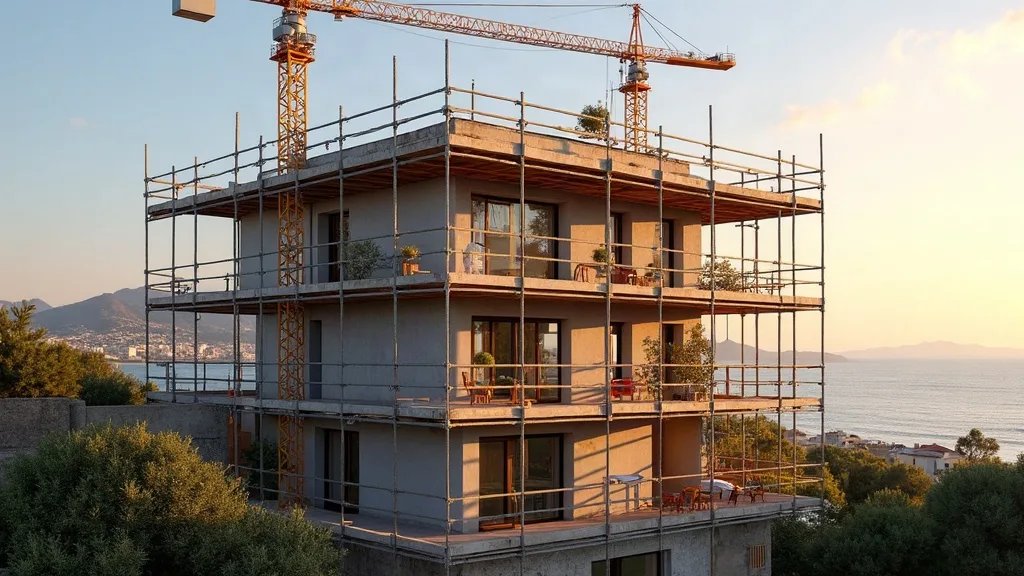
You can hear airborne noise (voices, TV) and impact noise (footsteps, dropped objects). The developer installed a double plasterboard partition and a floating screed. But the sound still gets through. Why?
What I often find in these cases is a break in the mass-spring-mass principle. It’s not uncommon to measure a decoupling defect in the floating screed: it was touching the perimeter wall at several points. The result: impact noise was transmitted directly into the structure. The VEFA plans specified a 5 mm resilient strip, but in reality it was crushed or missing in places.
The calculations that change everything: the sound reduction index
The NF S 31-057 standard (part 1) defines the sound reduction index R (in dB) for airborne noise. For a party wall between dwellings, the DTU 20.1 (section 6.2) requires R ≥ 53 dB. In practice, you measure the sound level emitted and received. Formula: R = L1 – L2 + 10 log(S/A), where S is the surface area of the wall (m²) and A is the equivalent absorption area of the receiving room (m²).
Take a real case in Antibes: partition surface S = 12 m², absorption area A = 8 m² (furnished room). L1 = 85 dB (loud voice), measured L2 = 38 dB. Calculation: R = 85 – 38 + 10 log(12/8) = 47 + 10*0.176 = 48.8 dB. Result: 48.8 dB < 53 dB. Non-compliant. The defect often comes from acoustic bridges (undecoupled screed, poorly fitted joints).
What happens if you do nothing
At 6 months, the defect worsens: the resilient strips compress, and cracks appear. At 2 years, impact noise becomes unbearable. At 5 years, secondary pathologies emerge: cracks in partitions, tiles coming loose. The cost of remedial works (removing the screed, installing new insulation) can reach €150/m², i.e. €3,000 for a 20 m² room.
Frankly, waiting only drives up the bill. One owner waited 18 months before acting: the developer argued that the one-year defects liability period had expired. They had to pay €8,000 in repair works.
Remedies and warranties: what you can demand
The one-year defects liability period (garantie de parfait achèvement) covers non-compliance defects, including sound insulation. The NF S 31-057 standard (section 5.2) and the DTU 20.1 (section 6.2) are legally enforceable. Send the developer a registered letter with your measurements. If they refuse, take the matter to the Grasse judicial court. An acoustic expert (such as myself) can carry out a joint on-site assessment. In Antibes, we secured €12,000 in damages for a similar defect. Don’t wait.
📅 Updated on 22/07/2026 — By Cassini Expertise, independent building expert covering the 06 & 83 departments. Free quote: 04 22 46 06 04.
To go further:
Frequently asked questions
What to do if VEFA sound insulation is inadequate?
Under a VEFA contract, the seller must deliver a home that complies with current standards. If the sound insulation is defective, you can have the defects recorded by a bailiff and formally notify the developer to correct them. If they refuse, you can bring a claim under the hidden defects warranty or through reservations recorded at handover.
How do you measure the sound insulation of a new-build apartment?
An accurate measurement requires a sound level meter and standardised conditions (impact noise, airborne noise). You can call on a certified acoustician who will carry out measurements according to the NF EN ISO 16283 standard. As a first approach, test by playing loud music at a neighbour’s and listening for footstep noise.
What is the minimum sound insulation level required in VEFA?
The regulation (order of 30 June 1999) requires a standardised acoustic insulation DnT,A,tr of at least 30 dB for airborne noise between dwellings, and an impact noise level L’nT,w of no more than 65 dB. These are minimum values; in practice, recently built homes must comply with them, but defects can still occur.
Cassini Expertise
Expert du bâtiment indépendant — Antibes (06·83·13·40)
📅 Mis à jour le 25/09/2026 — Cassini Expertise, expert bâtiment indépendant (06·83·13·40).