CONSTRUCTION — CRACKS
You bought a house in Nice, with a beautiful sea view. This summer, after three months of heatwave, a vertical crack appeared in your living room wall. It’s widening every week. Clay shrink-swell movement is the most common cause of this type of damage in the PACA region. Your plot is classified as moderate risk by the BRGM. But is that really the only cause? The answer is no: the BRGM zoning map, at a 1:50,000 scale, doesn’t capture local clay pockets or the influence of nearby trees. Here’s what you really need to check.
What You See — And What It Really Hides
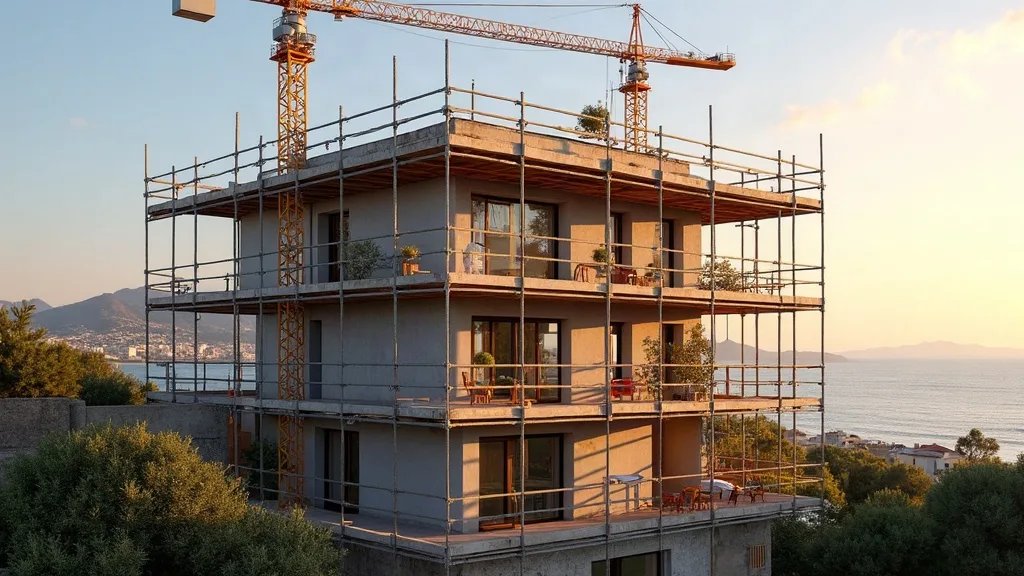
The crack: 2 mm at the bottom, 5 mm at the top, angling toward the window. You suspect a construction defect. In reality, the clay soil beneath the foundations dried out and shrank by several centimeters. But why hasn’t your neighbor, 50 meters away, had any issues?
It’s not uncommon to measure an identical house, even from the same builder. The BRGM report showed low risk. Yet the cracks were there. What no one tells you: the BRGM zoning map is at a 1:50,000 scale. Locally, the clay pocket can be much thicker. And nearby trees make the drying worse. Frankly, you have to dig beneath the slab to understand what’s really happening.
The Calculations That Change Everything: Vertical Shrinkage and Wall Stress
Clay’s volumetric shrinkage follows the laws of soil mechanics. Volumetric shrinkage depends on the plasticity index and the depth of soil drying. These parameters need to be measured locally through geotechnical soil testing for a reliable calculation. If the concrete is poorly reinforced or the mortar is weak, cracking occurs. These calculations fall under Eurocode 7 (EN 1997) recommendations, particularly for analyzing differential settlement and the resulting stresses on the structure.
The Three Hidden Causes BRGM Ignores
The BRGM zoning map is a regional-scale map. Locally, three factors increase the risk:
- Local clay pocket: even in a low-risk zone, a 2-metre-thick clay lens beneath the foundation can cause up to 4 cm of shrinkage.
- Nearby trees: trees close to the foundations affect soil drying and must be assessed as part of the diagnosis.
- Foundation defect: footings that are too shallow (less than 0.8 m) or lack a proper tie-beam.
What I often find in Nice: houses built in the 1970s-80s with foundations only 0.5 m deep — not enough for clay soils. The result: cracks that widen a little more every summer.
The Consequences of Doing Nothing
A crack widening by 1 mm a year can reach 5 mm within 5 years. Beyond 2 mm, watertightness is compromised: water infiltration, mould, and deteriorating window frames. If the crack exceeds 5 mm, the structure is at risk: partial collapse becomes possible. Without a diagnosis, your insurer may reject your claim. In the PACA region, many crack-related insurance claims are turned down for lack of sufficient technical evidence.
Solutions and Remedies: What an Expert Can Do
If you’re facing cracks after a drought, don’t rely on the BRGM zoning map alone. Bring in a building expert to carry out:
- Soil diagnosis: auger boring to measure clay thickness and potential shrinkage.
- Settlement calculation: in line with Eurocode 7, to determine whether the foundations are adequate.
- Tree assessment: evaluation of distance and root impact.
- Insurance claim support: an expert report to trigger the natural-disaster drought guarantee.
Assessments carried out under Eurocode 7 make it possible to precisely document the extent of clay shrinkage and support your claims with insurers. The zoning map is only an indicator — the reality on the ground comes first.
Do you have cracks in Nice, Cannes, or Antibes? Contact an expert for an accurate diagnosis. Don’t let the cracks get worse.
📅 Updated on 15/08/2026 — By Cassini Expertise, independent building expert serving Alpes-Maritimes (06) & Var (83). Free quote: 04 22 46 06 04.
Go further:
Frequently Asked Questions
Cracks after drought in Nice: what should you do?
If you notice cracks after a drought, it’s essential to report the damage to your home insurer within 5 working days. Next, bring in a building expert to assess the damage and follow their recommendations for repairs. Keep all evidence (photos, invoices) and check whether your municipality has been declared in a state of natural disaster.
Is the BRGM clay zoning map reliable for assessing crack risk?
The BRGM’s clay zoning map is a prevention tool based on the presence of clay soils, but it doesn’t account for local drought variations, vegetation, or the specific characteristics of your house. As a result, cracks can appear even in a low-risk zone. It’s important to supplement it with a dedicated soil study and an expert diagnosis.
How can I find out if my house is in a clay shrink-swell risk zone?
You can check the Géorisques website for your municipality’s clay zoning, but this zoning is only indicative. For an accurate assessment of your plot, have a geotechnical study (type G1 or G2) carried out by a specialist engineering firm. This will determine your building’s actual exposure to ground movement.
Cassini Expertise
Expert du bâtiment indépendant — Antibes (06·83·13·40)
📅 Mis à jour le 25/09/2026 — Cassini Expertise, expert bâtiment indépendant (06·83·13·40).