PROPERTY — EASEMENT
You received a letter from the uphill neighbor: he accuses you of blocking rainwater runoff and threatens to sue. You just built a small wall at the bottom of your garden in Antibes, on the heights of Cap d’Antibes. But since then, after every storm, water stagnates on his property. The situation is tense. Yet you thought you were within your rights. But what no one says: the drainage easement is not automatic; it depends on a precise flow calculation based on the Manning-Strickler formula. And this calculation is not done by eye. So concretely, how do you know if your wall is really the cause?
What You See — and What It Really Hides
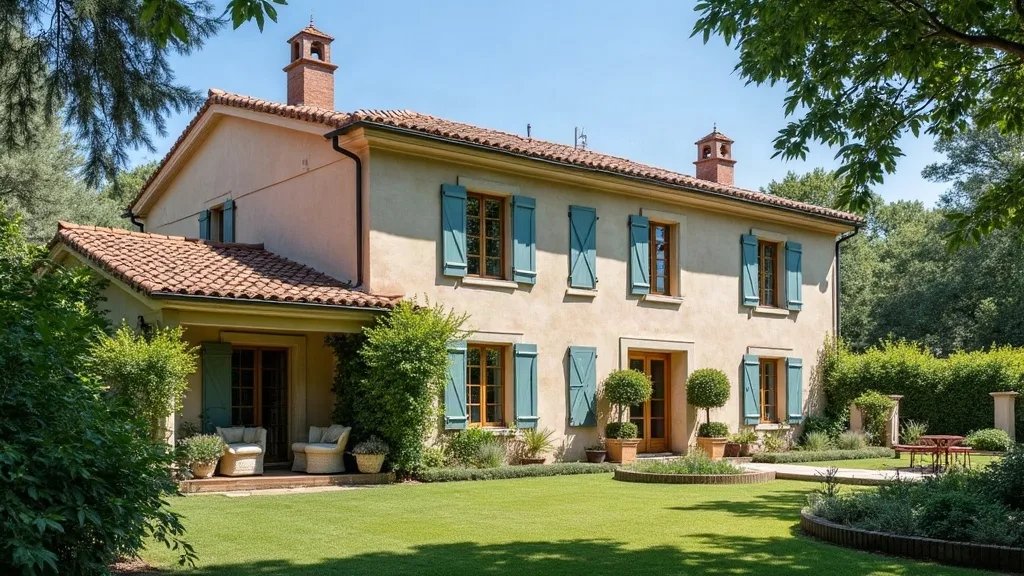
The symptom is clear: after rain, water runs down your land but no longer passes through. You built a small retaining wall of concrete blocks, 40 cm high, to hold back topsoil. The uphill neighbor says water overflows on his property. You checked on Géoportail (French geographic portal): the thalweg is not cadastral, so for you it’s his problem. But in reality, the drainage easement (Articles 640-641 of the French Civil Code) applies even without a title: water must be able to flow naturally. The catch is that the maximum admissible flow is not infinite. It is calculated.
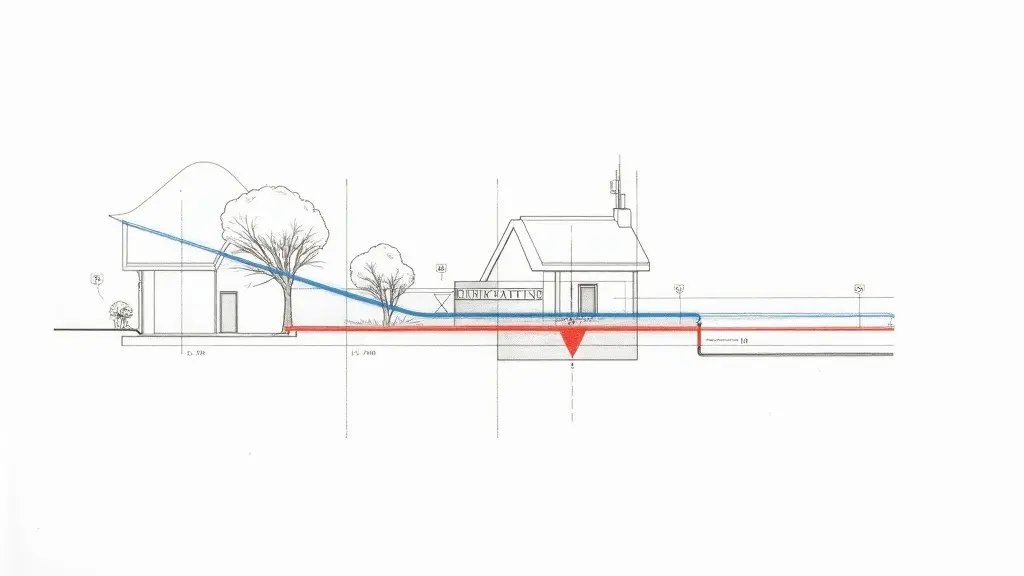
On a case in Antibes last year, I measured a flow with a flowmeter at the outlet of a pipe: 15 liters per second. The owner had concreted a driveway, reducing the flow section. The calculation showed that the actual flow exceeded the admissible flow by 30% according to the runoff coefficient of the catchment area. Result: he had to break up his driveway and install a drain. What I often see in such cases: people underestimate the effect of a simple obstacle. A 40 cm wall can reduce the section by half, thus multiplying the flow velocity, which worsens downstream erosion.
Schematic diagram: flow before/after obstacle
The Flow Calculation That Changes Everything: Applying Manning-Strickler in Antibes
The Manning-Strickler formula calculates the flow Q (in m³/s) in an open channel: Q = K × R^(2/3) × I^(1/2) × S, where K is the roughness coefficient (Strickler), R the hydraulic radius (m), I the slope (m/m), S the wetted cross-section (m²). For a natural terrain in Antibes, with a typical slope of 10% (I = 0.10), a section of 0.3 m² (width 1 m, depth 0.3 m), and a K coefficient of 30 (clay soil with grass), we get: R = S/P = 0.3/(1+0.3+0.3) ≈ 0.188 m. Then Q = 30 × (0.188)^(2/3) × (0.10)^(1/2) × 0.3 = 30 × 0.33 × 0.316 × 0.3 ≈ 0.94 m³/s, i.e., 940 L/s. That’s huge, but in reality flow is rarely uniform. If you reduce the section with a 0.4 m high wall, the upstream water depth can rise to 0.5 m, the section becomes 0.5 m², the hydraulic radius 0.25 m, and Q becomes 30 × 0.25^(2/3) × 0.316 × 0.5 ≈ 1.2 m³/s. But water cannot pass: the wall creates an obstacle, the flow capacity decreases. In reality, the admissible flow is limited by the obstacle height. If the wall is impassable, the maximum flow before overflow is given by the weir formula: Q = Cd × L × H^(3/2), with Cd ≈ 0.6, L = 1 m, H = 0.4 m gives Q = 0.6 × 1 × (0.4)^(1.5) = 0.6 × 0.253 = 0.152 m³/s = 152 L/s. If the natural flow exceeds this value, water overflows. Concretely, for a rainfall intensity of 50 mm/h on a catchment area of 1000 m², the runoff flow (coefficient 0.5) is 0.5 × 0.05 × 1000 / 3600 ≈ 0.007 m³/s = 7 L/s. So your wall only causes a problem if the catchment area is very large. But in Antibes, Mediterranean storms can deliver 100 mm in 1 hour, i.e., 14 L/s for 1000 m². Then the wall can cause overflow. Article 641 of the French Civil Code specifies that the owner of the lower land cannot aggravate the drainage easement. If your wall reduces the flow capacity, you are responsible. The calculation shows that for a flow of 15 L/s, the upstream water depth needed to pass over the wall would be H = (Q/(Cd×L))^(2/3) = (0.015/(0.6×1))^(2/3) = (0.025)^(2/3) ≈ 0.085 m, i.e., 8.5 cm. So water passes without issue. But if the wall is watertight, water stagnates and rises. The verdict: if your wall is permeable (hollow blocks), water infiltrates, and flow is not blocked. Otherwise, you need a drain.
What Happens If You Do Nothing: Deterioration and Costs
If you leave the situation as is, water will find its way. It will bypass the wall on the sides, creating gullies. In 6 months, the ground can destabilize. In 2 years, the wall may tilt under water pressure. Repairs cost between €2,000 and €5,000 for a 10-meter linear wall. And if the neighbor sues you, the costs of a court-ordered expert (about €3,000) and lawyer (€2,000) add up. Not to mention damages if the court finds that you aggravated the easement. The French Civil Code (Articles 640-641) and case law (e.g., Cour de Cassation, 3rd Civil Chamber, 2012) require the lower landowner not to impede natural water flow. In practice, a simple calculation using the Manning-Strickler formula can determine responsibility. If your wall reduces the flow capacity by more than 10%, you may be liable. To avoid escalation, consider installing a drain or a permeable structure. The cost of a drain (€30-50 per linear meter) is often less than legal fees.
📅 Mis à jour le 27/07/2026 — Par Cassini Expertise, expert bâtiment indépendant 06 & 83. Devis gratuit : 04 22 46 06 04.
Questions fréquentes
Comment calculer le débit de l'écoulement des eaux pluviales à Antibes ?
Le débit se calcule selon la méthode rationnelle : Q = C × I × A, où C est le coefficient de ruissellement, I l'intensité de pluie (en mm/h) pour une période de retour donnée (souvent décennale à Antibes), et A la surface du bassin versant en hectares. Pour les litiges, il faut aussi vérifier le règlement d'assainissement de la ville et les servitudes existantes.
Quelle est la servitude d'écoulement des eaux en droit français ?
En droit français, la servitude d'écoulement des eaux est régie par les articles 640 et 641 du Code civil : les fonds inférieurs doivent recevoir les eaux qui s'écoulent naturellement des fonds supérieurs. Le propriétaire du fonds supérieur ne peut rien faire qui aggrave la servitude, et le fonds inférieur ne peut pas faire obstacle à l'écoulement.
Que faire en cas de litige de ruissellement d'eau entre voisins à Antibes ?
En cas de litige, il faut d'abord tenter une conciliation amiable avec le voisin, en documentant les faits (photos, vidéos, relevés de pluie). Si aucun accord n'est trouvé, saisissez le tribunal judiciaire de Grasse (compétent pour Antibes) avec une expertise judiciaire pour évaluer le débit et les dommages. Vérifiez aussi si le problème vient d'une construction récente qui aggrave l'écoulement, ce qui peut engager la responsabilité du constructeur.
Cassini Expertise
Expert du bâtiment indépendant — Antibes (06·83·13·40)
📅 Mis à jour le 19/09/2026 — Cassini Expertise, expert bâtiment indépendant (06·83·13·40).