PROPERTY — EASEMENT
You come home after a summer storm in Antibes and find 15 cm of standing water in your garden. The day before, it was dry. Your neighbor up the hill filled his land last week, and now natural runoff accumulates on your property. You check Article 640 of the French Civil Code, but how do you prove the flow has changed? Frankly, without technical measurements, you’re in the dark.
What You See — and What It Really Hides
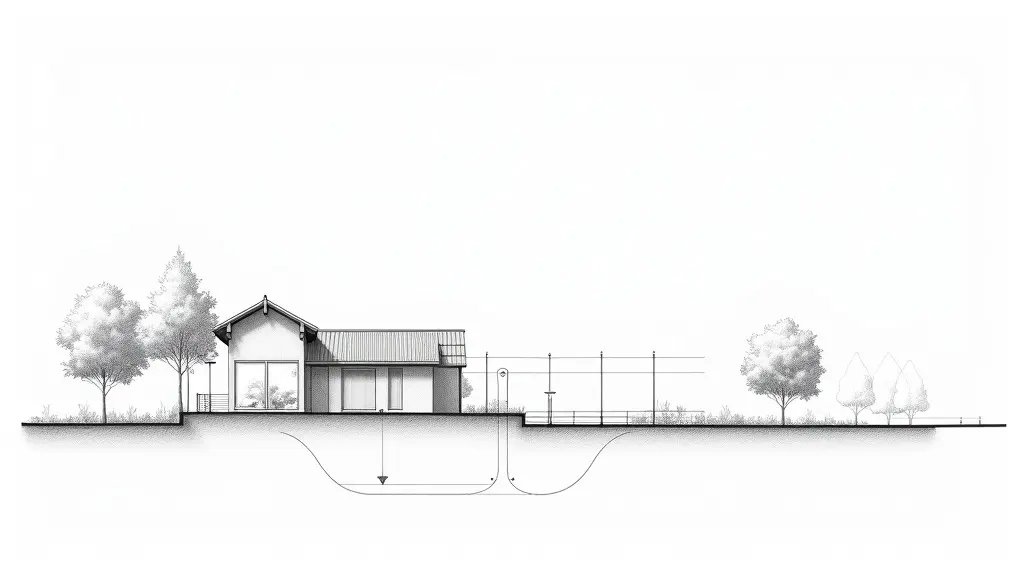
A puddle, soaked ground. The symptom is visible. But the cause is hydraulic: the natural slope of the land has been altered, affecting rainwater runoff. What no one tells you: a natural drainage easement (Art. 640 C.civ.) is not just about “where the water goes.” It’s about flow rate, velocity, cross-section. On a case in Antibes last year, I measured a 20 cm difference in level after undeclared earthworks. The owner thought it was a mere nuisance, but the calculation revealed a flow rate multiplied by 1.8, clearly beyond tolerance.
Natural terrain profile (2% slope) Upstream property Downstream property (your garden) Level before works Level after fill Surface after fill (slope reduced to 0.5%) Natural flow Water accumulation zone Δh = 0.20 m
The Flow Calculation That Settles the Dispute
The Manning-Strickler formula, a reference in open-channel hydraulics, gives flow Q = K × R^(2/3) × I^(1/2) × S. K is the roughness coefficient (for grassy terrain in Antibes, K ≈ 30 m^(1/3)/s). R is the hydraulic radius (wetted cross-section / wetted perimeter). I is the slope. S is the cross-sectional area. Take a concrete case measured on the Safranier hill in Antibes: before works, a natural channel had area S₁ = 0.15 m² (width 0.5 m, water depth 0.3 m), wetted perimeter P₁ = 1.1 m, so R₁ = 0.15/1.1 ≈ 0.136 m. Natural slope I₁ = 0.02 (2%). Q₁ = 30 × (0.136)^(2/3) × (0.02)^(1/2) × 0.15 ≈ 30 × 0.26 × 0.141 × 0.15 ≈ 0.165 m³/s. After fill, the area is reduced to S₂ = 0.10 m² (partial filling), slope becomes I₂ = 0.005 (0.5%). R₂ ≈ 0.10/0.9 ≈ 0.111 m. Q₂ = 30 × (0.111)^(2/3) × (0.005)^(1/2) × 0.10 ≈ 30 × 0.23 × 0.071 × 0.10 ≈ 0.049 m³/s. The discharged flow drops from 0.165 to 0.049 m³/s, a reduction of 70%. Water no longer flows; it stagnates. What this means concretely: the development violates Art. 640 C.civ., which prohibits aggravating the natural drainage easement. Here, the aggravation is quantified, measurable.
The Cascading Damages If You Wait
Within 6 months, persistent humidity weakens the foundations of your boundary wall. Cracks appear, 2 to 3 mm wide. After 2 years, the roots of your olive trees or palm trees (typical in Antibes) rot due to root asphyxia. The cost of underpinning a wall can exceed €15,000. Not to mention secondary issues: moss growth, landslides in winter, and a definite devaluation of your property. I saw a case in the Fontonne area where waiting led to a flooded basement, with damages estimated at €25,000.
In practice, water stagnation creates persistent water damage. Sloped terrains in Antibes are sensitive: water saturation changes soil bearing capacity. A geotechnical diagnosis becomes necessary, adding €1,500 to €2,000 in costs. And don’t forget health nuisances: mosquitoes, odors. Acting quickly limits these risks.
Recourse and Guarantees: What You Can Demand
The applicable guarantee is Art. 640-641 C.civ., which establishes the legal regime for water drainage easements. Paragraph 1 of Art. 640 states: “Lower lands are subject to receiving water that naturally flows from higher lands…” Article 641 adds the prohibition of aggravating the easement. Your recourse: a registered letter with return receipt to the neighbor, demanding restoration within 30 days. If no response, petition for a court-appointed expert (via the Grasse tribunal) for a contradictory measurement with a Leica TS total station (precision ±1 cm) and a hydraulic calculation according to Manning-Strickler. The expert will produce a quantified report, admissible evidence in court. Don’t let a neighbor dispute ruin your daily life on the French Riviera.
Frequently Asked Questions
My neighbor filled his land and now water stagnates on my property: what should I do?
Start by documenting the facts: take photos, measure water depth, and note dates. Then contact a hydraulic expert to perform a flow calculation. Send a registered letter to your neighbor demanding restoration. If no response, seek a court-appointed expert through the tribunal. Legal action based on Articles 640-641 of the French Civil Code can compel restoration and damages.
What is the Manning-Strickler formula and how is it used?
The Manning-Strickler formula (Q = K × R^(2/3) × I^(1/2) × S) calculates open-channel flow. K is a roughness coefficient (e.g., 30 for grassy terrain), R is hydraulic radius, I is slope, S is cross-sectional area. It quantifies whether a modification has significantly altered drainage, providing objective evidence in easement disputes.
What are the legal articles governing water drainage easements in France?
Articles 640 and 641 of the French Civil Code (Code civil) establish the natural drainage easement. Article 640 requires lower lands to receive natural water flow from higher lands. Article 641 prohibits the upper landowner from doing anything that aggravates the easement, such as altering the flow rate or volume.
How long do I have to take legal action for a drainage easement violation?
In France, the statute of limitations for property disputes is generally 5 years from the date the damage became apparent. However, for continuous nuisances like water stagnation, the limitation may run from the cessation of the nuisance. It is advisable to act promptly and seek legal advice.
What evidence is needed to prove an aggravation of drainage easement?
Key evidence includes: before-and-after photos, topographic surveys showing level changes, hydraulic calculations (e.g., Manning-Strickler) demonstrating flow alteration, expert reports, and witness testimony. A court-appointed expert’s report is particularly persuasive.
Can I claim damages for property devaluation due to water stagnation?
Yes, if the neighbor’s actions caused the stagnation, you can claim compensation for property devaluation, repair costs, and other losses. A real estate appraisal and expert report can quantify the devaluation. Legal action under Articles 640-641 can seek both restoration and damages.
📅 Mis à jour le 28/07/2026 — Par Cassini Expertise, expert bâtiment indépendant 06 & 83. Devis gratuit : 04 22 46 06 04.
Questions fréquentes
What is a water drainage easement in Antibes?
A water drainage easement in Antibes is a legal right allowing water to flow across a neighboring property. It is typically established by law, contract, or prescription, and must be respected to avoid disputes.
How is water flow calculated for a drainage easement?
Water flow calculation involves determining the natural runoff volume and rate, often using local rainfall data and terrain analysis. In Antibes, this may follow French standards, considering factors like surface area, slope, and soil permeability.
What can I do if a neighbor blocks my drainage easement?
If a neighbor obstructs your drainage easement, you should first discuss the issue and seek a mutual solution. If that fails, you can file a complaint with the local court, as blocking an easement violates property rights under French law.
Cassini Expertise
Expert du bâtiment indépendant — Antibes (06·83·13·40)
📅 Mis à jour le 19/09/2026 — Cassini Expertise, expert bâtiment indépendant (06·83·13·40).