Your brand-new apartment in Cannes-la-Bocca was due for delivery on 30 June 2023. Several months on, the developer has announced yet another postponement. No penalty has been paid. You signed a sale agreement with a firm contractual date, yet the site appears to have stalled. When an off-plan (VEFA) delivery is delayed, statutory compensation is owed unless the developer can prove force majeure. This page sets out the calculation rules, the legal basis, and the remedies available to a buyer in the Alpes-Maritimes.
Delayed VEFA Delivery: What the Contract Provides
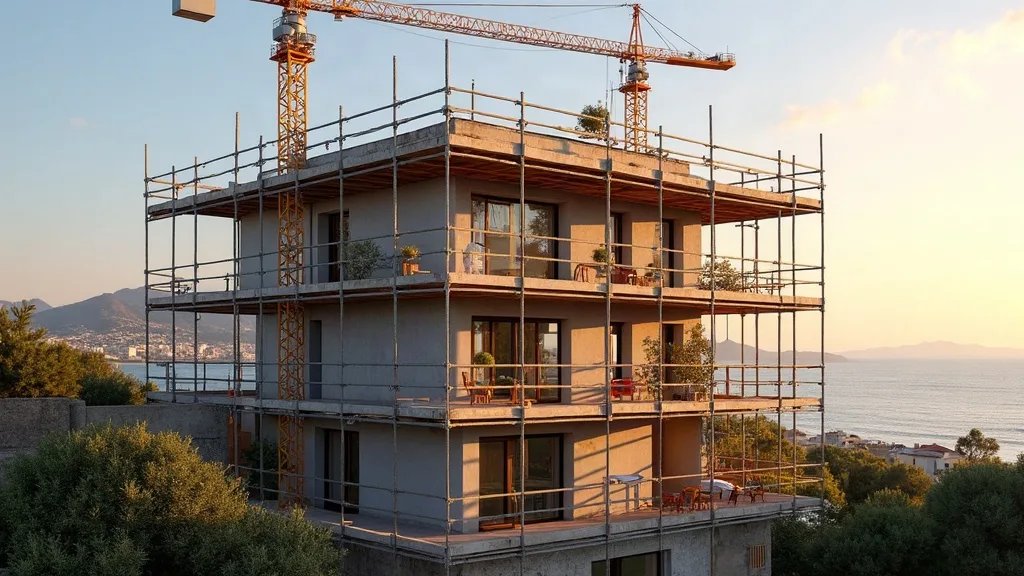
The developer notifies you of a delay in a terse letter citing “exceptional weather” or “technical difficulties.” On site, you find the windows aren’t fitted and the lift isn’t installed. The off-plan sale contract includes a late-delivery penalty clause, set by Article R. 261-18 of the French Building and Housing Code (CCH) at 1/3,000th of the sale price per day of delay. This statutory rate applies automatically from the day after the scheduled delivery date if the property has not been completed.
The delivery date is the one stated in the notarised deed of sale. It may be extended by an amendment if the buyer agrees. Absent such an amendment, penalties accrue automatically. The developer remains liable for delays caused by its subcontractors (Article 1231-1 of the French Civil Code), unless it proves a case of force majeure: an event that is unforeseeable, irresistible, and external.
Calculating VEFA Late-Delivery Penalties: The Applicable Formula
The calculation formula is as follows:
- Daily penalty = sale price (incl. VAT) × (1 ÷ 3,000)
- Total compensation = daily penalty × number of days of delay
For an apartment sold for €300,000, the daily penalty is €100. A 6-month delay (184 days) produces compensation of €18,400. This amount can represent 5% to 10% of the purchase price, depending on how long the delay runs.
The developer may deduct days attributable to force majeure, provided it can prove them. In practice, it often cites bad weather without producing official meteorological records (Météo-France). Without supporting evidence, penalties accrue in full. Article 1231-1 of the Civil Code requires the debtor (the developer) to prove the external cause that exonerates it.
Worked Example with a Force Majeure Adjustment
Take a new-build development in Cannes-la-Bocca, average price €320,000, with an announced delay of 8 months (240 days). The developer cites a landslide caused by heavy rainfall. The buyer checks Météo-France records and identifies 14 days of rainfall meeting the force majeure criteria. The calculation becomes:
- Daily penalty: €320,000 × (1 ÷ 3,000) = €106.67
- Compensable days: 240 − 14 = 226 days
- Total compensation: 226 × €106.67 = €24,107.42
The 14-day difference (€1,493) may seem minor, but it shows why every day claimed by the developer needs checking. An independent expert reviews the site schedule, site-meeting minutes, meteorological records, and the technical causes of the delay.
The Cost of Doing Nothing: What the Delay Can Hide
Failing to claim penalties means giving up a sum that can run into tens of thousands of euros. But the delay can also reveal hidden defects. A site left idle for several months is exposed to the weather: water ingress in unenclosed areas, degraded partition walls, corrosion of reinforcement if the concrete isn’t protected. Remedial work can cost several thousand euros per unit.
A late delivery also means lost rental income for an investor. In Cannes, average rent is €18/m² per month. For a 60 m² two-bedroom flat, that’s €1,080 per month, or €6,480 over a 6-month delay — on top of the statutory penalties. If the delay drags on beyond a reasonable period, the buyer can consider terminating the contract (Article 1224 of the Civil Code), with reimbursement of the price and damages.
Legal Basis for Penalties and Remedies
The VEFA late-penalty regime rests on two main provisions:
- Article L. 261-11 of the CCH: requires the developer to deliver the property on the scheduled date, save in cases of force majeure.
- Article R. 261-18 of the CCH: sets the penalty rate at 1/3,000th of the price per day of delay.
The developer’s contractual liability falls under Article 1231-1 of the Civil Code: “The debtor shall, where appropriate, be ordered to pay damages either for non-performance of the obligation or for delay in performance, unless he proves that the non-performance results from an external cause that cannot be attributed to him.” The developer therefore bears the burden of proving force majeure to escape penalties.
Steps to Claim Compensation
The first step is to send the developer a registered letter with acknowledgement of receipt formally demanding payment of the penalties. The letter should state:
- the contractual delivery date,
- the actual delivery date (or the date of the letter if the property still hasn’t been delivered),
- a precise count of the days of delay,
- the penalty amount calculated under the statutory formula,
- a deadline for payment (typically 15 to 30 days).
If the developer refuses to pay or disputes the calculation, the buyer can bring the matter before the Grasse Judicial Court, which has jurisdiction over Cannes and Cannes-la-Bocca. Proceedings can be brought on an urgent basis (référé) if the obligation isn’t seriously disputable, or on the merits. The judge may order a court-appointed expert assessment to establish the causes of the delay, whether the events cited were genuinely unforeseeable and irresistible, and the amount of compensation due.
The Role of an Independent Expert in Assessing the Delay
An independent building expert steps in to verify the developer’s claims. The assignment covers:
- reviewing the original site schedule and its updates,
- examining site-meeting minutes,
- checking official meteorological records (Météo-France),
- investigating the technical causes: a subcontractor’s failure, delayed material deliveries, unforeseen ground conditions (expansive clay, groundwater),
- quantifying the days of delay attributable to the developer, after deducting force majeure days.
The expert report substantiates the amount claimed and counters the developer’s arguments. The cost of the assessment (€2,000 to €5,000) can be charged to the developer if the delay is found to be its fault. The limitation period is 5 years from the actual delivery date (Article 2224 of the Civil Code).
Conclusion: Don’t Let Your Rights Slip Away
A delayed VEFA delivery entitles you to substantial compensation, calculated at a statutory rate. The developer can only escape liability by proving force majeure. If you’re facing an uncompensated delay, assert your rights in writing, consult an independent expert, and, if necessary, bring the matter before the competent Judicial Court. The sums at stake justify swift, well-documented action.
📅 Updated 29/08/2026 — By Cassini Expertise, independent building expert, 22 rue Vauban, 06600 Antibes. Coverage areas: Alpes-Maritimes (06) and Var (83). Phone: 04 22 46 06 04.
Frequently Asked Questions
How is VEFA late-delivery compensation calculated?
Late-delivery compensation is calculated at 1/3,000th of the sale price per day of delay, under Article R. 261-18 of the French Building and Housing Code. The reference price is the one agreed in the notarised deed of sale, all taxes included. Multiply that price by the number of days of delay and divide by 3,000.
Is there a grace period before I can claim VEFA late-delivery penalties?
There is no statutory grace period. Penalties accrue from the day after the contractual delivery date if the property hasn’t been handed over. The developer may invoke suspension events (force majeure, severe weather), which must be notified and substantiated. Check the contractual date and any extensions agreed by amendment.
How do I obtain compensation for a delayed VEFA delivery in Cannes-la-Bocca?
Send the developer a formal demand by registered letter with acknowledgement of receipt, citing the contract clauses and the calculated amount. If no agreement is reached within 15 to 30 days, bring the matter before the Grasse Judicial Court. Keep every piece of evidence: contract, correspondence, site reports, meteorological records. A technical expert assessment may be needed to substantiate the amount claimed.
Cassini Expertise
Expert du bâtiment indépendant — Antibes (06·83·13·40)
📅 Mis à jour le 25/09/2026 — Cassini Expertise, expert bâtiment indépendant (06·83·13·40).