EXPERT ASSESSMENT — VEFA FRENCH RIVIERA
You’ve just taken delivery of your villa in Cannes. The floor plan promised an unobstructed view over the bay. But standing on the terrace, all you see is a freshly cut earth bank just 3 metres from the bay window. You pull out your laser measure: the height difference between your slab and the top of the bank exceeds 2.50 m. Yet the site plan showed flat natural ground. Field experience regularly reveals a 1.80 m gap between the plan and reality. This is not a mere aesthetic detail: the French Construction Code (CCH L261-1) requires compliance with the contractual documents. And the view is one of those subjective elements developers tend to downplay — until an expert assessment proves otherwise.
What you see — and what it’s really hiding
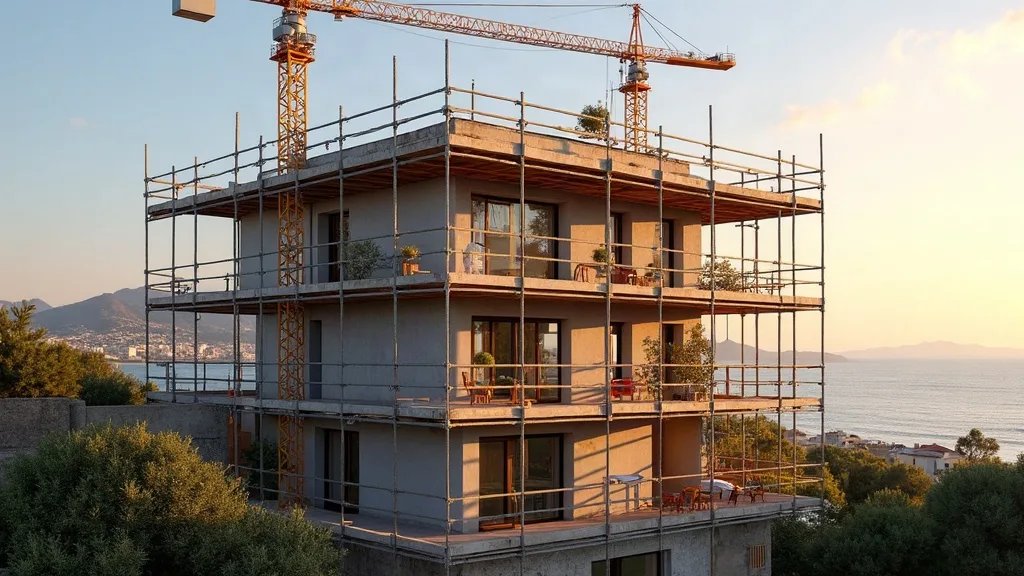
The symptom is clear: the earthworks created a berm that blocks the view. But the underlying problem often runs deeper. The project’s cross-section drawing showed a gentle slope to the south. In reality, the levelling work lowered the villa by 2.20 m relative to the natural ground, for foundation stability reasons (swelling clay soils). The result: a steep 3 m bank right on the property boundary.
What nobody tells you: the VEFA plan doesn’t always reflect the actual terrain after earthworks. Altimetric levels are often omitted or approximate. Frankly, a developer can alter the ground profile without informing you, as long as the building stays within the planning permit’s limits. But the view itself is not protected by Cannes’ local urban plan (PLU). It’s a contractual guarantee. And that’s where topographic expert assessment makes all the difference.
The calculations that change everything: slope and tolerance
To establish non-compliance, we compare the contractual cross-section (1/50 scale, NF ISO 5455) with the actual topographic survey. I use a Leica TS total station (±2 mm accuracy) and GNSS RTK in RGF93/Lambert 93. On this Cannes case, the plan promised a 5% slope (a 2.50 m drop over 50 m). The survey shows an average slope of 18% over the first 20 metres. The formula: slope (%) = (Δh / L) × 100. With Δh = 2.20 m (height difference between the villa and the back of the plot) and L = 12 m (horizontal distance), this gives 18.3%. Case law generally accepts a tolerance of ±5% relative or 0.20 m in elevation for a VEFA plan. Here, the discrepancy is 13.3 slope points — 266% of the promised value. Non-compliant.
What happens if you do nothing
By 6 months, the unplanted earth bank starts eroding. Runoff water carries sediment into your garden. By 2 years, cracks can appear in the temporary retaining wall. By 5 years, the cost of redoing the earthworks (excavation, disposal, re-grading) exceeds €15,000. Not to mention the loss in property value: a villa with a blocked view loses a significant share of its worth in Cannes.
Secondary defects are common: water pooling against the façade, rising damp, render deterioration. One owner waited 3 years before acting: the retaining wall had bulged by 8 cm. The repair cost €28,000.
Remedies and guarantees: what you can demand
The contractual conformity guarantee (CCH L261-1, paragraph 2) entitles you to demand restoration of the promised ground profile. The NF ISO 5455 standard sets out the tolerances for plan representation. Your course of action: send the developer (Nexity, GA Smart Building…) a registered letter with acknowledgment of receipt, backed by a bailiff’s report and an urban planning expert’s report. If they refuse, take the matter to the Grasse judicial court. I advise against signing any report confirming that reservations have been resolved without a prior expert assessment. A simple letter from the developer stating « reservations resolved » is not enough: only a joint technical inspection can confirm the defect has actually been corrected. For further reading, see our article on the broken sea view promise in Antibes.
📅 Updated on 31/07/2026 — By Cassini Expertise, independent building expert serving the 06 & 83 departments. Free quote: 04 22 46 06 04.
To go further:
Frequently asked questions
What should I do if my VEFA view is non-compliant?
If the view promised in your VEFA contract doesn’t match reality, you can invoke a discrepancy between the advertised sale and the actual outcome. Gather your documents (plans, marketing materials) and send the developer a formal notice. If they refuse to act, take the matter to court to seek compensation or contract termination.
What remedies exist for non-compliant VEFA land?
Non-compliant land (for example, excessive earthworks) constitutes a defect of conformity. You must notify the developer by registered letter with acknowledgment of receipt, specifying the discrepancies. If no agreement is reached, you can bring legal action within 5 years of the handover of the works.
What if the view becomes blocked after a VEFA purchase?
If the view is obstructed after purchase (for example, by a later construction), check whether the developer had an obligation to preserve that view. If so, you may claim damages for loss of enjoyment. Consult a real estate lawyer to assess your options.
Cassini Expertise
Expert du bâtiment indépendant — Antibes (06·83·13·40)
📅 Mis à jour le 25/09/2026 — Cassini Expertise, expert bâtiment indépendant (06·83·13·40).