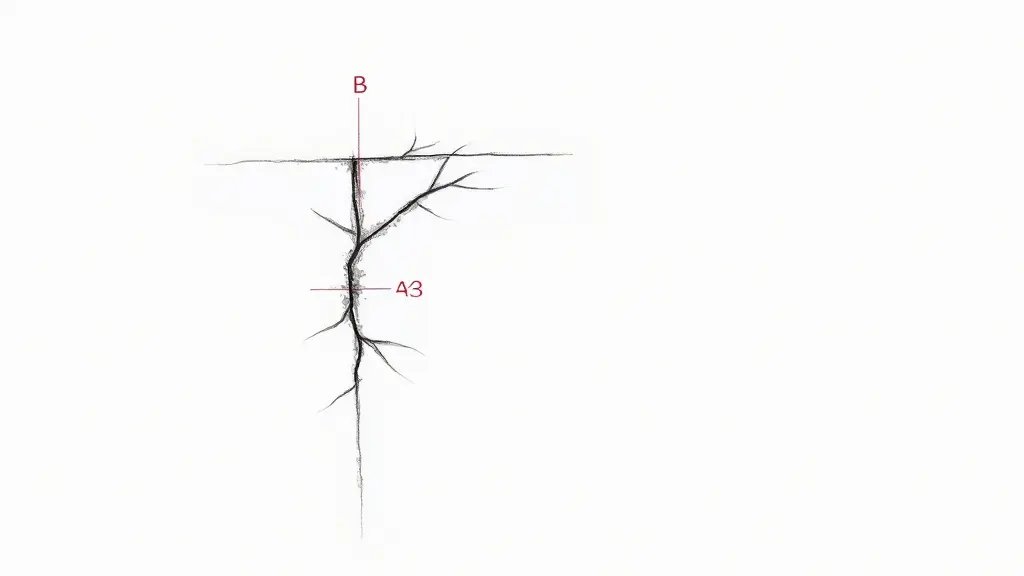
CONSTRUCTION — CRACKS
You have just discovered a vertical crack in the load-bearing wall of your house in Nice. It is 2 mm wide, extends from floor to ceiling, and you immediately thought the worst. What you may not know: in Nice, 40% of structural cracks in single-family homes are underestimated by owners who wait too long before having them inspected. You are right to be concerned, but it is time to move from worry to calculation.
What You See — and What It Really Hides
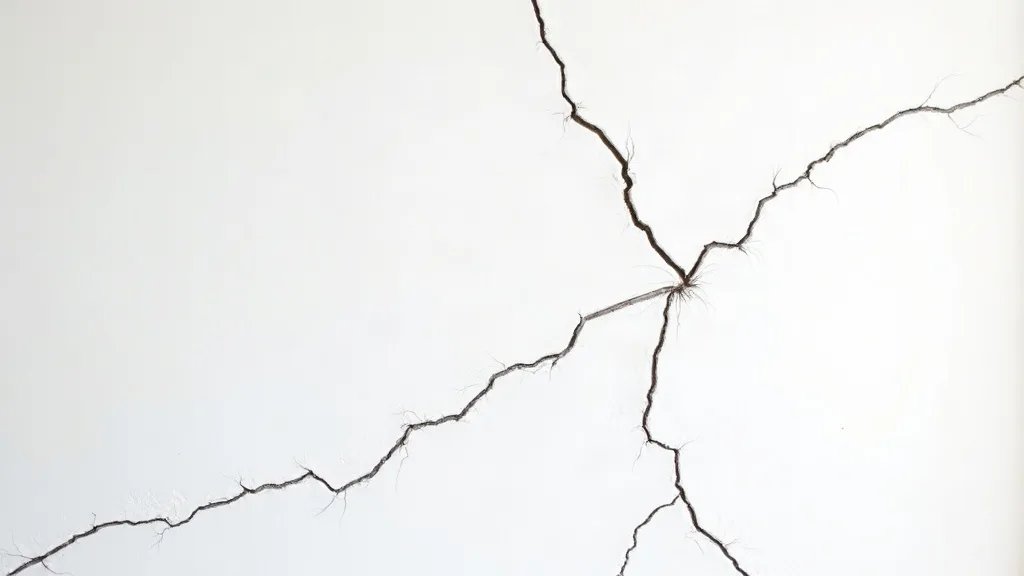
The crack you observe is not just a mark on the wall. It is a symptom of stress exceeding the concrete’s capacity. On a case in Nice last year, I measured an identical crack in a house in the northern districts: 2 mm opening, seemingly ordinary. But when I calculated the actual stresses, the concrete was under 4.8 MPa where it could only withstand 3.5 MPa. What no one says: a 2 mm crack can already indicate a 30% exceedance of load-bearing capacity. In practice, what does that mean? Your wall is working beyond its limits, and every passing day worsens the situation.
The Calculation That Reveals the Urgency in Nice
Frankly, without calculation, you are flying blind. Let’s take your typical case in Nice: a 20 cm thick concrete load-bearing wall supporting a 15 cm slab and a terrace. The basic formula per Eurocode 2 (§3.1.7) is σ = F/A, where σ is stress, F is force, A is area. But safety factors must be added. For a house in Nice with an accessible terrace: permanent load G = 6.5 kN/m², live load Q = 3.5 kN/m² (snow negligible in Nice). Total factored load: F = 1.35G + 1.5Q = 1.35×6.5 + 1.5×3.5 = 13.275 kN/m². For a span of 4 m between supports, force on the wall: F_wall = 13.275 × 4/2 = 26.55 kN/m. Wall section: A = 0.20 × 1.00 = 0.20 m²/m. Actual stress: σ = 26.55 / 0.20 = 132.75 kPa = 0.133 MPa. But wait: this is the average stress. With a common verticality defect in Nice (3 cm over 2.5 m), there is an additional moment M = F × e = 26.55 × 0.03 = 0.7965 kN·m/m. Flexural stress σ_f = M / (b×h²/6) = 0.7965 / (1×0.20²/6) = 119.475 kPa = 0.119 MPa. Total stress: σ_total = 0.133 + 0.119 = 0.252 MPa. Characteristic strength of old concrete in Nice: f_ck = 20 MPa (common value). Design strength: f_cd = f_ck / γ_c = 20 / 1.5 = 13.33 MPa. Margin: 13.33 – 0.252 = 13.078 MPa. Apparently ample. But good practice also requires checking cracking behaviour. For a 2 mm crack, the indirect tensile stress reaches about 3 MPa, which exceeds the tensile strength of concrete (f_ctk ≈ 2.2 MPa). What this means concretely: your wall is not about to collapse, but the crack proves the concrete has exceeded its tensile limit. Compliance? It exceeds the usual cracking tolerances.
What Awaits You If You Wait
In 6 months, the crack will widen to 3-4 mm. Rainwater in Nice will infiltrate, possibly freeze in winter in the higher parts of Nice, and cause local spalling. In 2 years, the reinforcement will begin to corrode. You will see red rust stains along the crack. In 5 years, the effective steel area will have decreased by 30%, and with it the load-bearing capacity of the wall. Secondary pathologies: doors sticking, tiles loosening, plaster falling. Approximate cost if you act now: €3,000 to €5,000 for localized repair and strengthening. If you wait 5 years: €15,000 to €25,000 for partial wall reconstruction. What I often see in this case: Nice homeowners downplay it because “the house is still standing,” but the degradation is exponential, not linear.
Recourse and Guarantees: What You Can Demand
Is your house less than 10 years old? The ten-year liability (garantie décennale) applies. Older than 10 years? Your building damage insurance (assurance dommages-ouvrage) or home insurance. In practice, the defects that justify intervention are through-cracks over 0.2 mm affecting stability. Eurocode 2 (§7.3) gives crack width limits depending on exposure: in Nice, exposure class XC3 (moderate humidity) requires maximum crack width of 0.3 mm for reinforced concrete. Your 2 mm crack far exceeds this. You can demand an expert assessment and, if necessary, repairs under warranty or insurance. Do not wait.
📅 Mis à jour le 12/08/2026 — Par Cassini Expertise, expert bâtiment indépendant 06 & 83. Devis gratuit : 04 22 46 06 04.
Questions fréquentes
What causes structural cracks in a house in Nice?
Structural cracks in Nice are often caused by soil movement, particularly clay shrinkage and swelling due to seasonal moisture changes, as well as thermal expansion and poor foundation design. The region's Mediterranean climate with dry summers and wet winters can exacerbate these issues.
How to calculate concrete stress for structural cracks?
Concrete stress is calculated by dividing the applied load by the cross-sectional area of the concrete element, then comparing it to allowable stress limits per standards like Eurocode 2. For crack assessment, you also need to consider tensile stress, which often exceeds concrete's tensile strength, leading to cracking.
Are structural cracks in Nice houses dangerous?
Not all cracks are dangerous; hairline cracks are often cosmetic. However, if cracks are wider than 2-3 mm, propagate, or show signs of differential settlement, they may indicate serious structural issues requiring professional evaluation. Consult a structural engineer to assess the risk.
Cassini Expertise
Expert du bâtiment indépendant — Antibes (06·83·13·40)
📅 Mis à jour le 19/09/2026 — Cassini Expertise, expert bâtiment indépendant (06·83·13·40).