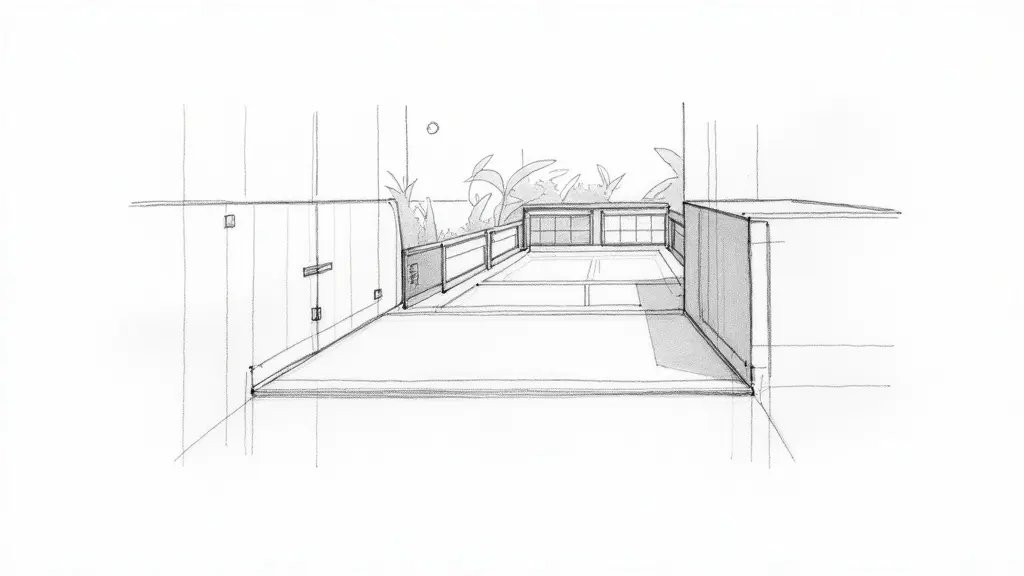
PROPERTY — FRENCH RIVIERA
You had a pool built in your garden in Antibes. The neighbor accuses you of encroaching on their plot. You measured with a tape measure: 30 cm difference. But it’s not that simple. On a case in Antibes last year, I measured a discrepancy of 28 cm with a Leica TS16 total station, while the owner thought he was within 5 cm. The reality on the ground is often deceptive.
What You See — and What It Really Hides
The pool wall protrudes a few centimeters beyond the apparent boundary. You looked at the cadastral map on Géoportail (French online mapping service): the boundary seems straight. But the cadastre is not a survey document; its accuracy is on the order of one meter. In Antibes, properties are often narrow and sloping, which amplifies errors.
What no one tells you: the PLU CASA (Local Urban Plan of the Sophia Antipolis Agglomeration Community) requires a minimum setback of 3 meters from property boundaries for any construction, including in-ground pools. And Article 674 of the French Civil Code prohibits any direct view (window) within 1.90 m of the boundary. But often, the problem is not the view, it’s the footprint. A contradictory boundary survey (bornage contradictoire) by a licensed surveyor (expert en urbanisme) is the only way to establish the legal boundary. Frankly, don’t trust your own measurement.
The Calculations That Change Everything: The 3-Meter Rule
The PLU CASA (Sophia Antipolis Agglomeration Community) requires for in-ground pools a minimum setback of 3 meters from property boundaries (Article 8-1 of the regulations). If your pool is at 2.80 m, you are breaking the law. But that’s not all: Article 674 of the French Civil Code prohibits direct views within 1.90 m of the boundary. Concretely, if your pool coping is at 2 m, you are in violation.
Let’s take a real case: in Antibes, a 400 m² plot, an 8×4 m pool. The owner measured a setback of 2.90 m. With a GNSS RTK topographic survey (accuracy ±1 cm in planimetry), I found 2.72 m. The 18 cm discrepancy comes from the slope of the land (12%), which shifts the measurement point. The correction formula: horizontal distance = measured distance × cos(slope angle). With a slope of 6.8°, cos(6.8°) = 0.993, so 2.90 × 0.993 = 2.88 m. But in reality, the measurement point was poorly chosen: it should have been measured from the face of the wall, not from the edge of the coping. Result: 2.72 m, i.e., 28 cm less than the 3 m tolerance. Verdict: non-compliant.
What Happens If You Do Nothing
The neighbor can take the case to the Grasse court to have the encroachment established. Generally, the judge orders the demolition of the encroaching part, or even the entire pool if it is indivisible. Cost: €15,000 to €30,000 for an 8×4 m pool. Not including expert fees (€3,000 to €5,000).
In the longer term, the encroachment can destabilize the neighboring retaining wall, especially on the clay soils of Antibes (expansive clays, shrink-swell). Eurocode 7 (NF EN 1997-1) requires adapted foundations. If the pool is not compliant, it can crack under the effect of ground movements. Within 2 years, damage can reach €10,000 in repairs.
Recourse and Guarantees: What You Can Demand
You have two levers: the builder’s ten-year liability (if the pool is less than 10 years old) and the boundary action. Article 674 of the French Civil Code (paragraph 2) specifies that direct views within 1.90 m are prohibited. The PLU CASA (Article 8-1) imposes the 3 m setback. Eurocode 7 (paragraph 2.4.2) requires a soil study for constructions in clay zones. Send a registered letter with acknowledgment of receipt to the builder, then take the case to the Grasse judicial court. A court-appointed expert (like me) will be named to measure contradictorily. In the meantime, do not modify anything: any transformation can be interpreted as an admission of encroachment.
📅 Mis à jour le 24/07/2026 — Par Cassini Expertise, expert bâtiment indépendant 06 & 83. Devis gratuit : 04 22 46 06 04.
Questions fréquentes
What is a boundary survey and why is it needed for a shared pool in Antibes?
A boundary survey determines the exact legal property lines. For a shared pool, it's essential to confirm the pool's location relative to boundaries, ensuring compliance with local regulations and preventing disputes.
What should I do if my shared pool encroaches on a neighbor's property in Antibes?
If encroachment is found, consult a land surveyor and a lawyer specialized in property law. Options include negotiating an easement, purchasing the affected land, or, in some cases, removing or modifying the pool.
Can a shared pool be built without a boundary survey in Antibes?
While not always legally required, it's highly recommended. Without a survey, you risk building over property lines, leading to legal disputes, fines, or forced removal. Always get a survey before construction.
Cassini Expertise
Expert du bâtiment indépendant — Antibes (06·83·13·40)
📅 Mis à jour le 19/09/2026 — Cassini Expertise, expert bâtiment indépendant (06·83·13·40).