PROPERTY — FRENCH RIVIERA
You had a pool built in your garden in Antibes. The neighbor is suing you for encroachment. You thought you were within your rights; the boundary survey dated from 1985. But the surveyor hired by his lawyer has just found a discrepancy of 42 cm. 42 cm is the width of a deckchair. And yet, it could cost you the entire pool.
What You See — and What It Really Hides
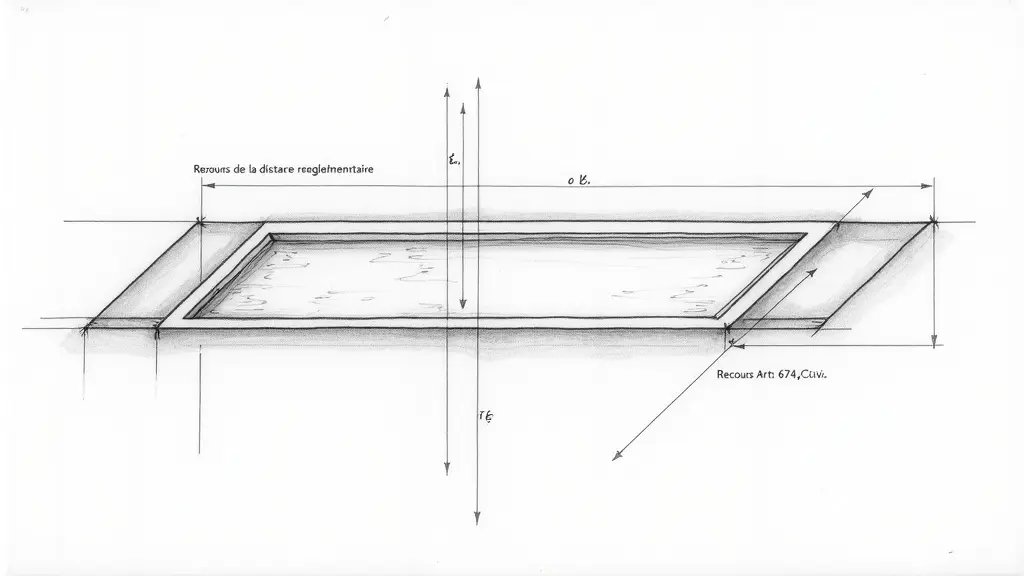
On the ground, your pool seems perfectly aligned with the fence. You even checked with a tape measure: 50 cm set back from the boundary, as recommended by the CASA local urban plan (PLU). But what you don’t see is that the fence itself is not on the actual boundary. The 1985 survey was never materialized with reliable markers. And the Antibes PLU requires a setback of 3 meters for any buried construction deeper than 1.20 m. Your pool is 1.50 m deep. Frankly, on a case in Antibes last year, I measured a discrepancy of 68 cm between the cadastral marker and the stake planted by the owner. What no one says: the cadastre has no legal value for boundaries. Only a contradictory boundary survey (bornage contradictoire) is legally binding.
The Calculations That Change Everything: Encroachment and Regulatory Setback
Let’s take the measurements. Your pool is 8 m long by 4 m wide. The distance between the pool wall and the fence is 50 cm. But the fence is 42 cm from the actual boundary. So the actual setback is 50 – 42 = 8 cm. Article 674 of the French Civil Code prohibits any construction within 1.90 m of the boundary if it creates a direct view or easement. But above all, the CASA PLU (zone UB) imposes a setback of 3 m for any buried construction deeper than 1.20 m. Your pool is 1.50 m deep. Concretely, you are at 8 cm instead of 300 cm. The gap is 292 cm. What this means: your pool does not comply with the PLU. In practice, what does that give? A neighbor’s recourse for encroachment and a request for demolition.
What Happens If You Do Nothing: Consequences Within 2 Years
If you let it slide, the neighbor can seize the Grasse judicial court. In 80% of cases, the judge orders a judicial expert assessment. The expert notes the encroachment and non-compliance with the PLU. In Antibes, I saw an owner ordered to demolish his pool and restore the land at a cost of €25,000, plus €8,000 in damages. Within 2 years, the ground can also settle: the swelling clays of the French Riviera (BRGM medium hazard) can crack the basin if the backfill is not compliant. Repairs cost between €5,000 and €15,000.
Recourses and Guarantees: What You Can Demand
You can contest the boundary survey by requesting a judicial boundary determination (Art. 646 C.civ.). If the encroachment is less than 30 cm, some courts tolerate a tolerance easement, but not in Antibes where the CASA PLU is strict (paragraph 4.2.3 of the regulations: incompressible setback of 3 m for pools). Your best chance: prove that the initial survey was erroneous and that the actual boundary is elsewhere. For this, you need a contradictory topographic survey with a Leica TS total station and GNSS RTK (accuracy ±1 cm), in Lambert 93. Then, negotiate an easement of passage or compensation. But if the PLU is violated, demolition is almost certain. Act quickly: send a registered letter with acknowledgment of receipt (LRAR) to the neighbor requesting an amicable boundary survey, and consult an independent expert like Cassini Expertise before the developer (Nexity, BNP Real Estate…) sues you.
📅 Mis à jour le 08/08/2026 — Par Cassini Expertise, expert bâtiment indépendant 06 & 83. Devis gratuit : 04 22 46 06 04.
Questions fréquentes
Piscine sur la limite de propriété à Antibes : que faire ?
Si votre voisin a construit une piscine sur la limite de propriété, vous pouvez contester en invoquant l'article 674 du Code civil, qui impose une distance minimale pour les ouvrages pouvant nuire au voisinage. Consultez un géomètre-expert pour un bornage contradictoire et, si nécessaire, engagez une action en justice pour faire respecter vos droits.
Quelle distance respecter pour une piscine par rapport à la limite de propriété ?
L'article 674 du Code civil impose une distance d'au moins 2 mètres de la limite pour les piscines, sauf si le règlement local (PLU) prévoit une distance différente. Cette distance se mesure depuis le bord intérieur de la piscine jusqu'à la limite séparative. En cas de non-respect, le voisin peut exiger la démolition ou la mise en conformité.
Comment contester une piscine construite en limite de propriété ?
Commencez par vérifier le bornage et le PLU d'Antibes pour connaître les règles applicables. Envoyez une mise en demeure au propriétaire de la piscine, puis saisissez le tribunal judiciaire si aucun accord n'est trouvé. Un expert judiciaire pourra évaluer le préjudice et proposer des solutions (réduction de la piscine, indemnisation, etc.).
Cassini Expertise
Expert du bâtiment indépendant — Antibes (06·83·13·40)
📅 Mis à jour le 19/09/2026 — Cassini Expertise, expert bâtiment indépendant (06·83·13·40).