TOPOGRAPHY — IMPLANTATION
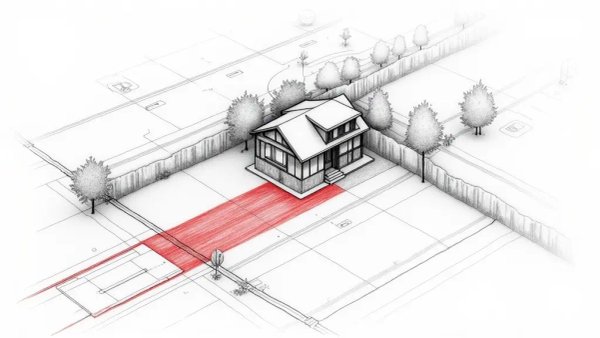
You receive the as-built survey report. The surveyor reports a 47 cm offset from the building permit site plan. You thought you had correctly followed the dimensions by measuring with a tape measure from the property boundary. But here it is: on site, reality is stubborn. In Nice, slopes and cadastral references play tricks.
What You See — and What It Really Hides
Your extension wall seems well aligned with the plan. Yet the surveyor’s report indicates a discrepancy. Why? Because the site plan uses Lambert 93 coordinates and NGF-IGN69 elevations. You measured from the edge of the road, without accounting for the slope. On a Nice plot with a 12% gradient, a 1° angle error gives a 20 cm horizontal offset.
What I often see in this case: the owner used a consumer laser rangefinder, accuracy ±3 cm, and neglected slope correction. Result: the actual implantation gradually drifts. The problem is not your good faith, but the lack of topographical control during construction.
The Calculations That Change Everything: Actual Deviation vs. Local Urban Plan (PLU)
The Nice Local Urban Plan (PLU) requires implantation within a 3-meter strip from the boundary. Your site plan indicates 2.50 m. The surveyor measures 2.03 m. That is a 0.47 m deviation. The tolerance accepted by case law is generally 5 cm for new constructions. You are outside tolerance. Planimetric deviation formula: Δ = √((X_actual – X_plan)² + (Y_actual – Y_plan)²). In practice, with a GNSS RTK accuracy of ±1 cm, measurement uncertainty is negligible. The verdict: characterized non-compliance under Article L462-1 of the Urban Planning Code (Code de l’Urbanisme), paragraph 2, which penalizes any substantial difference from the permit.
What this means concretely: the municipality may require demolition or a permit modification. But you can also regularize if the PLU allows it. In Nice, the urban planning department reviews cases individually.
What Happens If You Do Nothing: Risks in Nice
Six months after completion, you receive a letter from the municipality: formal notice to bring into compliance. You risk a fine of €1,200 per m² of non-compliant area, and a daily penalty up to €500. After 2 years, the permit may be annulled by the Administrative Court of Nice (tribunal administratif de Nice). Cost of proceedings: €5,000 to €15,000.
But there is worse: if your construction encroaches on a setback easement or a non-buildable zone, you may be forced to demolish. A similar case in Nice cost the owner 18 months of proceedings and €22,000 in fees. Do not let it slide.
Recourse and Guarantees: What You Can Demand
You are covered by the ten-year liability (garantie décennale) if the defect renders the structure unfit for its purpose. But here, it is an implantation defect, so rather the one-year perfect completion guarantee (garantie de parfait achèvement). Procedure: registered letter with acknowledgment of receipt to the builder, then referral to the Judicial Court of Nice (tribunal judiciaire de Nice). Hire a judicial topographical expert for a joint inspection. Article L462-1 CU, paragraph 3, allows the mayor to defer a decision if you initiate regularization. Act quickly: the deadline for judicial appeal is 2 months from the as-built survey.
📅 Mis à jour le 20/08/2026 — Par Cassini Expertise, expert bâtiment indépendant 06 & 83. Devis gratuit : 04 22 46 06 04.
Questions fréquentes
What happens if my building is not compliant with setback rules in Nice?
You may face a municipal order to regularize or demolish the non-compliant part. It's crucial to consult the local urbanism department (Service Urbanisme) to assess your options, as penalties can include fines and forced compliance.
Can I legalize a non-compliant building in Nice after construction?
Yes, in some cases you can apply for a regularization permit (permis de régularisation) if the building complies with current planning rules or if you can obtain a minor easement. However, success depends on the nature of the violation and local zoning laws.
Who enforces building compliance in Nice, France?
The local municipality (Mairie de Nice) through its urbanism department and the Direction Départementale des Territoires et de la Mer (DDTM) are responsible. They can issue injunctions, fines, and even demolition orders for non-compliance.
Cassini Expertise
Expert du bâtiment indépendant — Antibes (06·83·13·40)
📅 Mis à jour le 19/09/2026 — Cassini Expertise, expert bâtiment indépendant (06·83·13·40).