NEIGHBORHOOD — VEGETATION
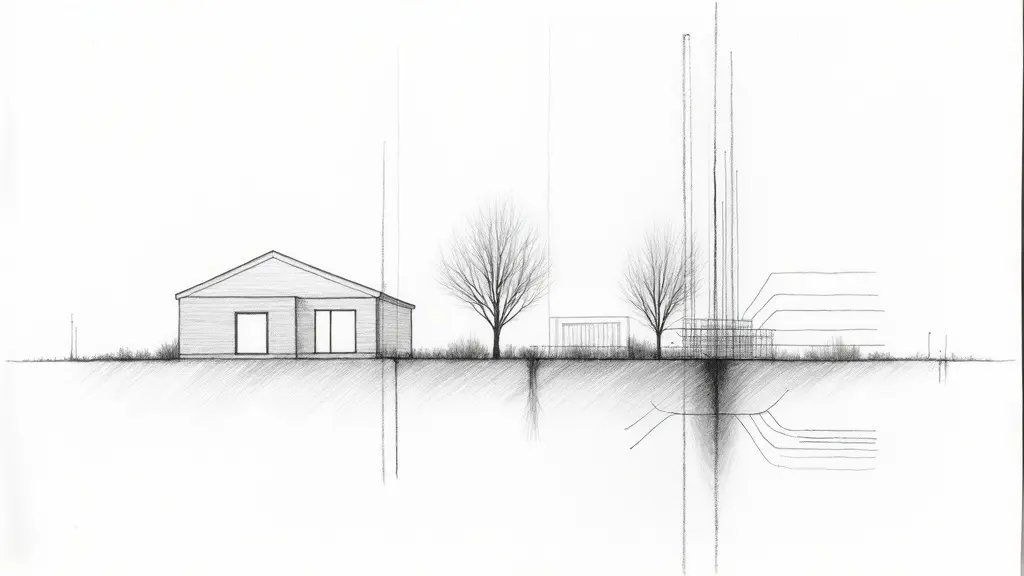
You live in Cannes, in the residential district of California or near Suquet. For a few months, a vertical crack has appeared in your basement wall. It is slowly widening. Looking outside, you see the roots of a large neighbor’s stone pine snaking up to your facade. 90% of disputes of this type on the French Riviera involve trees planted less than 3 meters from the property line. Your problem is classic, but its solution is not.
What You See — and What It Really Hides
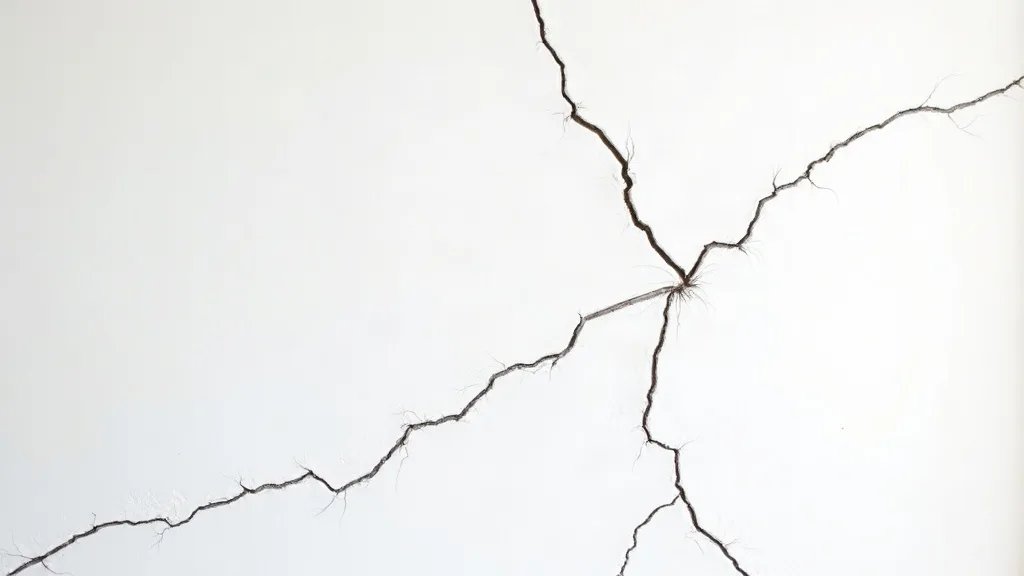
To the naked eye, you notice a stair-step crack in the concrete. The neighbor tells you his tree is 4 meters away, therefore harmless. But what no one says: an adult stone pine can spread its roots up to 15 meters. The real problem is not the distance, but the nature of the soil. In Cannes, soils are often clayey and expansive. Under the effect of water absorption by the roots, the clay shrinks, creating differential settlement of the foundations. I saw a case last year in Cannes-Mandelieu: a 1980 house whose crawl space had sunk 8 cm on the tree side.
What you also don’t see is the deep root system. It can run along wastewater pipes, deform them, and cause infiltrations that worsen soil movement. On the surface, everything seems normal. But underground, it’s a battle between roots and your foundations.
The Calculations That Change Everything: Eurocode 7 and Soil Reality
To determine if roots are truly the cause, we use Eurocode 7 (NF EN 1997-1). The key calculation is the allowable differential settlement: ΔL ≤ 0.002·L for a shallow foundation. Concretely, for a house 10 m long, the maximum differential settlement is 2 cm. Beyond that, cracks appear.
Take your case: the pine absorbs about 50 liters of water per day in summer. On a clay soil with a linear shrinkage index (IL) of 0.05, the vertical shrinkage is: Δh = IL · Δw · H, where Δw is the change in water content (0.15) and H the thickness of the active layer (2 m). So Δh = 0.05 × 0.15 × 2 = 0.015 m = 1.5 cm. This localized shrinkage under the foundation on the tree side creates a differential settlement of 1.5 cm over 5 m distance, i.e., a ratio of 0.003, exceeding the threshold of 0.002. Non-compliant with Eurocode 7. In practice, this means roots are the likely cause of the cracks.
What Happens If You Do Nothing: From Crack to Ruin
Within 6 months, the crack widens to 3 mm. Rainwater seeps in, rebar rusts. In 2 years, the wall can deform by 5 cm, and windows jam. At 5 years, repair costs exceed €20,000: underpinning, micropiles, drainage. Not to mention the depreciation of your property in Cannes, where the market is already tight.
Furthermore, roots continue to grow. They can clog your sewer pipes, causing backups. I saw a case in Cannes where ficus roots had pierced a PVC collector: €8,000 for repair. The longer you wait, the more damage spreads.
Recourse and Guarantees: What You Can Demand
Article 673 of the French Civil Code allows you to demand cutting of branches and roots that encroach on your property. But for roots, it’s more complex: you must prove damage. Eurocode 7, paragraph 2.4.5, requires foundations to be designed to resist vegetation effects. If the tree predates your house, the neighbor may argue you built with knowledge. The procedure: send a registered letter with return receipt to the neighbor, requesting tree removal and repair of disorders. If he refuses, call a judicial expert (like me) for a report. Then file a claim with the Grasse court. Average time is 6 months. You can also request an amicable expert appraisal with your legal protection insurance. Frankly, don’t delay: cracks don’t close on their own.
📅 Mis à jour le 11/08/2026 — Par Cassini Expertise, expert bâtiment indépendant 06 & 83. Devis gratuit : 04 22 46 06 04.
Questions fréquentes
Can tree roots damage house foundations?
Yes, tree roots can damage foundations, especially if the tree is close to the house. Roots can absorb moisture from the soil, causing it to shrink and the foundation to settle unevenly. In some cases, roots may also directly penetrate cracks or exert pressure on the foundation walls.
What to do if neighbor's tree roots are damaging my foundation?
First, document the damage with photos and consult a structural engineer to confirm the cause. Then, talk to your neighbor about the issue and propose solutions like root barriers or tree removal. If they refuse, you may need to check local laws, as you may be able to trim roots on your property, but you might be liable for damage to the tree.
Who is responsible for tree root damage to neighbor's property?
Generally, the tree owner is responsible for damage caused by their tree roots, but laws vary by location. In many places, you are allowed to trim roots that encroach on your property, but you must do so without harming the tree. If the tree is a protected species, you may need a permit. It's best to consult a lawyer or local authorities.
Cassini Expertise
Expert du bâtiment indépendant — Antibes (06·83·13·40)
📅 Mis à jour le 19/09/2026 — Cassini Expertise, expert bâtiment indépendant (06·83·13·40).