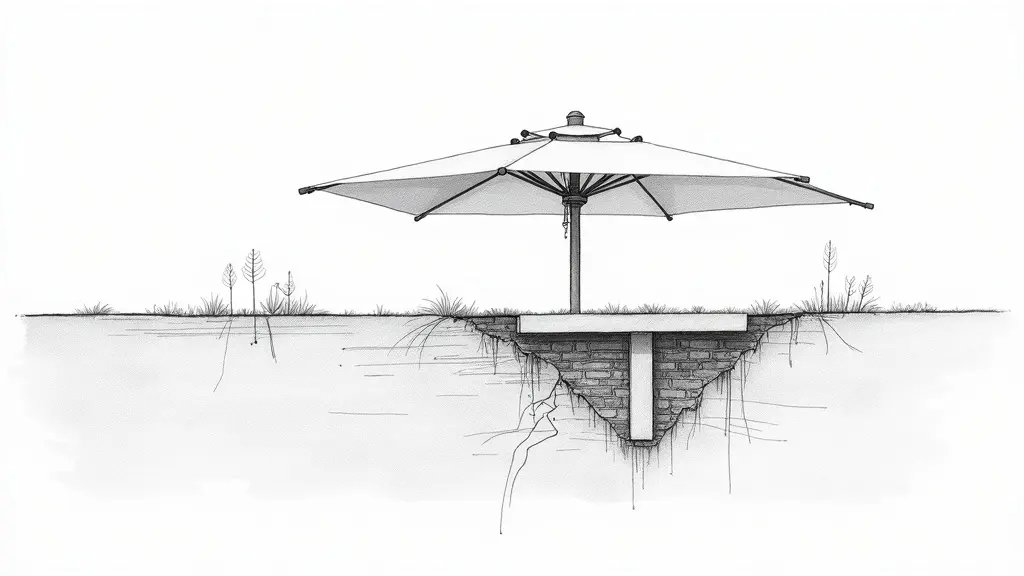
NEIGHBORHOOD — VEGETATION
You live in Cannes, in the Californie or Croix-des-Gardes district. For two years, an oblique crack has been running through your basement wall. It widens by 2 mm per year. Across the property line, a 12-meter stone pine planted 3 meters from the boundary. Your neighbor says it’s drought. But you’ve seen roots surfacing under your slab. You need an expert assessment to prove it.
What You See — and What It Really Hides
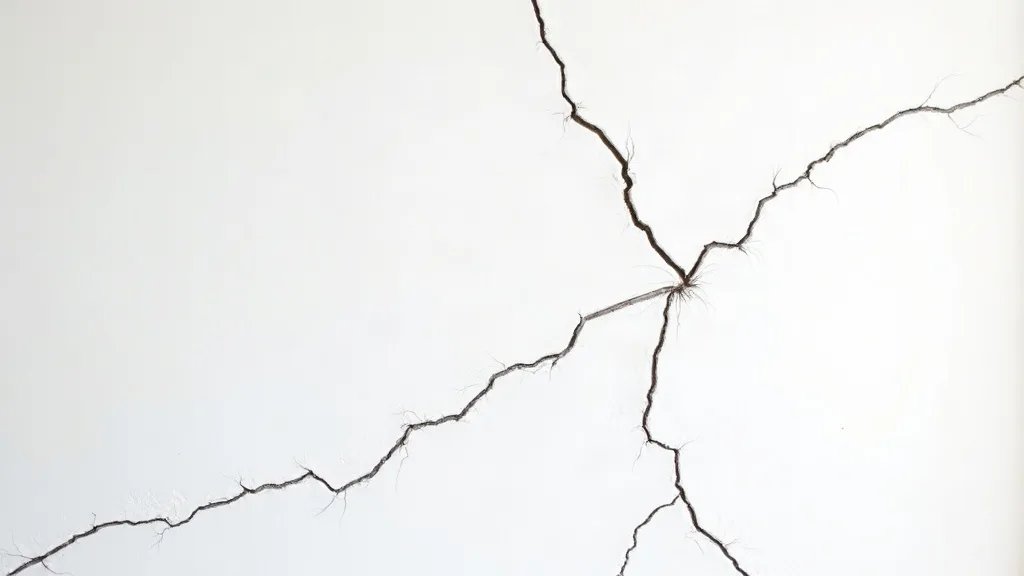
The visible symptom: a stepped crack in the foundation wall, wider at the bottom than at the top. The garage door no longer closes. But what you don’t see is the underground mechanism. The roots of an Aleppo pine can reach 6 meters deep and spread 15 meters. On swelling clay soil like in Cannes (BRGM medium hazard), they extract water, causing differential shrinkage. The shallow foundation (0.80 m) rests on plastic clay. The shrinkage creates non-uniform settlement.
What I often observe: homeowners measure the crack with a ruler and look at photos on Google Maps. But without a topographic survey and geotechnical analysis, you can’t distinguish clay shrinkage from root-induced settlement. Last year, in Cannes La Bocca, I measured a 4 cm settlement over 8 meters of facade. The owner blamed the tree, but it was a backfill compaction defect. The expertise saved the neighborly relationship.
The Calculation That Changes Everything: Differential Settlement and Stress
Eurocode 7 (NF P94-261) imposes a maximum differential settlement of 1/500 for shallow foundations on clay. For a span of 8 m between two support points, that gives 16 mm. Beyond that, the structure cracks. With a linear shrinkage of 2% in the clay (measured in the lab) and a root influence zone of 4 m radius, the calculated settlement is: Δh = ε·H = 0.02 × 4 m = 80 mm, i.e., 80 mm settlement at the tree, versus 10 mm on the opposite side. The difference: 70 mm, or 1/114, well above the threshold. Concretely, your wall experiences a tensile stress σ = E·ΔL/L ≈ 20 MPa (for C25/30 concrete), which exceeds the tensile strength of concrete (2.5 MPa). The crack is inevitable.
What Happens If You Do Nothing
In 6 months, the crack will widen to 5 mm. Moisture will penetrate, freeze in winter, swell. The reinforcement will start to rust. In 2 years, the ground floor slab will heave in places (clay swelling) and settle elsewhere. Doors and windows will jam. Repair cost: €15,000 to €30,000 for foundation reinforcement with micropiles. If you wait 5 years, the structure may be declared unfit for use. The property value will drop by 20%.
Frankly, I saw a case in Cannes where the owner waited 3 years. The roots had crossed the crawl space and blocked the drains. The insurance refused the claim because the damage was progressive. The neighbor had to cut down the tree and contribute 50% of the work, but after an 18-month procedure at the Grasse court.
Recourse and Guarantees: What You Can Demand
Article 673 of the French Civil Code allows you to force your neighbor to cut branches that overhang the boundary, but for roots, it’s more complex. Case law (Civ. 3e, June 15, 2017) admits that roots constitute an abnormal neighborhood disturbance if they cause damage. You must prove the causal link through an expert assessment. Eurocode 7 (paragraph 2.4.2) requires a geotechnical study for any project near trees. In practice, send a registered letter with acknowledgment of receipt to your neighbor with the expert report (geotechnical engineer + surveyor). If they refuse, petition the Grasse Judicial Court in summary proceedings. The judge will order a judicial expert assessment. The costs are advanced by the applicant but often charged to the losing party. What no one says: prior mediation can avoid 6 months of proceedings. I did it for two neighbors in central Cannes: the tree was pruned, roots cut, and a root barrier installed. Total cost: €3,000, shared.
📅 Mis à jour le 25/08/2026 — Par Cassini Expertise, expert bâtiment indépendant 06 & 83. Devis gratuit : 04 22 46 06 04.
Questions fréquentes
Can tree roots damage house foundations?
Yes, tree roots can damage foundations, especially in clay soils common in Cannes. Roots can extract moisture, causing soil shrinkage and foundation settlement, or they can physically grow into cracks and widen them. However, not all trees pose equal risk; species with aggressive roots like poplars or willows are more dangerous.
Who is responsible if a neighbor's tree damages my foundation in France?
Under French civil law (Article 1240), the neighbor is responsible for damage caused by their tree. You must notify them in writing and seek a mutual resolution. If they refuse, you can take legal action, but you must first prove the damage is directly caused by the roots, often requiring an expert assessment.
What can I do about a neighbor's tree roots damaging my property in Cannes?
Start by documenting the damage and sending a formal letter to your neighbor requesting action, such as root pruning or tree removal. If they do not cooperate, you can file a complaint with the mairie (town hall) or take civil court action. In urgent cases, you may prune roots yourself up to the property boundary, but you must avoid harming the tree's health.
Cassini Expertise
Expert du bâtiment indépendant — Antibes (06·83·13·40)
📅 Mis à jour le 19/09/2026 — Cassini Expertise, expert bâtiment indépendant (06·83·13·40).