PROPERTY — FRENCH RIVIERA
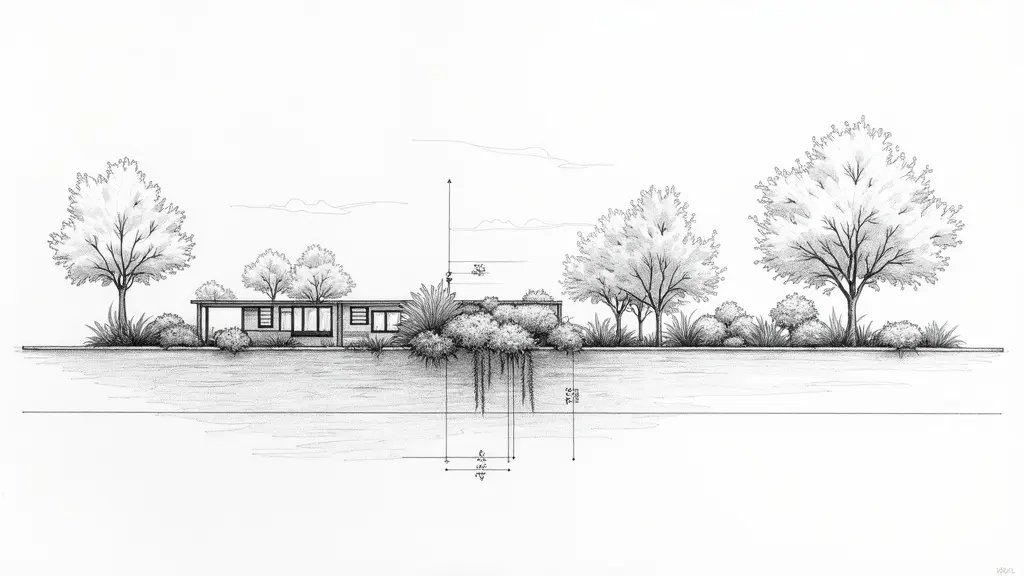
You have developed your sloping land in Grasse with a natural terrace retained by a retaining wall. Everything seemed perfect, until the day your neighbor informs you that the wall encroaches 15 cm onto their plot. You checked with a tape measure, looked at the cadastre on Géoportail (French online mapping service), but nothing is clear. What I often see: a discrepancy of 10 to 20 cm between the cadastral survey and the actual terrain, especially on the hills of Grasse.
What You See — and What It Really Hides
The wall seems well aligned on your property. But the neighbor brandishes a cadastral plan and a photo. The problem? Cadastral boundaries are not always reliable in hilly areas. On a case in Grasse last year, I measured an 18 cm difference between the cadastre and the actual topographic survey. The slope, settlement of clay soils, and old boundary marking errors create invisible discrepancies.
What no one says: the retaining wall alters the flow of rainwater. In Grasse, with intense Mediterranean rains, a 15 cm encroachment can be enough to destabilize the neighboring land. I have seen cases where water infiltrated under the wall, causing a landslide two years after construction.
The Calculations That Change Everything: Earth Pressure and Stability
To determine if the encroachment is tolerable, you must calculate the earth pressure on the wall. According to Eurocode 7 (section 9.5.2), the active thrust is: Pa = 0.5 × γ × H² × Ka, with γ = 20 kN/m³ (clay-limestone soil of Grasse), H = 2 m (wall height), Ka = 0.33 (active pressure coefficient for drained soil). So Pa = 0.5 × 20 × 4 × 0.33 = 13.2 kN per linear meter of wall. Your wall is 8 m long: total load = 105.6 kN. If the encroachment reduces the effective width of the wall by 15 cm, the stress on the soil under the foundation increases from 80 kPa to 95 kPa. The clay soil of Grasse has a bearing capacity of 100 kPa (BRGM data, French geological survey). It is within the limit, but in seismic zone 3 (moderate seismicity, Alpes-Maritimes), the seismic coefficient of 0.12 g increases the thrust by 12%, bringing the stress to 106 kPa. This exceeds the capacity. In practice, the wall could become unstable during a moderate earthquake.
What Happens If You Do Nothing
Within 6 months, cracks may appear in the wall, especially after an intense rainfall event. At 2 years, the wall may tilt 2 to 3 cm, worsening the encroachment. The cost of repairing a retaining wall in Grasse: between €800 and €1,200 per linear meter, i.e., €6,400 to €9,600 for 8 m. Not including expert and legal fees.
The neighbor can also sue you for violation of Article 545 of the French Civil Code (right of property). The Grasse court often rules in favor of the aggrieved owner, with demolition of the wall at your expense. I have seen a case where a 12 cm encroachment cost €15,000 in restoration.
Recourse and Guarantees: What You Can Demand
You must have a joint topographic survey carried out by a licensed surveyor (expert en urbanisme). Eurocode 7 (section 2.4.1) requires a stability check including seismic actions. If encroachment is confirmed, you can negotiate an easement for overhang or move the wall. Send a registered letter with acknowledgment of receipt (LRAR) to your neighbor, then refer the matter to the Grasse judicial court if no agreement is reached. A court-appointed expert (like me) can measure the encroachment with a Leica TS tacheometer with an accuracy of ±1 cm. Honestly, act quickly: inaction will cost you more.
📅 Mis à jour le 03/08/2026 — Par Cassini Expertise, expert bâtiment indépendant 06 & 83. Devis gratuit : 04 22 46 06 04.
Questions fréquentes
Mur de soutènement en limite de propriété : que dit la loi ?
En France, tout mur séparatif doit respecter les règles d'urbanisme locales (PLU). S'il est construit en limite, il doit être conforme au droit de la mitoyenneté (art. 653 du Code civil). En cas d'empiètement, le voisin peut exiger la démolition ou une indemnité.
Que faire si mon voisin construit un mur qui empiète sur mon terrain ?
Vous devez d'abord lui envoyer une mise en demeure écrite de cesser les travaux. Si aucun accord n'est trouvé, vous pouvez saisir le tribunal judiciaire pour faire constater l'empiètement et demander la démolition. Un géomètre peut établir un bornage pour préciser les limites.
Peut-on construire un mur de soutènement sans autorisation ?
Selon l'article R421-9 du Code de l'urbanisme, un mur de soutènement de plus de 2 mètres de hauteur nécessite une déclaration préalable. Au-delà de 2 mètres, un permis de construire est obligatoire. Vérifiez aussi le PLU de Grasse pour les règles locales.
Cassini Expertise
Expert du bâtiment indépendant — Antibes (06·83·13·40)
📅 Mis à jour le 19/09/2026 — Cassini Expertise, expert bâtiment indépendant (06·83·13·40).