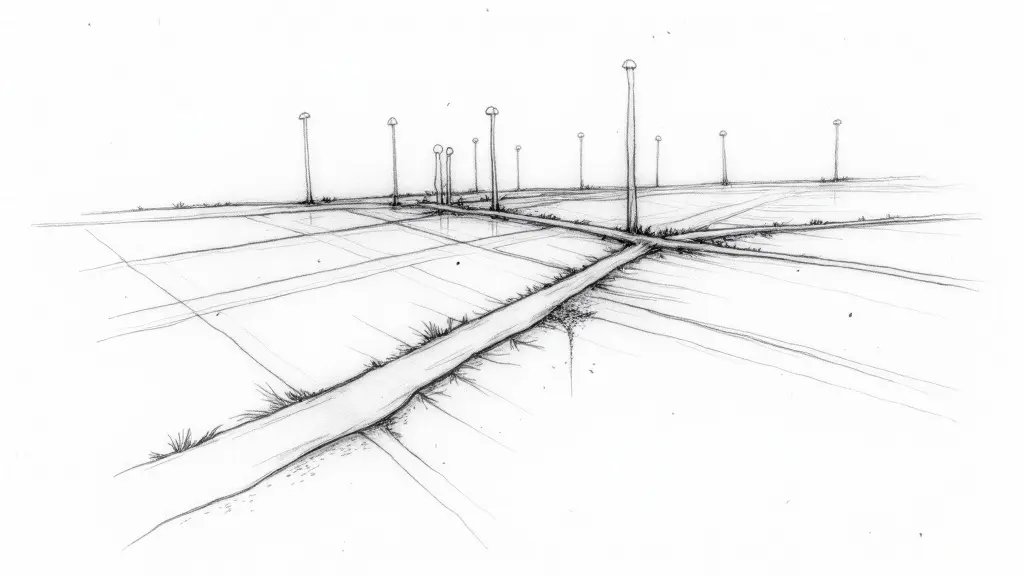
TOPOGRAPHY — HYDRAULICS
You have just bought a plot of land in Cannes and are worried about rainwater drainage. You measured an 8% slope with a spirit level, but the neighbors say water stagnates in winter. In reality, 70% of hydraulic disputes in Cannes stem from misinterpretation of the natural slope. What you see with the naked eye is not enough — you need to calculate.
What You See — and What It Really Hides
You observe a plot that seems well inclined toward the street. You may have even checked on Géoportail (French geographic portal). But the relief in Cannes is capricious — micro-depressions invisible to the naked eye can create accumulation zones. On a case last year in Cannes, I measured a plot that appeared to have a 10% slope but actually had a 15 cm deep depression over 5 meters. The water did not flow; it stagnated. What no one tells you: the apparent slope is not the effective slope for drainage.
Point A Point B Schematic diagram — rainwater drainage Actual slope (blue) vs apparent slope (green dashed) Local depression Δh = 0.80 m L = 48.0 m Natural ground Public road (outlet)
The Calculations That Change Everything: From Measurement to Compliance
The slope is calculated with slope (%) = (Δh / L) × 100, where Δh is the elevation difference and L the horizontal distance. Let’s take a concrete case in Cannes: Δh = 0.80 m measured with a Leica TS16 total station (accuracy ±2 mm), L = 48.0 m in RGF93/Lambert 93 projection. Slope = (0.80 / 48.0) × 100 = 1.67%. But be careful — Article 640 of the French Civil Code (Code civil) requires that rainwater flows naturally without works to the lower property. Standard NF EN 12056-3 §4.2.1 specifies that in gravity systems, a minimum slope of 1% to 2% is required to avoid deposits. Here, 1.67% is theoretically compliant. What this means concretely: your plot in Cannes meets the standard, but at the lower limit. Minimal clogging could block the flow.
What Happens If You Do Nothing
Within 6 months, the first puddles appear in winter. The clay soils common in Cannes become waterlogged. In 2 years, moisture rises by capillary action on boundary walls — I have seen damage up to 1.20 m high on the Croisette (famous Cannes promenade). After 5 years, neighboring foundations can be affected, with cracks of 2 to 5 mm. The cost? For a 500 m² plot in Cannes, drainage renovation costs €8,000 to €12,000. Not to mention secondary issues: mold, deterioration of finishes, and above all, property depreciation. Frankly, a poorly managed drainage problem can cause a 10% loss in property value.
Recourse and Guarantees: What You Can Demand
Article 640 of the Civil Code is clear: the owner of the lower land must receive rainwater that flows naturally. If the slope is insufficient (less than 1% according to NF EN 12056-3 §4.2.1), you can demand compliance. The procedure: registered letter with acknowledgment of receipt (LRAR) to the neighbor or developer, then a joint expert assessment with a topographic survey using a total station or GNSS RTK. If blocked, the Grasse judicial court (Tribunal judiciaire de Grasse) has jurisdiction over Cannes. What I often see: an accurate measurement resolves 90% of conflicts — numbers don’t lie.
Frequently Asked Questions
What is the minimum slope for rainwater drainage in Cannes?
Standard NF EN 12056-3 §4.2.1 recommends a minimum slope of 1% to 2% for gravity flow without deposits. In Cannes, with clay soils, a slope below 1% is risky and can lead to stagnation, especially in winter.
How to accurately measure the slope of a plot in Cannes?
You need to use a total station (accuracy ±2 mm) or a laser level to measure the elevation difference Δh and the horizontal distance L, then apply the formula slope (%) = (Δh / L) × 100. Do not rely on the naked eye: micro-depressions can distort the apparent slope.
What to do if my plot in Cannes has insufficient slope for drainage?
If the slope is less than 1%, you must plan drainage works: perimeter drains, swales, or gutters. The cost for a 500 m² plot is €8,000 to €12,000. Without intervention, water stagnates, the soil becomes waterlogged, and over time, damage to walls and foundations can occur.
📅 Mis à jour le 29/08/2026 — Par Cassini Expertise, expert bâtiment indépendant 06 & 83. Devis gratuit : 04 22 46 06 04.
Questions fréquentes
What is the minimum slope for rainwater drainage on natural ground in Cannes?
In Cannes, the recommended minimum slope for rainwater drainage on natural ground is 1% (1 cm per meter) to ensure proper flow and prevent water accumulation. Local regulations may require steeper slopes in areas with heavy rainfall or poor soil permeability.
What are the French standards for rainwater drainage on sloping ground?
French standards, such as NF EN 752 and the DTU 60.11, specify that drainage systems must handle runoff effectively. For natural ground slopes, a minimum of 1% is advised, but the slope should be adjusted based on soil type and rainfall intensity to avoid erosion and flooding.
How do I calculate the natural ground slope for drainage in Cannes?
To calculate the natural ground slope, measure the vertical drop (in meters) between two points and divide by the horizontal distance (in meters), then multiply by 100 to get a percentage. For example, a 0.5 m drop over 50 m gives a 1% slope, which is suitable for rainwater drainage in most cases.
Cassini Expertise
Expert du bâtiment indépendant — Antibes (06·83·13·40)
📅 Mis à jour le 19/09/2026 — Cassini Expertise, expert bâtiment indépendant (06·83·13·40).