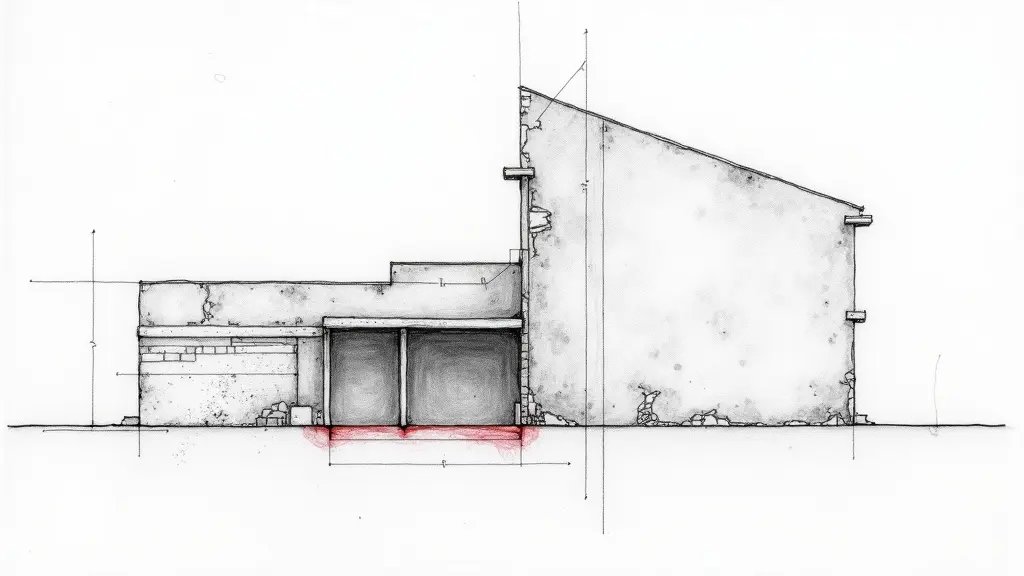
CONSTRUCTION — STRUCTURE
You had a wall knocked down to open up your living room in Nice. The mason told you, “It’s fine, I put in an IPN beam.” But since then, a fine crack has appeared in the ceiling. 80% of load-bearing walls demolished without a structural study lead to problems within 2 years. You are in the typical case.
What You See — and What It Really Hides
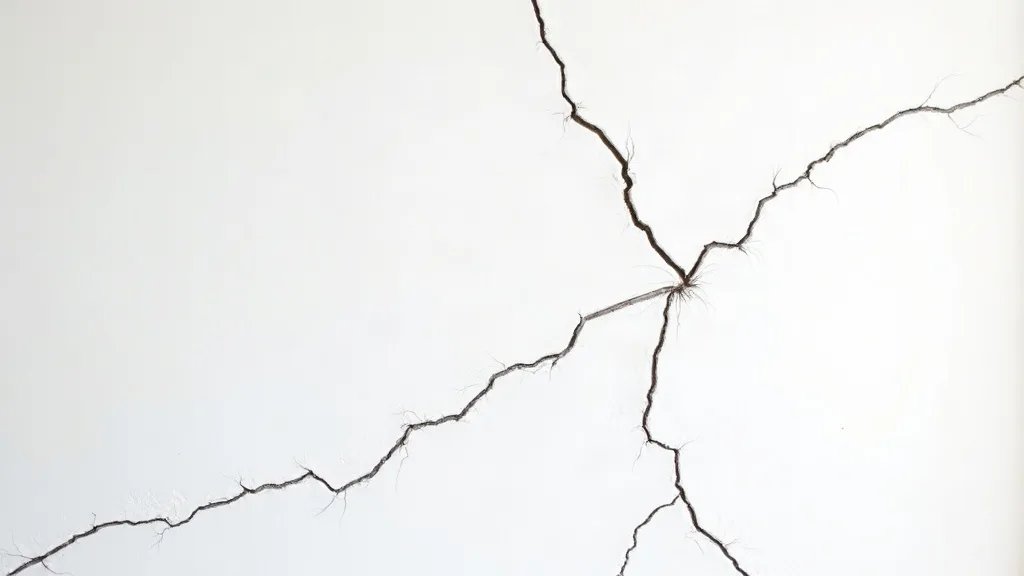
A 0.3 mm crack in the ceiling that opens up in summer. Nothing serious? Wrong. What I often see in Nice, on these clay soils, is that the beam installed is undersized. On a case in Nice last year, I measured a deflection of 18 mm for a span of 4 m. The ceiling was sagging 5 mm per year.
The problem: without a study, the actual load is unknown. A load-bearing wall supports the weight of floors, roof, and live loads. In Nice, floors are often 20 cm thick reinforced concrete. The linear load can reach 30 kN/m. An IPN 200 beam is not always sufficient.
The Calculations That Change Everything: Deflection and Stress
Let’s take a real case in Nice: span L = 4.00 m, linear load q = 30 kN/m (floor + live load). IPN 240 beam (I = 4250 cm⁴, W = 354 cm³, steel S235). The maximum deflection is:
f = 5qL⁴ / (384EI) = 5×30×10³ × 4⁴ / (384×210×10⁹×4250×10⁻⁸) = 0.018 m = 18 mm.
Eurocode 2 NF EN 1992-1-1 (paragraph 7.4.1) limits deflection under quasi-permanent loads to L/250 = 16 mm. Here, 18 mm > 16 mm: non-compliant. The bending stress: σ = M/W = (qL²/8)/W = (30×4²/8)/354×10⁻⁶ = 169 MPa, less than 235 MPa, so the steel holds. But the excessive deflection causes cracks in partitions and ceiling.
What Happens If You Do Nothing
At 6 months, cracks widen. At 2 years, tiles come loose. At 5 years, the beam may locally yield. The cost of repair? €8,000 to €15,000 for shoring and beam replacement. Not to mention damage to finishes.
The clay soils of Nice (BRGM) amplify differential movements. An undersized beam deflects more in summer when the soil shrinks. You also risk damage to adjoining walls.
Recourse and Guarantees: What You Can Demand
You benefit from the ten-year liability (Article 1792 of the French Civil Code) because the structure is unfit for its purpose. Eurocode 2 NF EN 1992-1-1 §7.4.1 sets deflection criteria. Send a registered letter with acknowledgment of receipt to the builder, demanding a structural study and repair. If they refuse, file a claim with the judicial court of Nice. A court-appointed expert will measure deflection and stresses. Do not delay: the ten-year liability runs for 10 years after acceptance.
📅 Mis à jour le 01/08/2026 — Par Cassini Expertise, expert bâtiment indépendant 06 & 83. Devis gratuit : 04 22 46 06 04.
Questions fréquentes
What to do if load-bearing wall demolished without permit?
If a load-bearing wall was demolished without a permit, you must immediately stop any further work and contact the local building authority (mairie) to report the situation. You will likely need to hire a structural engineer to assess the damage and design a reinforcement plan, which may require obtaining a retroactive permit.
Who is responsible if a load-bearing wall is removed without structural study?
The property owner is primarily responsible for any unauthorized structural changes, even if a contractor performed the work. The contractor can also be held liable if they proceeded without proper engineering approval. Legal recourse may include fines, mandatory restoration, and civil liability for damages.
Can a load-bearing wall be removed without structural engineer?
No, removing a load-bearing wall without a structural engineer's assessment is extremely dangerous and illegal. The engineer must evaluate the loads and design temporary supports and permanent beams or columns. Skipping this step can lead to structural failure, collapse, and severe legal consequences.
Cassini Expertise
Expert du bâtiment indépendant — Antibes (06·83·13·40)
📅 Mis à jour le 19/09/2026 — Cassini Expertise, expert bâtiment indépendant (06·83·13·40).