GEOLOGY — FRENCH RIVIERA
You live in Nice, in the hills. After the October Mediterranean episode, you noticed your garden deforming. A crack in the retaining wall, a tree leaning a bit more. In two days, the ground slipped 15 cm. You wonder: will it continue? Should you evacuate?
What You See — and What It Really Hides
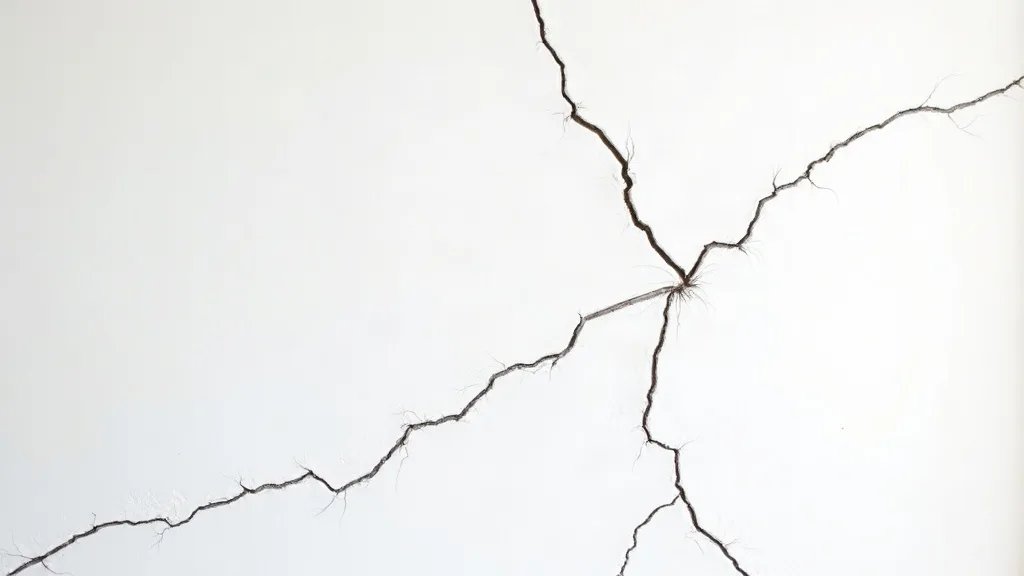
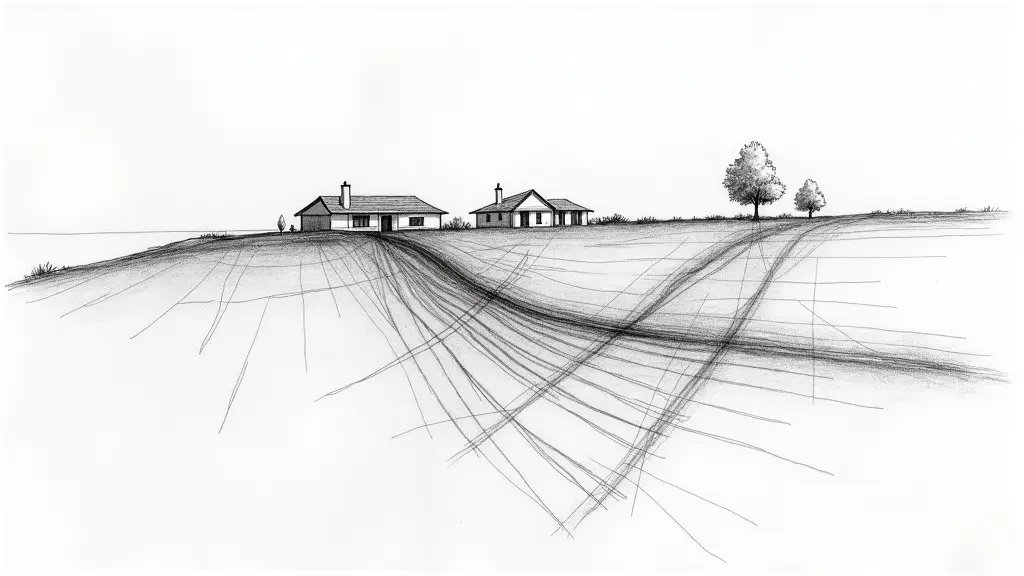
The most obvious sign is the arc-shaped crack in the soil at the foot of the slope. But what you don’t see is the deep slip plane, often 2-3 meters below the surface. On a case in Nice last year, I measured a slip of 22 cm in one night, even though the slope was only 12%. What nobody tells you: the swelling clays of the Alpes-Maritimes, when saturated, lose 80% of their cohesion. The underlying karstic limestone acts like a slide.
The real problem is that movement is never uniform. The top of the slope pulls, the bottom pushes. Trees tilt, walls deform. And you watch your property lose value.
The Calculations That Change Everything — Stability per Eurocode 7
To know if your ground will continue to slide, we use the factor of safety Fs = (shear strength) / (shear stress). According to Eurocode 7 (section 2.4.7.3), an Fs below 1.3 is unacceptable. In practice, for a 15% slope in Nice with sandy clays (cohesion c’ = 5 kPa, friction angle φ’ = 25°), the calculation gives: total stress σ = γ·h·cos²β = 20 kN/m³ × 4 m × cos²(8.5°) ≈ 78 kPa. Shear stress τ = γ·h·sinβ·cosβ = 20 × 4 × sin(8.5°) × cos(8.5°) ≈ 11.7 kPa. Shear strength τ_r = c’ + σ·tanφ’ = 5 + 78 × tan(25°) ≈ 41.4 kPa. Fs = 41.4 / 11.7 ≈ 3.5. Seemingly stable. But if water saturates the soil, cohesion drops to 0 and unit weight increases to 22 kN/m³. Then τ = 22 × 4 × sin(8.5°) × cos(8.5°) ≈ 12.9 kPa, and τ_r = 0 + (78 – 10×4)×tan(25°) ≈ 31.8 kPa (since pore water pressure u = 10×4 = 40 kPa). Fs = 31.8 / 12.9 ≈ 2.5. Still stable? No, because the slip plane may be deeper. If h = 6 m, τ = 19.3 kPa, τ_r = 0 + (78 – 60)×tan(25°) ≈ 8.4 kPa → Fs = 0.44. Catastrophe.
What this means concretely: under the effect of Mediterranean rains, a 2 m thick clay layer can become a lubricant. The calculation shows that an apparently stable slope can fail if the water table rises. The PPRI Var Alpes-Maritimes (article 3.2) — the French flood risk prevention plan for the Var and Alpes-Maritimes regions — classifies these areas as high hazard. In Nice, the PLU (Local Urban Plan) prohibits any new construction on slopes >20% without a geotechnical study.
What Happens If You Do Nothing — Accelerated Degradation
Within 6 months, the crack widens. Rainwater infiltrates, increasing the slip. At 2 years, the retaining wall may collapse. Replacement cost: €15,000 to €30,000. At 5 years, the house itself may crack. Shallow foundations undergo differential settlement. Structural repairs for landslide-induced settlement can be substantial. Underpinning work, when required, typically involves costs ranging from €50,000 to €150,000 depending on the foundation depth and soil conditions.
And that’s not all. The ground can create a drainage easement for the downhill neighbor, leading to legal recourse. Not to mention property depreciation: unstable land loses 30-50% of its value.
Recourse and Guarantees: What You Can Demand
If the slip is due to a drainage or retaining defect during construction, the ten-year liability (article 1792 of the French Civil Code) may apply. You must send a registered letter with acknowledgment of receipt to the builder, then call in an expert. The Nice court has jurisdiction. Eurocode 7 (section 2.4.2) requires a geotechnical study for any construction on a slope. If it wasn’t done, the developer is at fault. The PPRI Var Alpes-Maritimes establishes requirements for protective measures such as ditches and drains on existing buildings in designated hazard zones. An expert assessment can determine whether your property is subject to these requirements and what remedial work is necessary. Early intervention is critical to prevent further property damage and ensure compliance with local regulations.
📅 Mis à jour le 27/07/2026 — Par Cassini Expertise, expert bâtiment indépendant 06 & 83. Devis gratuit : 04 22 46 06 04.
Questions fréquentes
What causes landslides after heavy rain in Nice?
Heavy Mediterranean rains saturate the soil, increasing pore water pressure and reducing shear strength. This can trigger landslides on slopes, especially where the ground is already unstable or altered by human activity.
How are landslide risks assessed in Nice?
Engineers use geological surveys, slope stability analysis, and hydrological models to evaluate risks. They calculate factors of safety considering soil properties, slope geometry, and water infiltration to predict potential failure zones.
What measures can prevent landslides in Nice?
Preventive measures include proper drainage systems to control water runoff, retaining walls, slope reinforcement, and vegetation planting. Regular monitoring and early warning systems also help mitigate risks.
Cassini Expertise
Expert du bâtiment indépendant — Antibes (06·83·13·40)
📅 Mis à jour le 19/09/2026 — Cassini Expertise, expert bâtiment indépendant (06·83·13·40).