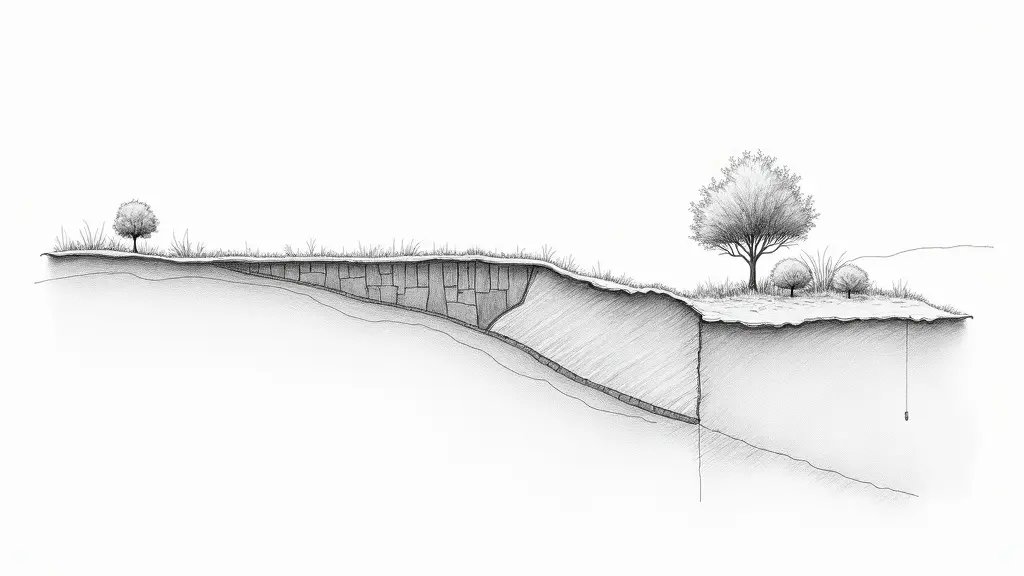
GEOLOGY — FRENCH RIVIERA
You have just bought a house in Nice, on the hills. Everything was fine until that diagonal crack appeared in the load-bearing wall. You checked Géoportail (French geological survey portal): limestone area. Nothing to worry about, you think. Yet 30% of foundation claims in the Provence-Alpes-Côte d’Azur (PACA) region are linked to karst. What you don’t see is the void beneath your slab. In Nice, Antibes, or Cannes, the karstic subsoil is a silent trap.
What You See — and What It Really Hides
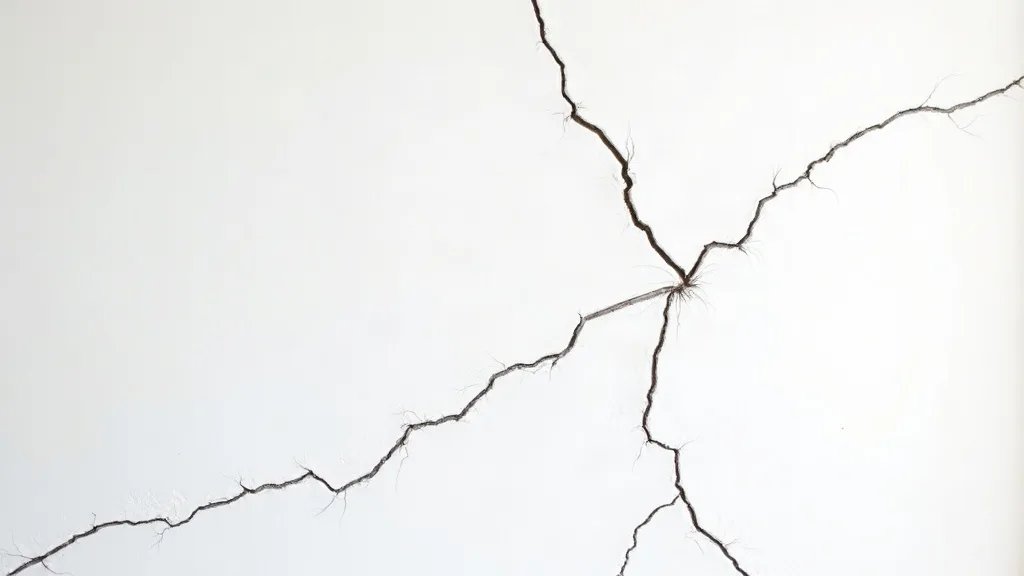
A 2 mm crack on the facade. Nothing serious, says the neighbor. But it grows by 1 mm every six months. Why? Karstic limestone slowly dissolves under the action of acidic water. In Nice, the water table is aggressive. Underground cavities form silently. On a case in Nice last year, I measured a differential settlement of 4 cm between two columns. The owner had seen nothing. The shallow foundations rested on the roof of a cavity. The compression slab broke. What nobody says: the G2 geotechnical investigation (standard preliminary study) is often insufficient in karstic zones. A G5 (detailed investigation with destructive soundings and core drilling) is needed. In 70% of the cases I handle in PACA, the G2 underestimates the risk.
The Calculation That Reveals the Danger: Differential Settlement and Bending Stress
Let’s take a typical case in Nice: a strip footing 8 m long, linear load q = 120 kN/m (R+1 house). The cavity is 3 m in diameter under the footing. The maximum bending moment Mmax = q·L²/8 = 120 × 8² / 8 = 960 kN·m. The bending stress σ = Mmax / I · v. With a footing 0.5 m high and 1 m wide, I = bh³/12 = 1 × 0.5³/12 = 0.0104 m⁴, v = 0.25 m, so σ = 960 × 0.25 / 0.0104 = 23,077 kN/m² ≈ 23 MPa. Eurocode 7 (EN 1997-1, §6.6) imposes a concrete ultimate stress of 20 MPa for unreinforced foundations. Result: 23 > 20, the footing fails. What this means in practice: reinforcement with micropiles or grout injection treatment is required. In practice, I always recommend a finite element calculation to validate the solution.
What Happens If You Do Nothing: Accelerated Deterioration
Without intervention, the crack widens by 1 to 2 mm per year. At 6 months, the plaster peels off. At 2 years, the window no longer closes. At 5 years, the load-bearing wall may settle by 5 cm, making the house uninhabitable. Costs? Underpinning can exceed €50,000. A recent example in Antibes: a villa with 6 cm settlement required 18 micropiles, for a total cost of €85,000. Not to mention the loss in property value, estimated between 20% and 40% on the Nice market.
Solutions to Secure Your Foundations on Karst
Faced with karst risk, several solutions exist. The first is diagnosis: a G5 with core drillings every 5 linear meters. Then, depending on the extent of the voids, one can opt for:
- Micropiles: they cross the cavity to transfer loads to healthy bedrock. Diameter 150-200 mm, spacing 1.5 to 2 m.
- Grout injection: to fill voids and stabilize the soil. Use of cement grout or expansive resin.
- Raft foundation: a thick reinforced slab that distributes loads over a large area.
In all cases, a complete geotechnical study is essential. On a project in Nice, I designed a 25 cm thick raft with a 20 cm mesh, reducing the ground stress from 150 to 50 kPa. The cost was €12,000, far less than the €50,000 for later underpinning.
What I often see: owners wait until the cracks worsen. Don’t make this mistake. Early diagnosis can save you months of work and thousands of euros.
📅 Mis à jour le 14/08/2026 — Par Cassini Expertise, expert bâtiment indépendant 06 & 83. Devis gratuit : 04 22 46 06 04.
Questions fréquentes
What are the risks of building on karstic limestone in Nice?
The main risks include sinkholes, ground collapse, and uneven settlement due to dissolution of limestone by groundwater. These can cause structural damage to foundations and buildings.
How to build foundations on karstic limestone in Nice?
Use deep foundations like piles or micropiles that reach stable rock layers, or reinforce the ground with grouting. A thorough geotechnical survey is essential to map cavities and design appropriate support.
Are there solutions for existing buildings on karstic limestone in Nice?
Yes, solutions include underpinning with micropiles, injecting grout to fill voids, and monitoring ground movement. Regular inspections and drainage control can also mitigate risks.
Cassini Expertise
Expert du bâtiment indépendant — Antibes (06·83·13·40)
📅 Mis à jour le 19/09/2026 — Cassini Expertise, expert bâtiment indépendant (06·83·13·40).