CONSTRUCTION — DEFECT
You have just noticed cracks on the render of your house in Antibes. You may have measured them with a tape measure, noted their direction on a sketch. That is a normal reflex. But what you do not know is that 70% of homeowners who do this misjudge the actual severity of the disorder. Crack classification is not just about measured width: a proper expert analysis looks at the whole system. And that is where everything is decided.
What You See — and What It Really Hides
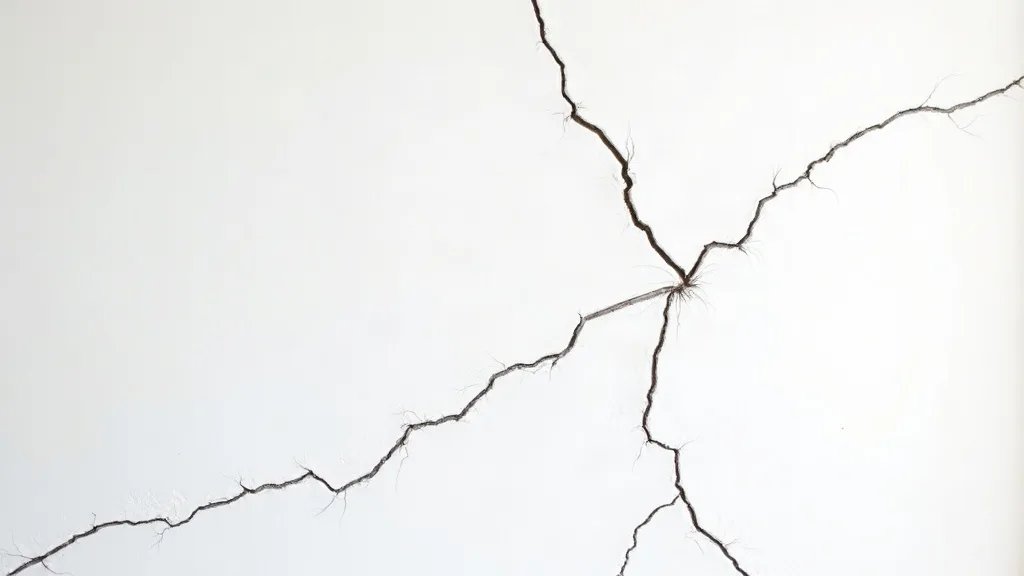
You see lines on the plaster. Some are thin, others wider, sometimes stepped along joints. You wonder if it is aesthetic or structural.
What I often observe on villas in Antibes is confusion between micro-cracks from render shrinkage and active cracks related to substrate movement. The difference? The former is often superficial and stable. The latter evolves. It sometimes indicates differential soil settlement, common on the slopes of Garoupe or Cap, or excessive structural loading. On a case last year in Antibes, a client saw three isolated cracks. The mapping revealed a connected network of 12 cracks forming a 45° angle, a classic signature of shear in a partition wall. What you take for separate defects is often a coded message from the building.
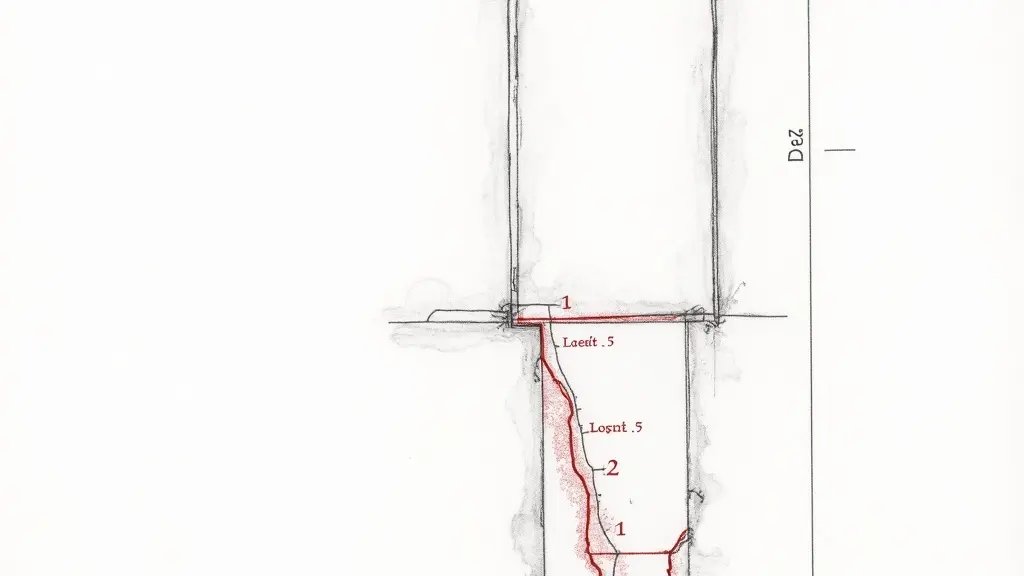
FACADE RENDER Crack F1 Crack F2 Crack F3 L = 100 cm Δh = 70 cm Δh = 70 cm Point A Point B Point C Point D Point E Point F Schematic diagram: Mapping of a crack network (schematic facade view) Arrows and dimensions allow calculation of crack slope and orientation for crack classification.
The Mechanics of a Crack: Calculating Its Evolutionary Potential
A proper expert analysis never classifies a crack by width alone. It factors in orientation, slope, and context. Take the concrete example of crack F1 in the diagram. It goes from point A (80,100) to point B (180,180). Its projected length L is 100 cm. Its height difference Δh is 80 cm. Its slope p is calculated: p = (Δh / L) × 100 = (80 / 100) × 100 = 80%. This is a steep slope of 80%. According to the standard, a crack with a slope greater than 45% and an oblique orientation relative to structural joints (as here) is suspected of mechanical activity.
In practice, what does that mean? Suppose this crack is on a 20 cm thick concrete block wall in Antibes. If we measure an average opening w of 1.2 mm, we can estimate the potential angular rotation θ of the cracked element. Simplifying for a through crack: θ ≈ w / (L/2) = 1.2 mm / 500 mm = 0.0024 rad. That is about 0.14°. It seems small. But if this rotation occurs on a load-bearing wall, it induces additional shear stress. For a Young’s modulus of concrete E = 30 GPa and a wall height of 2.5 m, the additional stress σ can be estimated as σ ≈ E * θ * (h/L) = 30e9 * 0.0024 * (2.5/1) ≈ 180 kPa. Compare this to the typical shear strength of a concrete block wall (about 500-800 kPa). We are in an alert zone, not immediate failure, but the safety margin is reduced. What this means concretely: this crack, likely classified as category 2 (evolving crack requiring monitoring) under common expert practice, is not just a waterproofing issue. It is a symptom of potential structural disorder.
Consequences at 2 Years and 5 Years If You Do Nothing
Within 6 to 12 months, rainwater, sometimes laden with the salty sea spray typical of the Antibes coastline, infiltrates. The render detaches locally. Damp patches appear inside.
At 2 years, without intervention, the freeze-thaw cycle (even moderate in Antibes) acts. Water in the crack freezes and expands, widening it. The crack becomes more visible, and the render may bulge or fall off in places. The substrate (concrete blocks) may start to degrade due to moisture.
At 5 years, if the crack is active and structural, the wall may undergo differential movement. In the worst case, the crack can propagate through the entire wall thickness, leading to loss of load-bearing capacity. For a non-structural crack, the aesthetic damage becomes severe, and repair costs multiply (e.g., complete re-rendering instead of local repair).
What to Do: The Right Approach
The standard recommends a three-step approach: diagnosis, monitoring, and repair.
Diagnosis: A qualified expert (e.g., a structural engineer or a building pathology specialist) must map all cracks, measure their width, length, orientation, and slope, and assess the context (soil type, foundation, wall type). This is the only way to classify the crack correctly.
Monitoring: For cracks classified as category 2 or higher, periodic monitoring (e.g., every 6 months) with crack gauges or simple tell-tales is essential to detect evolution.
Repair: Depending on the classification, repair may range from simple sealing (for stable micro-cracks) to structural reinforcement (for active, wide cracks). In Antibes, due to the coastal environment, repairs must also consider salt resistance and waterproofing.
Do not wait. A crack is a message. Decode it before it becomes a structural problem.
📅 Mis à jour le 20/07/2026 — Par Cassini Expertise, expert bâtiment indépendant 06 & 83. Devis gratuit : 04 22 46 06 04.
Questions fréquentes
Quelles sont les causes des fissures de façade à Antibes ?
Les fissures de façade à Antibes sont souvent dues aux mouvements du sol argileux, aux variations thermiques et à l'humidité. Le retrait-gonflement des sols argileux est particulièrement fréquent dans cette région, surtout après des périodes de sécheresse puis de fortes pluies. Une mauvaise conception des fondations ou des défauts d'étanchéité peuvent aussi aggraver le phénomène.
Comment classer les fissures selon la norme XP P95-100 (fiches de désordres des façades) ?
La classification usuelle distingue les fissures en fonction de leur largeur, profondeur et évolution. On distingue les fissures fines (moins de 0,2 mm), moyennes (0,2 à 2 mm) et larges (plus de 2 mm). Elle définit aussi des critères de stabilité et de gravité pour orienter les réparations.
Quand faut-il faire appel à un expert pour des fissures de façade à Antibes ?
Il est conseillé de consulter un expert si les fissures dépassent 2 mm de largeur, si elles s'agrandissent rapidement ou s'accompagnent de déformations. Une fissure en escalier ou traversant la façade indique souvent un problème structurel. Un diagnostic précoce permet d'éviter des réparations coûteuses et sécurise le bâtiment.
Cassini Expertise
Expert du bâtiment indépendant — Antibes (06·83·13·40)
📅 Mis à jour le 19/09/2026 — Cassini Expertise, expert bâtiment indépendant (06·83·13·40).