PROPERTY — EASEMENT
You have just discovered a concrete manhole at the bottom of your garden in Cannes, or traces of work on your land. While digging to plant a tree, your shovel hit a pipe. It is not yours. 85% of property owners affected by a network passage easement are unaware of it until the first incident. Honestly, you wonder if you still have full rights over your plot.
What You See — and What It Really Hides
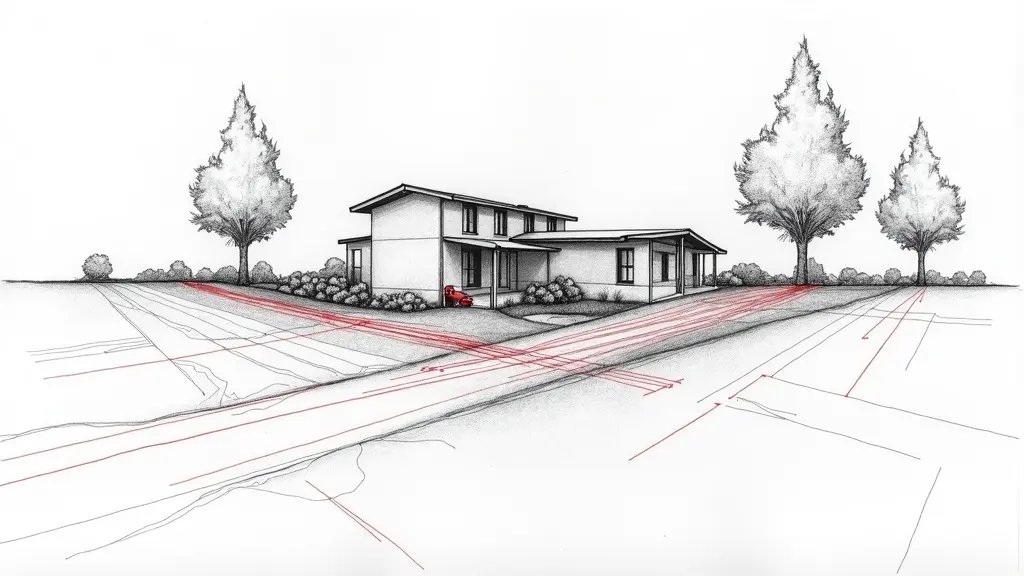
A manhole, a marker, a trapdoor. Sometimes, nothing visible on the surface. What no one says: the essential happens underground. In a case last year in Cannes, near La Croisette, the owner measured 15 meters between the manhole and his boundary with a simple ruler. He thought the pipe ran along the fence. In reality, with a topographic survey using a Leica TS16 total station (accuracy ±2 mm), we found that the pipeline crossed his land diagonally for 22 meters, passing less than 3 meters from his house. The width of the passage on the surface says nothing about the actual depth or the exact alignment in RGF93/Lambert 93 planimetry.
Ground surface (owner’s plot) Boundary line (fence) Pipeline in service (Ø 300 mm) Depth: 1.2 m Depth: 0.8 m Manhole Easement width: 2.0 m Conflict point (future construction)
The Load Capacity Calculation That Changes Everything
Standard NF EN 1610 (paragraph 6.3.2) imposes a maximum stress on the pipeline. For a buried PVC pipe Ø 300 mm, the formula for allowable load is σ = F/A. Let’s take a concrete case in Cannes: a construction vehicle of 8 tons (F = 78,500 N) could drive on the surface. The contact area of a wheel is about 0.05 m². σ = 78,500 / 0.05 = 1,570,000 Pa (1.57 MPa). The compressive strength of PVC is 40 MPa. The minimum safety factor is 2.0. 40 / 2 = 20 MPa allowable. Here, 1.57 MPa < 20 MPa: theoretically, the pipe can withstand it. But this calculation assumes a compliant burial depth (min. 0.8 m per NF EN 1610 §7.2.1) and good compaction of the backfill. What I often observe: in Cannes, with sandy soils, differential settlement changes everything. If the actual depth is only 0.6 m, the dynamic load transmitted to the ground can multiply the stress by 1.5. Result: 2.36 MPa, still within tolerance, but the margin narrows dangerously. Concretely, repeated truck traffic could damage the network in the medium term.
What Happens If You Do Nothing
Within 6 months, perhaps nothing. Then localized lawn depressions appear along the invisible path. In Cannes, with intense Mediterranean rains, water infiltrates the voids created by settlement. In 2 years, the risk of pipeline rupture increases by 30%. The secondary pathology? Flooding of your basement if the network is a stormwater collector. Costs: for a simple topographic check and report, expect €800 to €1,200. For repairing a pipeline damaged by your work, the bill can reach €5,000, not including land restoration costs. And if it’s a public network, the local authority may claim damages.
In the long term, 5 years, your property value may be affected. An imprecisely defined easement creates land uncertainty. Upon resale, the buyer will demand a price reduction or regularization at your expense. I saw a deal fall through in Cannes over a dispute about 50 cm of uncertain right-of-way.
Recourse and Guarantees: What You Can Demand
Article 686 of the French Civil Code (Code civil) establishes the easement. You can demand that the beneficiary (the municipality, a syndicate, a neighbor) prove the legal existence of the easement by a title. If it exists, demand a precise contradictory boundary survey (bornage contradictoire) with a surveyor (expert en urbanisme) to materialize the ground footprint (width of passage) and the depth envelope. NF EN 1610 is your ally: its §4.1 requires that pipelines be constructed so as not to harm existing or future constructions. If a pool or extension project in Cannes is compromised by this pipe, it is a major technical argument. The procedure: send a registered letter with acknowledgment of receipt (LRAR) to the beneficiary requesting plans and a condition report. In case of refusal or unsatisfactory response, refer the matter to the Grasse judicial court (tribunal judiciaire de Grasse), with a prior judicial expert assessment. Do not wait for an accident.
Frequently Asked Questions
How can I tell if a pipeline crosses my land without visible signs?
You can request a topographic survey from a surveyor (expert en urbanisme) to detect buried networks. Also, check the land registry (cadastre) for easement notations. Contact the local municipality or network operators for existing plans.
What are my rights if a pipeline easement prevents me from building?
You can request relocation of the pipeline if technically feasible, or claim compensation for the loss of use. The beneficiary must prove the easement’s legality. Consult a lawyer specializing in property law.
Who is responsible for damage caused by a pipeline on my land?
The beneficiary (e.g., municipality, utility company) is responsible for maintenance and damage caused by the network. If your actions damage the pipeline, you may be liable. Always document the condition before any work.
📅 Mis à jour le 08/08/2026 — Par Cassini Expertise, expert bâtiment indépendant 06 & 83. Devis gratuit : 04 22 46 06 04.
Questions fréquentes
What is an underground pipeline easement in Cannes?
An underground pipeline easement in Cannes is a legal right granted to a utility company to install and maintain pipelines beneath your property. It restricts certain activities like deep excavation or building structures over the easement area to ensure safe access for repairs.
Can I build a fence or shed over a pipeline easement in Cannes?
Generally, no. You must keep the easement clear of permanent structures that could hinder pipeline access. Light, removable items like a small fence post might be allowed, but you need written approval from the network operator and must comply with local regulations.
What are my rights if a pipeline crosses my property in Cannes?
You retain ownership of the land, but the easement gives the utility company rights to access and maintain the pipeline. You have the right to fair compensation for the easement and to be notified before any entry, but you cannot obstruct their work or violate easement terms.