NEIGHBORHOOD — WATER
You come home after a storm in Grasse and find 15 cm of muddy water in your lower garden. Your neighbor, whose land is higher, redeveloped his property last year. Since then, every rain turns your garden into a basin. You measured the ditch he dug: 80 cm wide. But is it enough to drain the water? The answer lies in a calculation few homeowners know: the Manning-Strickler formula.
What You See — and What It Really Hides
You see stagnant water. You suspect the neighbor. What no one says: Article 640 of the French Civil Code prohibits altering the natural flow of runoff to the detriment of lower properties. But “detriment” must be measured. In a similar case in Grasse last year, I saw a ditch sized “by eye.” In practice, what does that mean? A ditch that is too small will systematically overflow. A ditch that is too wide can be contested for encroachment. You need the right number.
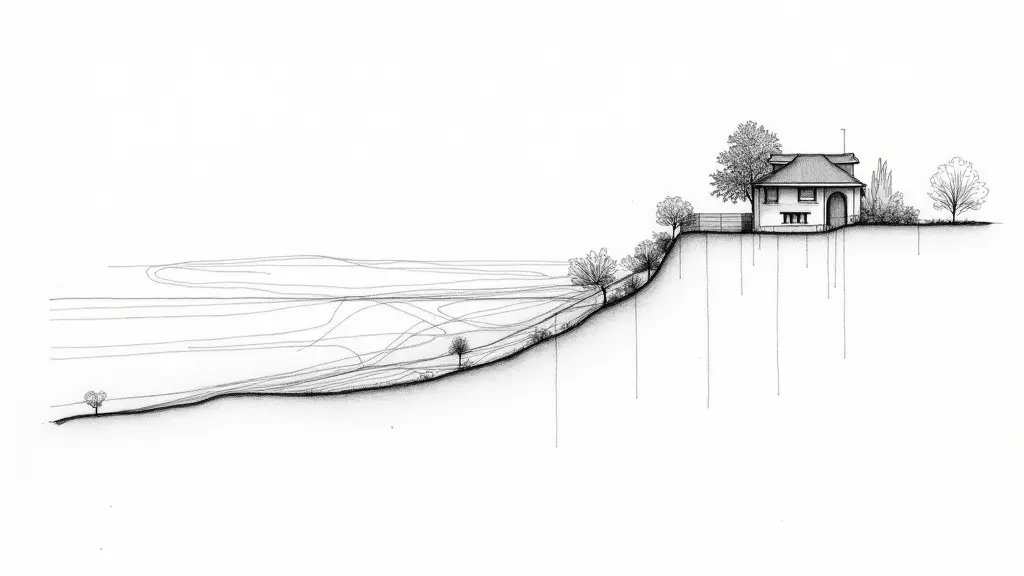
Neighboring land (upstream) Slope I = 8% Your land (downstream) Flood zone Ditch Flow Q Width b = 0.80 m Height h = 0.40 m
The Manning-Strickler Calculation That Changes Everything
The formula is Q = K × R^(2/3) × I^(1/2) × S. Q is the flow rate (m³/s). K is the roughness coefficient (for bare earth: 20). R is the hydraulic radius. I is the slope. S is the cross-sectional area. Let’s take realistic values for Grasse, with its steep slopes. The ditch is 0.80 m wide (b) and 0.40 m water depth (h) during a storm. Area S = b × h = 0.80 × 0.40 = 0.32 m². Wetted perimeter P = b + 2h = 0.80 + 0.80 = 1.60 m. Hydraulic radius R = S / P = 0.32 / 1.60 = 0.20 m. Slope I = 8% (0.08) – typical of the Grasse hillsides. Now calculate: Q = 20 × (0.20)^(2/3) × (0.08)^(1/2) × 0.32. (0.20)^(2/3) ≈ 0.34. (0.08)^(1/2) ≈ 0.283. So Q = 20 × 0.34 × 0.283 × 0.32 ≈ 0.616 m³/s. That is 616 liters per second. The standard NF EN 12056-3 (paragraph 4.2.1) requires, for this type of ditch, sizing for the 10-year storm. In Grasse, the 10-year intensity is about 90 mm/h. For an upstream area of 800 m² (neighbor’s land), the incoming flow is: (90/1000/3600) × 800 ≈ 0.020 m³/s (20 l/s). The ditch can theoretically evacuate 616 l/s, more than enough. But if the height h is actually 0.15 m (poorly maintained ditch), Q drops to 0.185 m³/s. And if the slope is 3% (regraded land), Q = 0.112 m³/s. What this means in practice: a poorly sized or clogged ditch in Grasse can be undersized by a factor of 5 relative to the need. Your flooding has a measurable technical cause.
What Happens If You Do Nothing
Within 6 months, erosion will carve rills into your land. Your tree roots, suffocated, will show signs of rot. Within 2 years, repeated water stagnation will alter the soil’s bearing capacity. You will see localized subsidence near the property line. A client in Grasse saw his fence tilt 10 cm in 18 months because of this. Frankly, the cost? To stabilize an eroded slope and drain a 1000 m² plot in Grasse, expect between €8,000 and €15,000. Not to mention secondary issues: rising damp toward the house, mold growth on buried walls, foundation degradation if water stagnates against them. This is not just a puddle; it is an accelerated degradation process.
Recourse and Guarantees: What You Can Demand
Article 640 of the French Civil Code is your guarantee. It requires the owner of the upper land not to worsen the natural flow. If the Manning calculation proves that the development creates excess flow or abnormal stagnation, you are entitled to demand restoration. The procedure: a registered letter with formal notice, attaching a preliminary calculation. If the neighbor contests, have an expert surveyor with a total station (accuracy ±1 cm) measure the actual slope and elevations. The Grasse judicial court has jurisdiction. What I always say: a number is worth more than an argument. Here, the key number is the flow rate Q. If it exceeds the predictable natural flow (calculated using Grasse rainfall data), you will win.
Frequently Asked Questions
My neighbor altered the rainwater flow and my land is flooded: what should I do?
First, document the situation with photos and measurements. Then send a registered letter to your neighbor citing Article 640 of the French Civil Code and include a preliminary Manning calculation. If unresolved, hire an expert surveyor to produce a detailed report. You can then take the case to the Grasse judicial court.
What is the Manning-Strickler formula and how is it used?
The Manning-Strickler formula calculates flow rate in open channels: Q = K × R^(2/3) × I^(1/2) × S. It is used to determine if a ditch or channel can handle a given runoff. K is roughness, R is hydraulic radius, I is slope, S is cross-sectional area.
What are the typical costs for drainage and slope stabilization in Grasse?
For a 1000 m² plot, expect €8,000 to €15,000 for drainage and slope stabilization. Costs vary based on soil type, slope, and access.
📅 Mis à jour le 08/08/2026 — Par Cassini Expertise, expert bâtiment indépendant 06 & 83. Devis gratuit : 04 22 46 06 04.
Questions fréquentes
Comment calculer le ruissellement d'une colline voisine avec Manning?
Pour calculer le ruissellement, utilisez l'équation de Manning : Q = (1/n) * A * R^(2/3) * S^(1/2), où Q est le débit (m³/s), n est le coefficient de rugosité, A est la section mouillée (m²), R est le rayon hydraulique (m), et S est la pente (m/m). Estimez d'abord la surface contributive et la pluie de projet, puis déterminez le débit de pointe.
Quelle est la formule de Manning pour un écoulement à surface libre?
La formule de Manning est V = (1/n) * R^(2/3) * S^(1/2), où V est la vitesse moyenne (m/s), n est le coefficient de rugosité, R est le rayon hydraulique (m), et S est la pente du lit. Pour obtenir le débit, multipliez V par la section mouillée A.
Comment dimensionner un fossé pour les eaux de ruissellement de Grasse?
Dimensionnez le fossé en calculant le débit de pointe avec la méthode rationnelle ou un modèle hydrologique, puis utilisez Manning pour vérifier que la capacité du fossé est suffisante. Choisissez une rugosité adaptée (n≈0.03 pour béton lisse, 0.05 pour terre) et une pente qui évite l'érosion (0.5-3%).