GEOLOGY — FRENCH RIVIERA
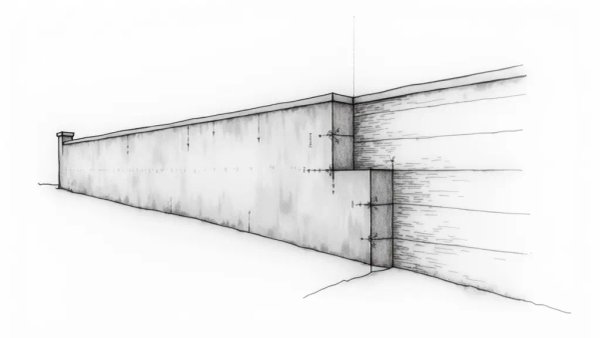
You live in Grasse, in the hills, and your dry stone retaining wall shows signs of weakness. A 30 kg block fell off yesterday, fortunately without causing damage. But you feel the wall is moving. In 22 years of fieldwork on the French Riviera, I have seen dozens of similar cases: the stability of a dry stone wall is a subtle balance between geometry, weight, and friction. And in Grasse, with its clay-limestone soils and slopes often exceeding 30%, the risk is real.
What You See — and What It Really Hides
The wall looks straight, the stones well interlocked. But you have noticed a slight bulge in the center, a few loose stones at the top. Nothing serious, you think. Yet this bulge is a sign of internal thrust: water or roots have destabilized the backfill behind the wall. Without a precise calculation, you cannot know if the wall is close to failure.
What I often see in this case: the owner has looked at the wall but has not measured the actual inclination of the facing or the exact height. Yet these data are crucial. In Grasse, on a case last year, I measured a 2.5 m high wall with an inclination of 15° from vertical — well beyond the 10° recommended by DTU 13.12 (French technical document for dry stone retaining walls) for dry stone.
The Calculations That Change Everything: Sliding Stability Check
For a dry stone retaining wall, design is performed according to Eurocode 7 §11 (stability verification) and DTU 13.12 (French technical document for dry stone retaining walls). The main criterion is non-sliding of the wall on its foundation. The stabilizing force is the weight of the wall multiplied by the soil/stone friction coefficient, while the driving force is the earth thrust.
Formula: Factor of safety FS = (W × μ) / Pa ≥ 1.5 (Eurocode 7 §11.2.2)
Where:
– W = weight of wall = γstone × volume. For a limestone wall (γ = 22 kN/m³), average cross-section 0.8 m² per linear meter, H = 2.5 m → W = 22 × 0.8 × 2.5 = 44 kN/m
– μ = tan(φ) with φ = soil/stone friction angle. For limestone on clay (φ ≈ 25°), μ = 0.47
– Pa = active thrust = 0.5 × γsoil × H² × Ka. For clay-limestone soil (γ = 20 kN/m³), Ka = (1 – sin φ)/(1 + sin φ) = 0.41. So Pa = 0.5 × 20 × 2.5² × 0.41 = 25.6 kN/m
FS = (44 × 0.47) / 25.6 = 0.81 — less than 1.5, therefore unstable.
What this means in practice: your wall is undersized. The 15° inclination and insufficient stone weight do not compensate for the thrust. In Grasse, with intense rainfall events, the clay saturates and pressure increases, worsening the risk.
What Happens If You Do Nothing
Within 6 months, the bulge worsens. Cracks appear between the stones. Within 2 years, an entire section may collapse, carrying away topsoil and threatening the terrace or house below. I saw in Grasse an untreated wall cause a 50 m³ landslide, with damage to public roads: a €15,000 bill for the owner.
Secondary pathologies include water infiltration into foundations, instability of neighboring trees, and irreversible aesthetic degradation. Not to mention loss of property value: a collapsed wall means 10 to 20% less on the sale price.
Recourse and Guarantees: What You Can Demand
If the wall was built less than 10 years ago, the ten-year liability (art. 1792 of the French Civil Code) may apply, as a collapse compromises the solidity of the structure. Eurocode 7 §11.2.2 requires a safety factor ≥ 1.5. DTU 13.12 specifies implementation conditions. Your steps: registered letter with acknowledgment of receipt to the builder, then contradictory expert appraisal. If nothing progresses, refer to the Grasse judicial court. In the meantime, keep everyone away from the wall.
📅 Mis à jour le 06/08/2026 — Par Cassini Expertise, expert bâtiment indépendant 06 & 83. Devis gratuit : 04 22 46 06 04.
Questions fréquentes
Pourquoi un mur de soutènement en pierre sèche s'effondre-t-il à Grasse ?
L'effondrement est souvent dû à une surcharge hydraulique, un défaut de drainage, ou une fondation insuffisante. À Grasse, les fortes pluies méditerranéennes peuvent saturer le sol et augmenter les pressions, dépassant la capacité du mur si celui-ci n'est pas correctement dimensionné.
Comment calculer la stabilité d'un mur en pierre sèche selon l'Eurocode 7 ?
Il faut vérifier les états limites ultimes (ELU) et de service (ELS) : glissement, renversement, capacité portante du sol et stabilité générale. On utilise des coefficients partiels sur les actions et les matériaux, et on modélise la poussée des terres avec des paramètres de sol adaptés.
Quelle est la hauteur maximale d'un mur en pierre sèche sans armature ?
En général, on considère qu'un mur en pierre sèche non armé peut atteindre environ 2 à 3 mètres, mais cela dépend fortement de la qualité des pierres, de l'inclinaison, du sol de fondation et des conditions hydrauliques. Pour des hauteurs supérieures, il faut des calculs précis et souvent des renforcements.
Cassini Expertise
Expert du bâtiment indépendant — Antibes (06·83·13·40)
📅 Mis à jour le 19/09/2026 — Cassini Expertise, expert bâtiment indépendant (06·83·13·40).