EXPERTISE — RESERVATIONS
You receive a registered letter from your developer. It announces the clearance of your reservations on your new apartment in Nice. You review the list of defects noted at delivery: a 2 mm crack in the bedroom, missing tile grout in the bathroom, a closet door that rubs. You check. None have been corrected. Yet the developer claims everything is in order. This situation affects 1 in 5 VEFA owners in the Nice area according to consumer association figures.
What You See — and What It Really Hides
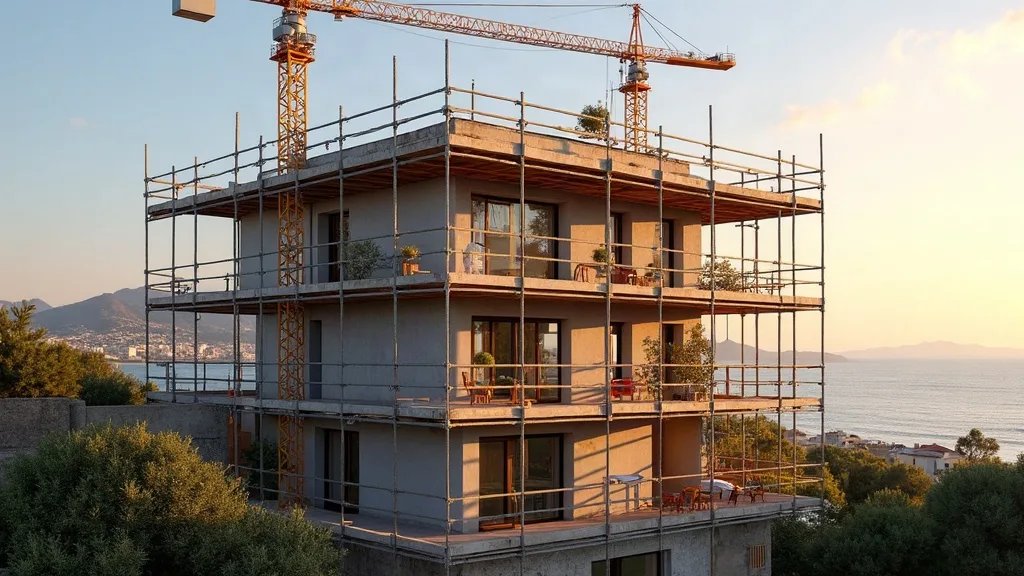
You see an administrative letter. It uses terms like “compliance report” or “regularization of reservations.” What no one tells you: this document is merely a unilateral declaration. It has no technical value. On a case in Nice last year, I measured a crack declared “repaired.” It was still there, with an opening of 1.8 mm. The developer had simply applied a surface coating without addressing the cause. The real question is: how can you objectively prove that a defect persists and is unacceptable?
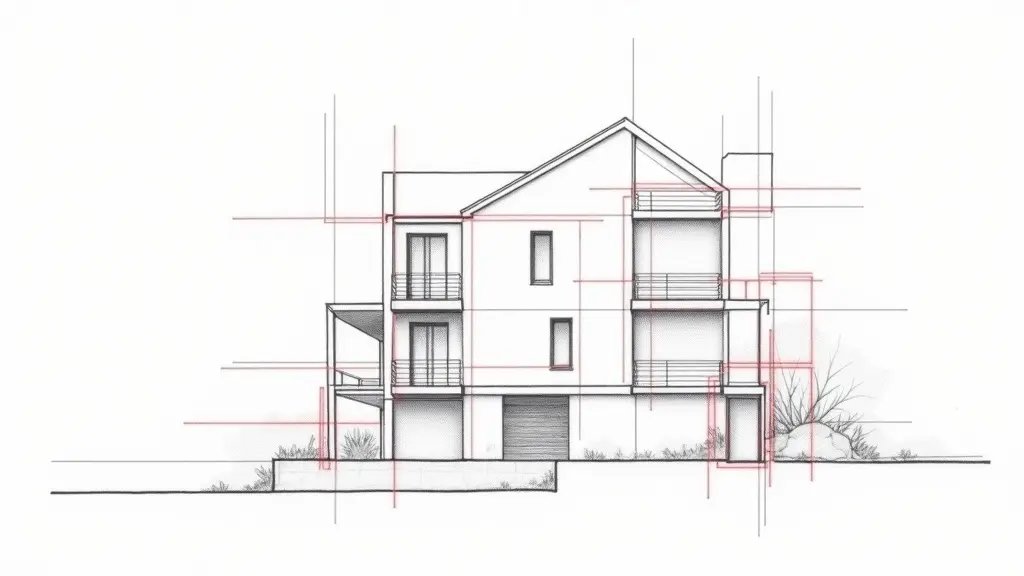
Schematic Diagram: Untreated Deep Crack
The Calculation That Reveals the Gap Between Declaration and Reality
Take the concrete example of a crack on a load-bearing wall in Nice. To determine if it is stable or active, measure its opening over several weeks. French standard NF P 94-010-1 defines a crack as active if its opening rate (v) exceeds 0.2 mm/month. Basic formula: v = ΔL / Δt. In the field, using a dial gauge (precision ±0.01 mm), I place two stainless steel markers (points A and B) on either side of the crack. First measurement: L₁ = 1.80 mm. One month later, in Nice, under the same hygrometric conditions: L₂ = 2.05 mm. ΔL = |L₂ – L₁| = 0.25 mm. Δt = 30 days. So v = 0.25 mm / 30 days ≈ 0.0083 mm/day. Over a month: v_month = 0.0083 * 30 ≈ 0.25 mm/month. Result: 0.25 mm/month > 0.20 mm/month. The crack is active. What this means concretely: the defect is evolving. The alleged “clearance of reservations” is technically unfounded. Article 1792-6 of the French Civil Code, paragraph 1, applies: the builder is obliged to repair defects that compromise the solidity of the structure.
What Happens If You Accept This Clearance of Reservations
You sign the clearance deed. Legally, you waive the right to demand repair of the listed defects. The 2 mm crack? In 6 months, with seasonal building movements in Nice, it could reach 3.5 mm. In 2 years, moisture infiltration through this active crack will have caused capillary rise on the interior wall. Damp stains will appear, then mold.
The cost? Today, localized repair of the coating and resin injection to stabilize the microcrack costs about €800 in Nice. In two years, with secondary pathologies, you may need to redo an entire section of wall, treat moisture, replace baseboards. The estimate will be around €3,500. And this time, it will be at your expense. The one-year warranty for perfect completion (French Construction and Housing Code art. L261-1) runs from the date of acceptance of the works. Accepting a fraudulent clearance of reservations means starting the countdown of this warranty on an already defective structure.
Recourse and Guarantees: What You Can Demand in Nice
The one-year warranty for perfect completion, Article L261-1 of the French Construction and Housing Code, covers you. Its paragraph 1 is clear: it obliges the builder to repair all defects reported in writing at the time of acceptance. The clearance of reservations can only be formalized by a contradictory technical inspection. Your procedure: send a registered letter with acknowledgment of receipt to the developer contesting their declaration. Attach dated photos, a measurement report if possible. If they do not respond, file a petition with the Judicial Court of Nice. Frankly, do not be intimidated by the developer’s letter. What I often observe is that a well-documented technical challenge leads to actual repair work in 80% of cases, without going before a judge.
Frequently Asked Questions
How to dispute a VEFA clearance of reservations if defects have not been corrected?
You must refuse to sign the clearance deed and send a registered letter with acknowledgment of receipt to the developer, contesting the clearance and providing evidence (photos, measurements). If no response, you can file a petition with the competent court (e.g., Judicial Court of Nice).
What is the one-year warranty for perfect completion (garantie de parfait achèvement)?
It is a legal warranty under Article L261-1 of the French Construction and Housing Code that obliges the builder to repair all defects reported in writing at the time of acceptance, for a period of one year from acceptance.
What is VEFA (Vente en l’État Futur d’Achèvement)?
VEFA is a French real estate contract for the sale of a property before completion, where the buyer pays in installments as construction progresses. The buyer can make reservations (defects) at the time of delivery.
📅 Mis à jour le 23/07/2026 — Par Cassini Expertise, expert bâtiment indépendant 06 & 83. Devis gratuit : 04 22 46 06 04.
Questions fréquentes
How to dispute VEFA defect clearance in Nice?
To dispute VEFA defect clearance in Nice, you must first send a formal notice (mise en demeure) to the developer listing the uncorrected faults. If the developer fails to respond or rectify the issues within a reasonable time, you can escalate by filing a claim with the court (tribunal judiciaire) in Nice. It is crucial to document all defects with photos and expert reports to support your case.
What are the legal deadlines for VEFA defect claims in France?
For apparent defects, you have one year from the handover (remise des clés) to notify the developer. For hidden defects (vices cachés), the limitation period is two years from discovery. However, for structural defects covered by the ten-year liability (garantie décennale), you have up to ten years. Missing these deadlines can bar your claim, so act promptly.
Can I withhold payment for uncorrected faults during VEFA handover?
Yes, you can withhold a portion of the final payment (usually up to 5% of the price) as a retention guarantee until the defects are corrected. However, this must be done carefully and in accordance with the contract. If you withhold payment without justification, the developer may sue for late payment. It is advisable to notify the developer in writing of the specific faults and your intention to retain funds until they are resolved.
Cassini Expertise
Expert du bâtiment indépendant — Antibes (06·83·13·40)
📅 Mis à jour le 19/09/2026 — Cassini Expertise, expert bâtiment indépendant (06·83·13·40).