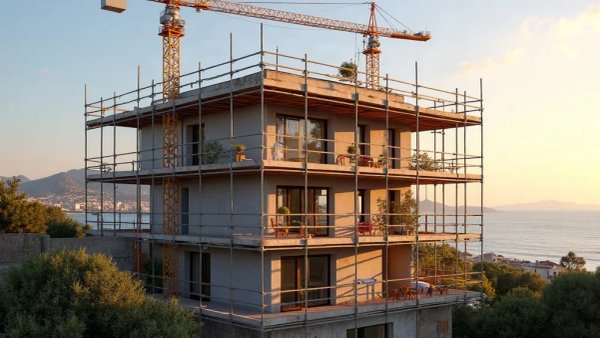
EXPERTISE — RESERVATIONS
You have just received the developer’s letter. It confirms the lifting of reservations on your new apartment in Nice. Yet, as you run your hand over the living room wall, you still feel that fine crack snaking across. Or perhaps it’s that water leak under the kitchen sink, reappearing a week after the “repair.” You are not alone: on the French Riviera, nearly 15% of VEFA (sale of future completion) disputes involve defects declared as corrected… but that persist after the formal lift. This letter, meant to close the reservation period, becomes the starting point of a new conflict.
What You See — and What It Really Hides
You see a crack reappear. A damp patch that doesn’t dry. A door that still rubs. The developer, on the other hand, sent a technician, perhaps even applied a camouflage coating. The lift declaration is administrative. It does not constitute a technical finding of definitive correction. Frankly, that’s where the problem lies.
What I often observe in Nice and its metropolitan area is the confusion between these two steps. Last year, for a client in the Ariane district, a 2 mm crack on a partition wall was hastily filled. Without investigation into its cause – differential soil settlement – it returned in three months, wider. What you observe is often only the symptom. The real question is: was the defect treated at the root, in accordance with Nice’s professional standards, or simply masked to “clear” the file? Only an adversarial examination, with measurements, can tell.
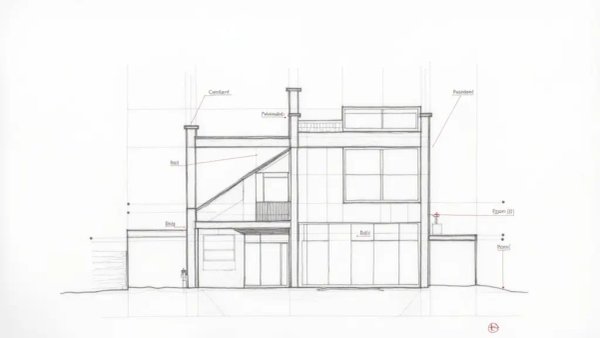
Active crack Camouflage coating Crack corrected at source Length of affected wall: L = 3.60 m Schematic diagram: Surface treatment vs. correction at source A persistent defect after reservation lift requires a cross-sectional analysis to identify the real origin.
The Calculation That Reveals the True Extent of the Defect
Let’s take the concrete example of a crack on a floor in Nice. You measure an apparent opening w = 0.5 mm. But is it significant? Standard NF P 11-212 (French standard for geotechnical design) addresses soil-related defects. For a floor, we evaluate the differential deflection. Imagine a reinforced concrete beam (E = 30 GPa, I = 8.33e-5 m⁴ for a 0.20×0.25 m section) with span L = 4.00 m, subjected to a permanent load q = 8 kN/m.
The theoretical maximum deflection is f = (5 * q * L⁴) / (384 * E * I). So f = (5 * 8000 * 4⁴) / (384 * 30e9 * 8.33e-5) = 0.0107 m, i.e., 10.7 mm. The tolerance for finished elements is often L/500 = 8 mm. Here, 10.7 mm > 8 mm. The calculation indicates potential non-compliance. If this excessive deflection is the cause of your crack, and it was not corrected upstream (by underpinning, injection, etc.), simple filling is ineffective. What this means concretely: the guarantee of proper functioning of equipment elements (Art. 1792-3 C.civ., paragraph 1) may be invoked for this persistent defect, as it affects solidity or waterproofing. The calculation proves that the symptom (crack) has a quantifiable structural cause, unresolved.
What Awaits You If You Let It Go
Within 6 months, the 0.5 mm crack can reach 2 mm. Water infiltration, if not treated at its source behind the tile, will generate mold in the lining. In Nice, with the Mediterranean climate and intense rainy episodes, a poorly corrected waterproofing defect on a terrace can lead to water damage for the downstairs neighbor within two seasons.
Secondary pathologies appear: wood rot, reinforcement corrosion, insulation deterioration. The cost? A superficial repair today: €200 to €500. The same repair, but complete and curative in 2 years, after worsening: €2,000 to €8,000 depending on the extent. Not to mention the loss of property value. I saw a case in Nice where an untreated micro-crack in an expansion joint led, after 5 years, to infiltration requiring complete removal of a curtain wall, billed over €15,000 to a co-owner while the ten-year guarantee was contested.
Recourses and Guarantees: What You Can Demand
The applicable guarantee is the perfect completion guarantee (1 year) if you are within that period, otherwise the proper functioning guarantee (2 years for equipment elements, Art. 1792-3 C.civ.) or the ten-year guarantee (10 years for defects compromising solidity, Art. 1792 C.civ.). Your first recourse is a registered letter with acknowledgment of receipt to the developer, stating that the defect persists despite the reservation lift and demanding a real intervention within 15 days. Attach photos, videos. If he does not react, have it recorded by an independent expert (bailiff or court expert). Then, refer the matter to the Nice judicial court. This is not a threat; it is the strict application of the civil code. Do not let an administrative letter deprive you of your rights over a property in Nice, where real estate represents a substantial investment.
📅 Mis à jour le 25/07/2026 — Par Cassini Expertise, expert bâtiment indépendant 06 & 83. Devis gratuit : 04 22 46 06 04.
Questions fréquentes
Que faire en cas de désordres après la levée de réserves à Nice ?
Après la levée de réserves, si des désordres apparaissent, vous devez les signaler par écrit au constructeur. Si les désordres relèvent de la garantie décennale (art. 1792 C.civ.), vous pouvez engager une action dans les 10 ans suivant la réception. Consultez un avocat expert en droit de la construction pour évaluer vos recours.
Quelle est la durée de la garantie décennale après réception ?
La garantie décennale couvre les dommages qui compromettent la solidité de l'ouvrage ou le rendent impropre à sa destination. Elle court pendant 10 ans à compter de la réception des travaux, même si des réserves ont été levées. Passé ce délai, l'action est prescrite.
Quels désordres sont couverts par l'article 1792 du Code civil ?
L'article 1792 couvre les dommages affectant la solidité de l'ouvrage (ex: fissures structurelles) ou le rendant impropre à sa destination (ex: infiltrations rendant le logement inhabitable). Les désordres esthétiques mineurs ne sont généralement pas couverts, sauf s'ils rendent l'ouvrage impropre à son usage.
Cassini Expertise
Expert du bâtiment indépendant — Antibes (06·83·13·40)
📅 Mis à jour le 19/09/2026 — Cassini Expertise, expert bâtiment indépendant (06·83·13·40).