CONSTRUCTION — CRACKS
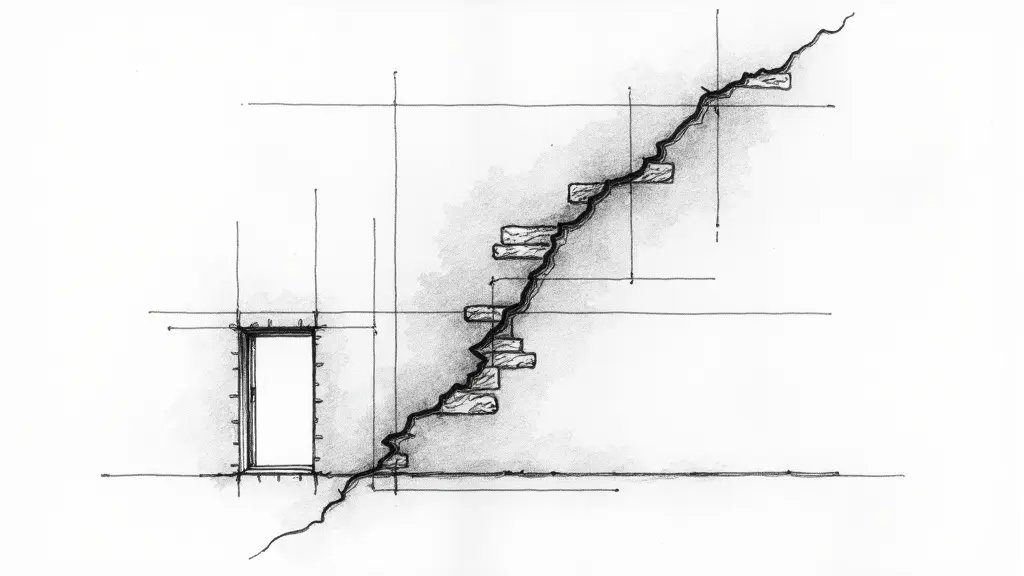
You’ve just discovered a stair-step crack on the wall of your house in Toulon. It starts from a window corner and rises to the ceiling at 45°. You measured it: 2 mm wide at its widest point. What you don’t see is that beneath your feet, the foundations are moving unevenly. Frankly, in the Var department, 7 out of 10 diagonal cracks are linked to differential soil settlement.
What You See — and What It Really Hides
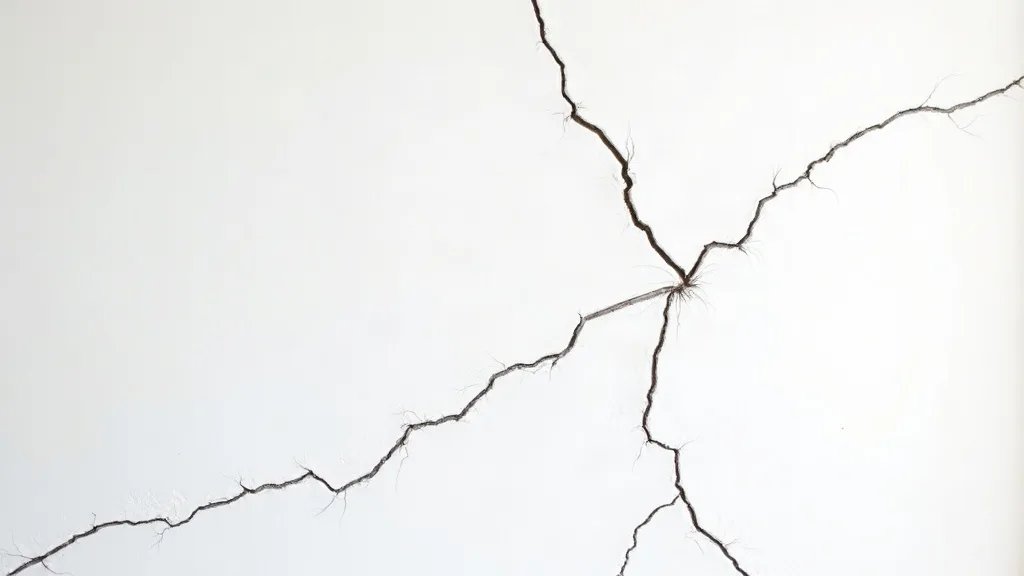
The diagonal crack is the symptom. The wall is under shear because one part of the house is sinking more than the other. On a case in Toulon last year, I measured a height difference of 3.5 cm between two corners of a house on strip footings. The owner had only seen the crack. What no one says: differential settlement is like a wobbly table. One leg sinks, everything else deforms. In practice, what does that mean? Stresses in the masonry that eventually crack along the weakest joints, often following a stair-step pattern. And in Toulon, with sometimes heterogeneous soils – fill over clay, sandy areas – the risk is real.
Cracked wall Stable part Δh = 2 cm Compressible soil Schematic section – Differential settlement Settling foundation Stable foundation
The Calculation That Reveals the Extent of the Disorder
We don’t just look. We calculate. The Eurocode 7 standard (§6.6.2) and the French DTU 13.12 (§5.2.1) provide the framework. For a single-family house in Toulon, let’s take a concrete case. Strip footing width B = 0.60 m, load from the wall Q = 120 kN/m. The soil is a clayey silt, allowable bearing pressure estimated qadm = 150 kPa. The applied stress σ = Q / B. So σ = 120 / 0.60 = 200 kPa. First verdict: 200 > 150. The stress exceeds the allowable bearing capacity. Now, settlement. Simplified formula: s = (Δσ / E) * H. With Δσ = 50 kPa (surcharge), oedometric modulus E = 8 MPa for the silt, thickness of compressible layer H = 2 m. s = (50 / 8000) * 2000 = 12.5 mm. If this settlement is not uniform – because the soil is heterogeneous or the load poorly distributed – we have a differential. DTU 13.12 tolerates a differential settlement Δs / L ≤ 1/500. For a span L = 6 m between two points, allowable Δs = 6000 / 500 = 12 mm. If your field measurement gives a Δs of 20 mm (as I’ve often seen in Toulon on houses from the 1980s), we get 20/6000 = 1/300. Out of tolerance. What this means concretely: the structure is subjected to abnormal forces. The crack is only the visible consequence.
Inevitable Deterioration If Nothing Is Done
Leave it be, and in 6 months, the crack widens. It can reach 5 mm. Rainwater infiltrates in Toulon, winter frost makes the crack work. In 2 years, windows and doors jam. The front door no longer closes properly. Interior partitions crack in turn. In 5 years, structural worsening can occur: poorly distributed load path, risk to the stability of the settling part. Secondary pathologies: moisture, thermal bridges, increased heating costs. The cost? A localized underpinning can start at €15,000. If you wait too long, sometimes an entire facade needs consolidation, and then it exceeds €40,000. Not to mention the loss of property value.
What I often see is that homeowners downplay it at first. A small crack, they fill it. But the ground movement continues. The crack reappears systematically. And the problem, having become chronic, is more complex and costly to treat.
Recourse and Guarantees: What You Can Demand
You are not defenseless. For a recent construction (less than 10 years), the ten-year liability (“garantie décennale”) applies. Even beyond, liability can be engaged if the disorder stems from a construction defect or insufficient soil study. The reference standards are DTU 13.12 (paragraph 5.2 on allowable settlements) and Eurocode 7 (section 6 on foundations). The procedure: official report by a bailiff, then contradictory expert assessment. An independent expert measures the differential settlement with an optical level or total station. He compares it to the tolerances. His report is authoritative. Then, a formal notice by registered letter with acknowledgment of receipt to the builder or insurer. If refused, referral to the judicial court of Toulon. Direct tone: don’t wait. A foundation disorder does not resolve itself. Act with a solid, quantified technical file.
Frequently Asked Questions
When should I worry about a diagonal crack in a wall in Toulon?
If the crack is wider than 2 mm, follows a stair-step pattern, or is accompanied by sticking doors or windows, it may indicate differential settlement. Immediate expert assessment is recommended.
📅 Mis à jour le 05/08/2026 — Par Cassini Expertise, expert bâtiment indépendant 06 & 83. Devis gratuit : 04 22 46 06 04.
Questions fréquentes
What causes diagonal cracks in Toulon foundations?
Diagonal cracks in Toulon are typically caused by differential settlement, where parts of the foundation sink unevenly due to variations in soil moisture, expansive clay, or poor compaction. This movement creates shear stress that results in cracks running diagonally from corners of openings.
How do you calculate differential foundation settlement?
Differential settlement is calculated by measuring the difference in vertical displacement between two points on the foundation. This is done using surveying instruments or settlement gauges, and the difference divided by the distance between points gives the angular distortion, which is compared to allowable limits.
Are diagonal cracks in Toulon a sign of serious structural damage?
Diagonal cracks wider than 3 mm or those that continue to grow over time can indicate significant differential settlement, which may compromise structural integrity. It's important to have a professional engineer assess the severity and recommend underpinning or soil stabilization if needed.
Cassini Expertise
Expert du bâtiment indépendant — Antibes (06·83·13·40)
📅 Mis à jour le 19/09/2026 — Cassini Expertise, expert bâtiment indépendant (06·83·13·40).