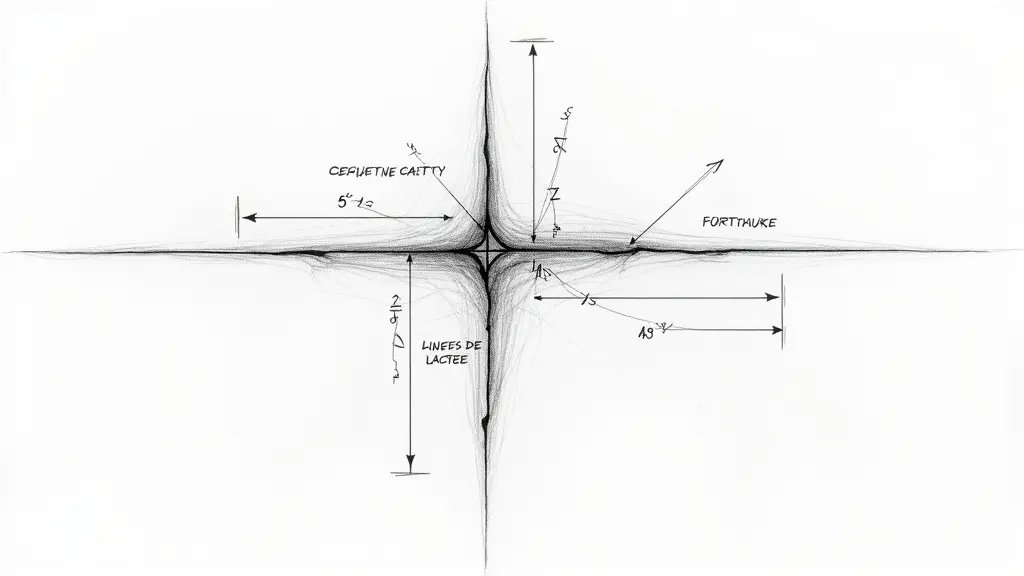
CONSTRUCTION — CRACKS
You have noticed diagonal cracks starting from the corners of doors or windows. They are slowly widening. In Toulon, on sloping clay soil, 80% of single-family homes built before 2000 exhibit this type of disorder. This is not just an aesthetic issue: it is a sign that your house is moving, and its foundations are in danger.
What You See — and What It Really Hides
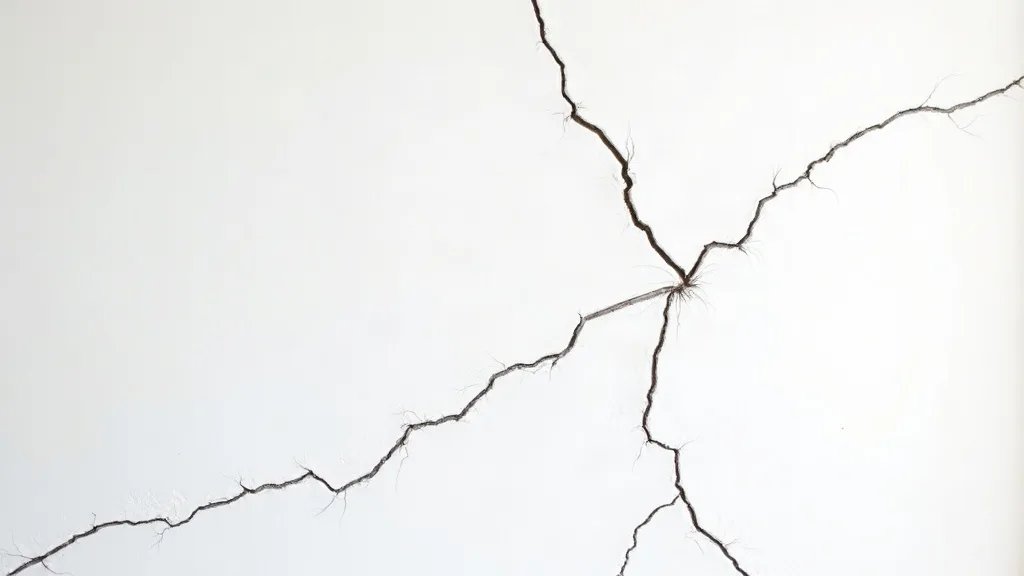
The cracks are inclined at 45°, wider at the top than at the bottom. Typical sign of differential settlement: one part of the house sinks more than the other. On a case in Toulon last year, I measured a difference of 4 cm between the front and back of a house. The owner had simply filled the cracks with putty. Six months later, they reappeared, wider.
What no one says: this settlement is often due to poorly recognized soil before construction. In Toulon, the soil alternates between swelling clays (shrink-swell) and karstic limestone. A shallow foundation on clay can lose up to 30% of its bearing capacity during a drought. Eurocode 7 (NF EN 1997-1, §6.6.2) requires appropriate soil investigation, but many builders skip it. What I often see: houses built without soil study on clay soils end up showing diagonal cracks within 5 to 10 years.
The Calculations That Change Everything — Allowable Settlement or Not?
Let’s take a concrete case in Toulon: a strip footing 0.50 m wide, loaded at 150 kN/ml (two-story house). The soil report gives a modulus of subgrade reaction K = 20,000 kN/m³ for clay, but after drought, K drops to 10,000 kN/m³. The immediate settlement under load is:
s = q / K with q = 150 / 0.5 = 300 kN/m².
So s = 300 / 10,000 = 0.03 m = 3 cm.
If another footing rests on limestone (K = 100,000 kN/m³), the settlement is only 0.3 cm. The difference of 2.7 cm between the two footings causes rotation of the structure, and thus diagonal cracks. According to DTU 13.12 (French standard for shallow foundations), the allowable differential settlement for a single-family home is 1 cm. Beyond that, disorders are inevitable.
Consequences If You Do Not Act
Ignoring these cracks means risking the worsening of disorders. Cracks widen, doors and windows jam, tiles lift. In extreme cases, the structure can become unstable. On a case in Nice, a homeowner waited 3 years before calling an expert: differential settlement had reached 8 cm, and the house had to be underpinned at a cost of €50,000. In Toulon, with recurrent drought, the risk is even higher. Do not let a simple crack become a financial pit.
Solutions According to Eurocode 7 and DTU 13.12
Faced with proven differential settlement, several solutions exist:
- Underpinning: installation of micropiles or bored piles to transfer loads down to a resistant soil (limestone or marl).
- Expansive resin injection: quick technique to fill voids and stabilize the soil, but reserved for moderate settlements (less than 2 cm).
- Foundation reinforcement: widening of footings or creation of grade beams to distribute loads.
The choice depends on the extent of settlement and soil nature. Eurocode 7 requires a preliminary geotechnical study (G2) to design foundations. On a case in Antibes, I recommended micropiles 8 m deep to cross a 5 m clay layer and anchor in limestone. The cost was €15,000, but the house has been stable for 5 years.
If you are facing diagonal cracks, do not wait. Contact a structural expert for a precise diagnosis. In Toulon and throughout the PACA region, Cassini Expertise intervenes quickly to assess disorders and propose solutions compliant with standards.
📅 Mis à jour le 24/07/2026 — Par Cassini Expertise, expert bâtiment indépendant 06 & 83. Devis gratuit : 04 22 46 06 04.
Questions fréquentes
Why is my house cracking in Toulon?
Diagonal cracks in Toulon homes often result from differential settlement caused by the region's clay-rich soils, which shrink and swell with moisture changes. This movement creates uneven support under foundations, leading to stress cracks. Check for water drainage issues or tree roots near the foundation, as they exacerbate soil moisture variations.
How to fix differential settlement in Toulon?
Fixing differential settlement requires addressing the soil and foundation. Common solutions include underpinning with piers or helical anchors to stabilize the foundation, improving drainage to control soil moisture, and repairing cracks with epoxy injections. Always consult a structural engineer to assess the severity and design a tailored solution.
What are signs of foundation settlement in Toulon?
Signs include diagonal cracks around doors, windows, or corners, sticking doors/windows, uneven floors, and gaps between walls and ceilings. In Toulon, these often appear after dry spells or heavy rains due to expansive clay. If you notice these, monitor cracks for growth and seek a professional evaluation.
Cassini Expertise
Expert du bâtiment indépendant — Antibes (06·83·13·40)
📅 Mis à jour le 19/09/2026 — Cassini Expertise, expert bâtiment indépendant (06·83·13·40).