CONSTRUCTION — CRACKS
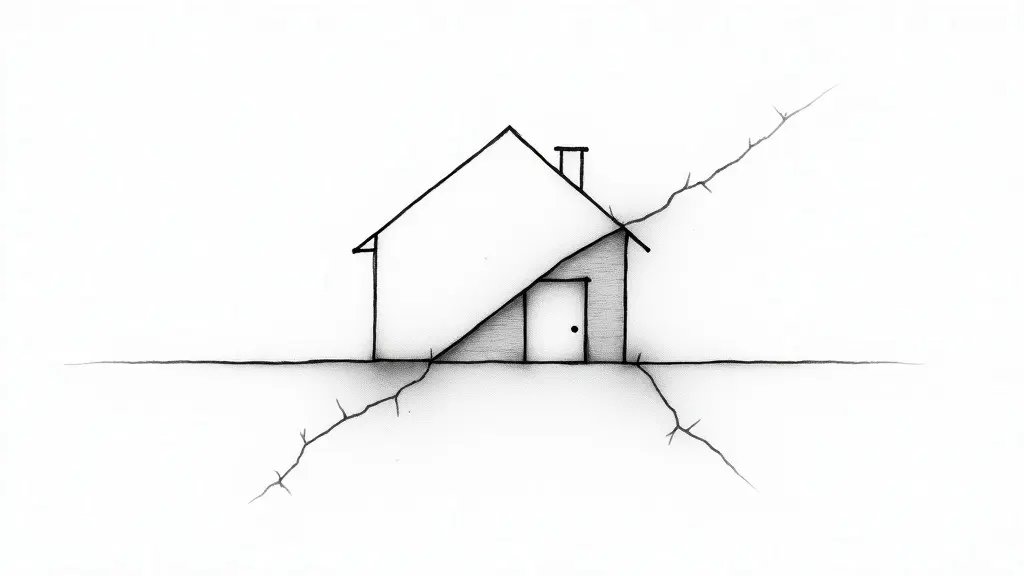
You have just spotted a diagonal crack starting from a window corner and rising toward the ceiling. Not a cosmetic microcrack: it is 3 mm wide. Your house, built in 2018 on a sloping plot, was handed over six months ago. Since then, the clay soil has moved with autumn rains. What you see is a sign of differential foundation settlement. And this is not a simple finishing defect.
What You See — and What It Really Hides
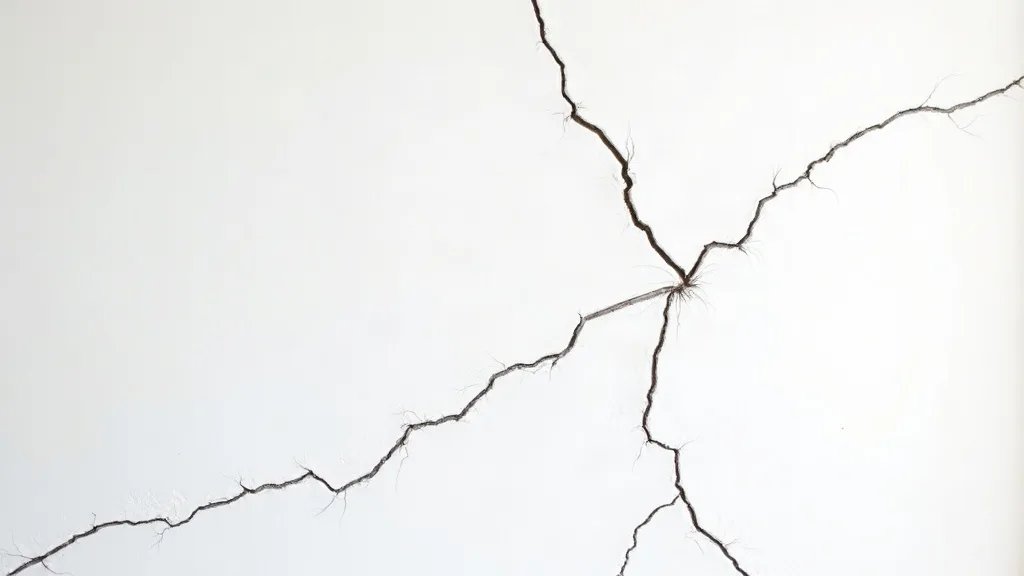
A diagonal crack is the classic symptom of ground movement under part of the house. In Toulon (a city in southern France), swelling clays (medium hazard according to BRGM, the French geological survey) and karstic limestones create dissolution pockets. If foundations were not taken to the same depth or the soil was not homogenized, the building deforms. Honestly, I see this every year on the French Riviera.
On a case in Toulon last year, I measured a 12 cm depth difference between two boreholes 5 m apart. The developer had skipped a full geotechnical study. Result: shallow foundations settled 4 cm on the downhill side versus 1 cm on the uphill side. The crack appeared in less than a year.
The Calculations That Change Everything: Verification According to Eurocode 7
The standard requires limiting differential settlement between two supports. For a typical building, Eurocode 7 (paragraph 6.6.1) sets a maximum differential settlement of 1/500 of the span between supports. Take your house: a 6 m span between two load-bearing walls. That is 6000 / 500 = 12 mm max. With a measured settlement difference of 20 mm, you are out of tolerance.
The DTU 13.12 (French technical document for shallow foundations) specifies that the design stress q_net must be less than the allowable stress q_adm. Formula: q_net = N / A, where N is normal force (load) and A is footing area. For a 20 cm thick wall with a 50 cm wide footing and a load of 80 kN/m, q_net = 80,000 / (0.5 × 1) = 160 kPa. If the clay soil has a bearing capacity of 120 kPa (common value in Toulon), it is non-compliant. What this means concretely: your foundations are undersized for the soil in place.
What Happens If You Do Nothing
In 6 months, the crack will widen from 3 mm to 8 mm. Autumn rains worsen clay swelling. At 2 years, the front door no longer closes, bathroom tiles come off. At 5 years, the structure may show irreversible damage: broken ring beams, wall tilting. The cost of underpinning (micropiles, grouting) often exceeds €20,000 for a single-family home in Toulon.
What nobody tells you: if you wait too long, the ten-year liability (“garantie décennale”) expires (10 years). After that, it is on your dime. And insurers often require an expert assessment before any work.
Recourse and Guarantees: What You Can Demand
Your house is covered by the ten-year liability (Article 1792 of the French Civil Code). You must send a registered letter with return receipt to the builder, detailing the cracks and citing Eurocode 7 (paragraph 6.6.1) and DTU 13.12. Have an independent expert assess the damage. If the developer refuses, file a claim with the Toulon judicial court. In practice, mediation may suffice. But do not delay: the worse the damage, the more expensive the repair.
In Toulon, I see too many homeowners who think it is cosmetic. It is not. Act now.
📅 Mis à jour le 17/08/2026 — Par Cassini Expertise, expert bâtiment indépendant 06 & 83. Devis gratuit : 04 22 46 06 04.
Questions fréquentes
What causes diagonal cracks in house walls?
Diagonal cracks, especially those wider at the top and narrower at the bottom, are typically caused by differential foundation settlement. This occurs when one part of the foundation sinks more than another, leading to uneven support and stress that cracks the walls.
Are diagonal cracks in walls a sign of foundation problems?
Yes, diagonal cracks that start at corners of doors or windows and extend outward are often a sign of differential foundation settlement. However, not all diagonal cracks are serious; if they are hairline and stable, they may be cosmetic, but widening or recurring cracks should be evaluated by a structural engineer.
How do you fix diagonal cracks caused by foundation settlement?
The fix depends on the severity and cause. For active settlement, underpinning with piers or helical piles stabilizes the foundation. For minor, stable cracks, epoxy injection or flexible sealants can repair the crack, but addressing the underlying settlement is crucial to prevent recurrence.
Cassini Expertise
Expert du bâtiment indépendant — Antibes (06·83·13·40)
📅 Mis à jour le 19/09/2026 — Cassini Expertise, expert bâtiment indépendant (06·83·13·40).