GEOLOGY — FRENCH RIVIERA
You live in Antibes, and for several months, cracks have appeared in the walls of your house. A vertical crack of 3 mm in the living room, another stair-step crack near the French door. You checked on Géoportail: your plot is in the red clay zone according to the BRGM (French Geological Survey). 1 in 4 houses in the Provence-Alpes-Côte d’Azur region is affected by this phenomenon. But concretely, why is it moving?
What You See — and What It Really Hides
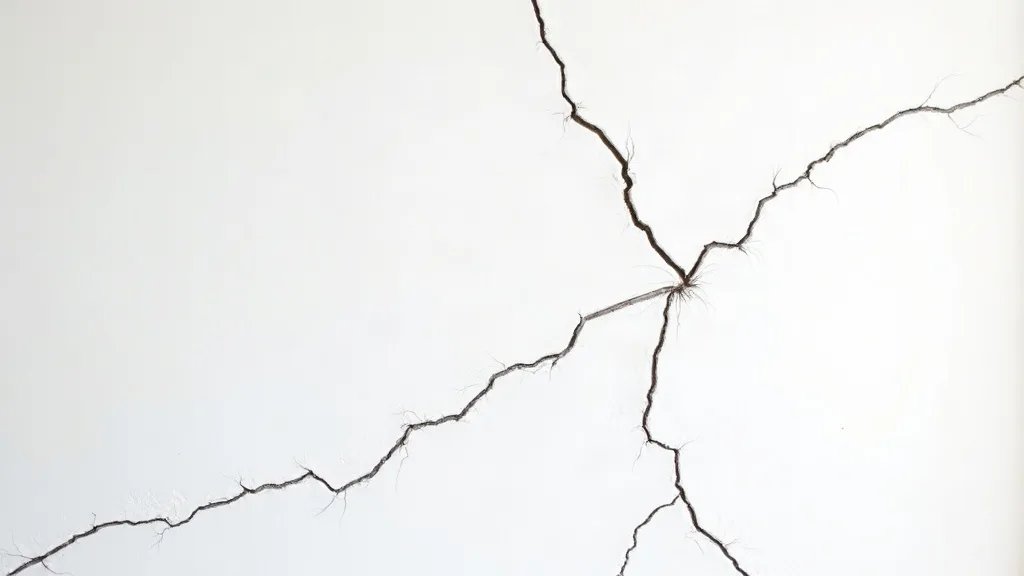
Cracks open and close depending on the season. In summer, after a drought, they widen. In winter, they close a bit. This cyclical movement betrays the presence of swelling clays under your foundations. What I often observe: homeowners believe it’s a construction defect, but the real culprit is the soil.
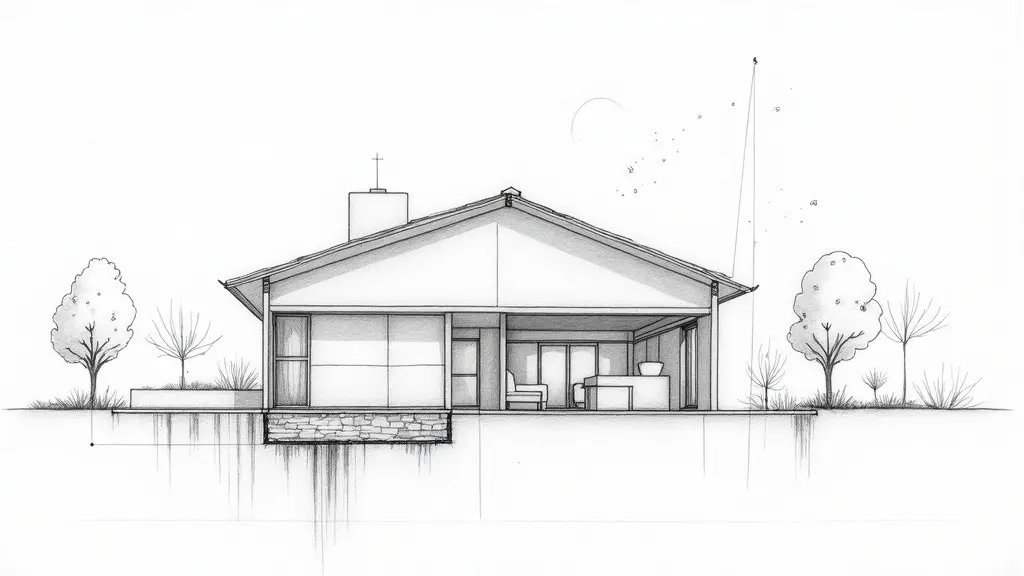
Clay is like a sponge. When it rains, it swells and lifts the house. When it’s dry, it shrinks and the house settles. Moisture variations create differential movements. On a case in Antibes last year, I measured a lift of 4 cm under one corner of a villa, while the other side remained stable. Result: structural cracks.
House Foundations Dry clay level Swollen clay level Lift Cracked wall
The Calculations That Change Everything: What Amplitude of Swelling?
The French standard NF P 94-060-1 defines the laboratory test method to measure the free swelling of a clay. In practice, we use the shrink-swell formula: ΔH = H0 × (Cg × Δw) where Cg is the swelling coefficient (often between 0.05 and 0.15 for clays in the Antibes region). Let’s take an example: a clay layer 2 m thick, with Cg = 0.1 and a water content variation Δw = 5% (from dry to wet). Then ΔH = 2 × 0.1 × 0.05 = 0.01 m = 1 cm. That’s enough to crack a poorly founded house.
The BRGM classifies the Antibes area as high hazard for clay shrink-swell. In the red zone, the alert threshold is a differential movement greater than 2 cm between two points of the building. On a house 10 m long, a slope of 0.2% (2 cm/10 m) already exceeds the tolerances allowed by French technical documents DTU 13.11 and 13.12 for shallow foundations (DTU: Unified Technical Document, a set of French construction standards). What this means concretely: your house moves more than the standards allow.
What Happens If You Do Nothing
Cracks worsen. In 6 months, a 2 mm crack can become 5 mm. In 2 years, openings reach 1 cm, doors no longer close, tiles lift. Buried pipes can break, causing infiltrations that worsen swelling.
At 5 years, disorders become structural: cracked load-bearing walls, deformed roof, risk of partial collapse. Underpinning work (micropiles, grade beams) costs between €30,000 and €80,000 for a single-family house in Antibes. Not to mention loss of market value: a cracked house sells 20 to 30% cheaper.
Recourse and Guarantees: What You Can Demand
The ten-year liability guarantee (“garantie décennale”) covers damages compromising the solidity of the structure. But you must prove that the clay soil was known or foreseeable. The BRGM provides hazard maps: if your plot is in the red zone, the builder should have adapted the foundations (depth, reinforced concrete, expansion joint). According to standard NF P 94-060-1 (paragraph 5.2), a preliminary geotechnical study is mandatory in high-hazard zones. If it was not carried out, the builder is at fault. Procedure: send a registered letter with acknowledgment of receipt to the builder, requesting a joint expert appraisal. If refused, refer the matter to the Grasse judicial court (“tribunal judiciaire”). A court-appointed expert will measure movements and determine responsibilities. Do not delay: the ten-year limitation period runs from the date of completion of the works.
📅 Mis à jour le 23/08/2026 — Par Cassini Expertise, expert bâtiment indépendant 06 & 83. Devis gratuit : 04 22 46 06 04.
Questions fréquentes
Maison fissurée Antibes sol argileux que faire ?
En cas de fissures dues au retrait-gonflement des argiles, faites d'abord évaluer la structure par un expert. Ensuite, stabilisez l'humidité du sol autour des fondations en installant un drain ou en éloignant les arbres. Des travaux de reprise en sous-œuvre ou de renforcement peuvent être nécessaires.
Quelles sont les causes des fissures sur une maison en sol argileux ?
Les variations d'humidité dans le sol argileux provoquent son gonflement (en période humide) et son retrait (en période sèche), ce qui exerce des pressions sur les fondations. Cela entraîne des tassements différentiels et des fissures dans les murs.
Qui contacter pour une fissure de maison à Antibes ?
Contactez votre assurance habitation pour déclarer le sinistre et vérifier la prise en charge. Ensuite, faites appel à un géotechnicien pour une étude de sol et à un ingénieur structure pour évaluer les dégâts. Enfin, un expert en bâtiment peut superviser les réparations.
Cassini Expertise
Expert du bâtiment indépendant — Antibes (06·83·13·40)
📅 Mis à jour le 19/09/2026 — Cassini Expertise, expert bâtiment indépendant (06·83·13·40).