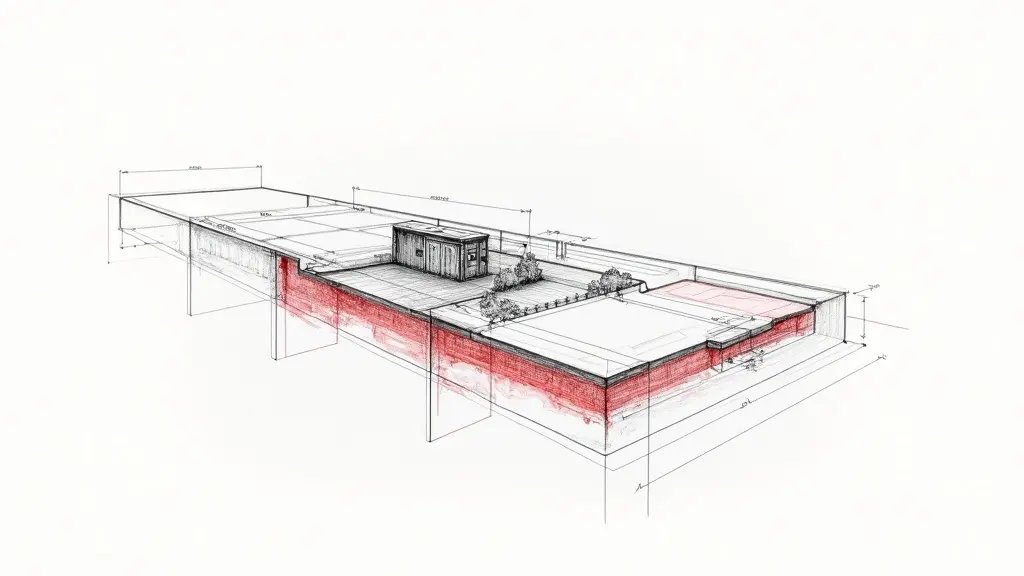
TOPOGRAPHY — EARTHWORKS
You have just received the earthworks invoice for your construction project in Nice. The contractor claims 850 cubic meters of excavated material. You measured yourself, using a ruler and the plan, and you get 720 m³. A difference of 130 m³ means over €3,000 at €25 per cubic meter for disposal. What no one tells you: the calculation method changes everything. The average-area method, often used by default, can overestimate the volume by 15 to 20% compared to the prismoidal method, recommended by the French standard NF P 94-202 (Earthworks – Classification of usable materials).
What You See — and What It Really Hides
You see a sloping plot on the heights of Nice, with approximate elevations on a plan. You mentally draw a line between the high point and the low point. You multiply the average area by the average depth. It seems logical.
What it hides: a plot is not a regular box. The average-area method assumes a linear variation of the relief between two profiles. In reality, in Nice, with often heterogeneous soils (clays, marls, scree), the ground surface between two topographic profiles is a curve. The prismoidal method, on the other hand, models this curve. On a project in Nice last year, I observed an 18% difference between the two methods for a 12% slope. The contractor billed using the simpler, higher method. The owner paid for fictitious soil.
COMPARISON OF CALCULATION METHODS Actual ground profile (curve) Prismoidal volume (accurate) Average-area volume (overestimates) Profile A Profile B Distance between profiles (L) = 30 m Natural Nice slope
The Prismoidal Formula That Corrects the Accounts
The prismoidal method applies Simpson’s formula: V = L/6 * (A₁ + 4Am + A₂). L is the distance between the two topographic profiles. A₁ and A₂ are the areas of the end profiles. Am is the area of the mid-profile. In practice, what does this give? Let’s take a concrete case on a construction site in Cimiez, Nice. Measurement with a Leica TS16 total station (accuracy ±2 cm): Distance L = 30 m. Upstream profile area A₁ = 45 m². Downstream profile area A₂ = 15 m². Mid-profile area Am = 28 m² (measured, not the average!).
Calculation: V = 30/6 * (45 + 4*28 + 15) = 5 * (45 + 112 + 15) = 5 * 172 = 860 m³.
Calculation by the average-area method ((A₁+A₂)/2 * L): V = ((45+15)/2) * 30 = 30 * 30 = 900 m³.
Difference: 40 m³, i.e., a 4.7% overestimation for this section. On a complete earthworks project in Nice with ten sections, the cumulative difference often exceeds 10%. The French standard XP P 94-063, §5.3.2 (Earthworks – Volume calculation methods), indicates that for volumes greater than 500 m³ and slopes >5%, “the prismoidal method is recommended for better accuracy.” Here, the average result is outside the acceptable precision tolerance for a contractual calculation. What this means concretely: you could be paying for 40 m³ of soil that was never moved.
Consequences of a Wrong Calculation on Your Nice Construction Site
You pay too much from the start. But that’s just the beginning. The “extra” 40 m³ in the calculation influences logistics. More trucks planned, more machine hours billed. Above all, the volume of fill needed to level the site will also be miscalculated.
In 6 months, if the excavation volume was overestimated, the fill volume may be underestimated. Result: once the foundations are poured, there is not enough soil to backfill around the slab. You have to buy more. Additional cost. After 2 years, a poor cut/fill balance can cause differential settlement on the plot, especially on the compressible soils of the Var plain. Cracks may appear on fences or outdoor structures. The cost to rectify settlement? Expect between €8,000 and €15,000 for a geotechnical study and resin injections. All because the initial volume was wrong.
Recourse and Guarantees: What You Can Demand
You are not defenseless. The French standard NF P 94-202, “Earthworks – Classification of usable materials,” and its application guide XP P 94-063 are references. Article 4.2 of NF P 94-202 states that “volumes must be determined by a method appropriate to the terrain configuration.” Demand a detailed calculation, profile by profile, with areas A₁, Am, A₂. If the contractor uses the average method on a sloping plot in Nice, contest it by registered letter with acknowledgment of receipt. Attach a request for verification by an independent surveyor using an electronic total station. If the disagreement persists, the Nice judicial court (Tribunal judiciaire de Nice) has jurisdiction. Frankly, in 8 out of 10 cases I see, a well-supported technical challenge leads to renegotiation. You pay for the soil actually moved, not for imaginary cubic meters.
📅 Mis à jour le 09/08/2026 — Par Cassini Expertise, expert bâtiment indépendant 06 & 83. Devis gratuit : 04 22 46 06 04.
Questions fréquentes
How is excavation volume calculated using the prismoidal method?
The prismoidal method calculates volume by averaging the areas of two parallel cross-sections and adding four times the area of the mid-section, then multiplying by one-sixth of the distance between the sections. This formula accounts for curvature and provides a more accurate estimate than simpler methods like the average-end-area method.
Why is there a dispute over excavation volume in Nice?
The dispute in Nice arises because different calculation methods (e.g., prismoidal vs. average-end-area) yield significantly different volumes, especially when the terrain is irregular. Contractors and surveyors may disagree on which method is contractually required, leading to disputes over payment and quantity of excavated material.
What is the difference between prismoidal and average-end-area method?
The average-end-area method simply averages the areas of two end cross-sections and multiplies by the distance, which is accurate only for prism-shaped volumes. The prismoidal method uses a mid-section area to better approximate curved or varying shapes, making it more precise for natural terrains but requiring an extra measurement.
Cassini Expertise
Expert du bâtiment indépendant — Antibes (06·83·13·40)
📅 Mis à jour le 19/09/2026 — Cassini Expertise, expert bâtiment indépendant (06·83·13·40).