CONSTRUCTION — WATERPROOFING
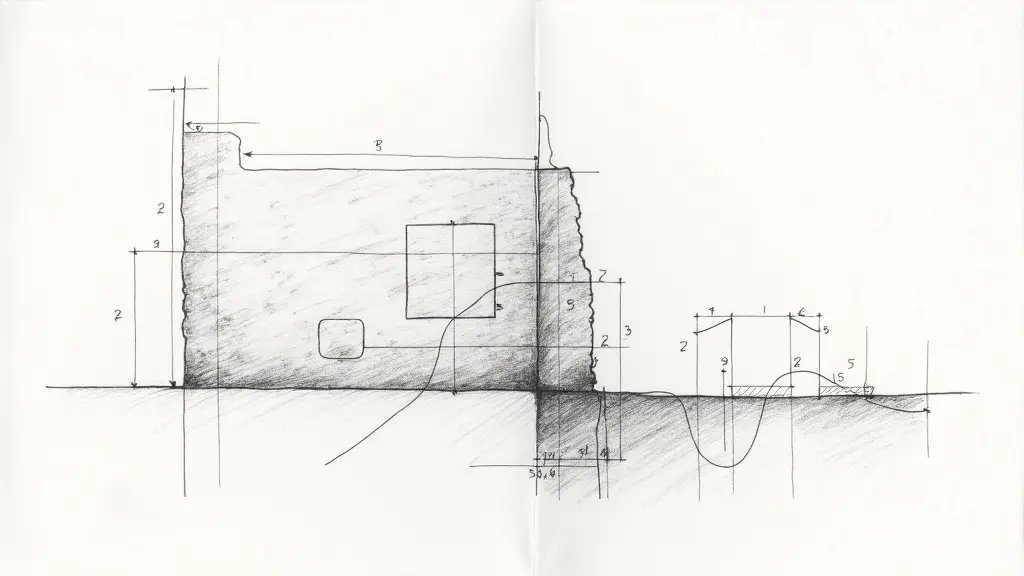
Your stone wall in the old town of Antibes is oozing moisture 50 cm above the floor. You’ve cleaned and repainted, but the damp returns. It’s been going on for two years. Yet the cause is often mechanical: untreated capillary rise. In old Antibes, with its limestone rubble walls and sometimes century-old water network, this phenomenon is common. But without a precise diagnosis, you risk treating symptoms without addressing the source.
What You See — and What It Really Hides
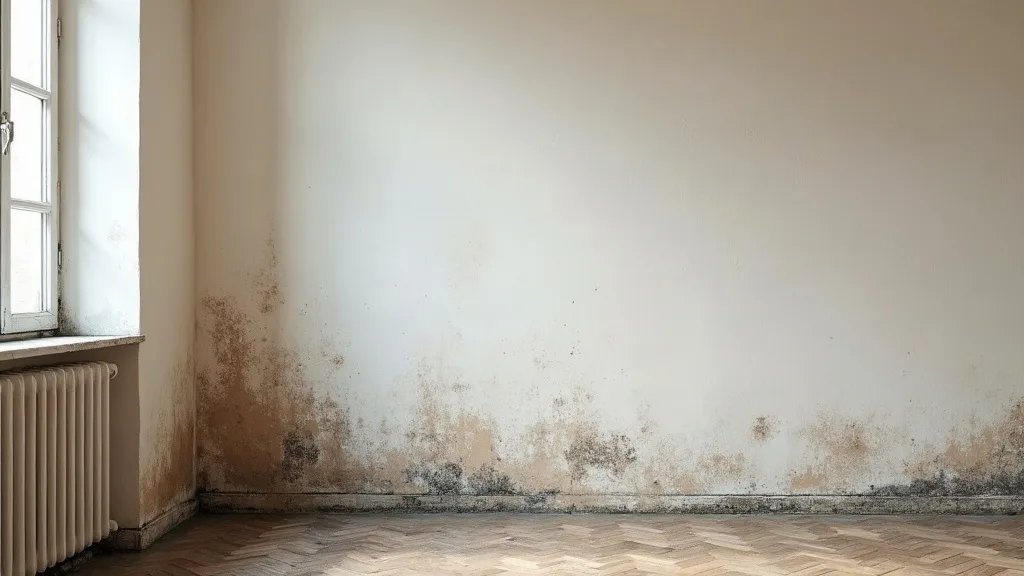
A damp patch rising along the wall, white efflorescence, saltpeter. You think it’s a leak? Possible, but in old buildings in Antibes, capillary rise is the number one cause. The porous limestone wall sucks water from the ground by capillarity. The water sometimes rises up to 1 meter. What no one tells you: visual diagnosis is not enough. You need to measure moisture content, conductivity, and especially calculate the hydrostatic pressure at the base of the wall.
On a case in Antibes last year, I measured 18% moisture content in an 80 cm thick wall, compared to 3% in a healthy wall. The owner had already invested €5,000 in water-repellent paint. Result: water rose behind the paint, causing blisters. Frankly, without a technical diagnosis, you’re throwing money out the window.
The Calculations That Change Everything: Capillary Pressure and Equilibrium Height
The capillary rise height in a wall is calculated using Jurin’s law: h = (2γ cosθ) / (ρ g r), where γ is the surface tension of water (0.072 N/m), θ the contact angle (for limestone, about 30°), ρ the density of water (1000 kg/m³), g gravity (9.81 m/s²), and r the pore radius. For limestone from the Antibes region, the average pore radius is about 0.1 mm (10⁻⁴ m).
Calculation: h = (2 × 0.072 × cos30°) / (1000 × 9.81 × 10⁻⁴) = (0.144 × 0.866) / (9.81 × 10⁻¹) = 0.1247 / 0.981 ≈ 0.127 m, i.e., 12.7 cm. But this theoretical calculation assumes cylindrical pores. In reality, limestone porosity is complex, and on-site measurements show rises of 50 cm to 1.20 m. The French DTU 20.1 (section 5.3.2) — a technical document for building construction — recommends a standard rise height of 1.00 m for untreated stone walls. Practically, this means your render must be vapor-permeable over this entire height, otherwise water accumulates behind.
What does this mean in practice? I measured a wall in Antibes with a capacitive moisture meter: 15% moisture at 30 cm from the floor, 8% at 80 cm, and 4% at 1.20 m. The moisture content curve follows a decreasing exponential law. The saltpeter (nitrate) threshold appears above 10% moisture. Your wall is therefore in the critical zone.
What Happens If You Do Nothing: Cascade of Deterioration
At 6 months: efflorescence thickens, paint blisters. At 2 years: saltpeter degrades the render, cracks appear. At 5 years: the wall loses cohesion, stones become loose. Repair cost: expect €200 to €400 per m² for treatment by injecting hydrophobic resin, plus render redo. Not to mention damage to woodwork and furniture. In the old town of Antibes, where walls are shared, moisture can also migrate to the neighbor’s side.
Secondary pathologies: mold (respiratory risk), degradation of wooden floors, corrosion of embedded pipes. A case in Antibes: an owner waited 3 years before acting; the wall partially collapsed during neighboring construction work. Bill: €15,000 for emergency repairs.
Recourse and Guarantees: What You Can Demand
The ten-year liability guarantee (“garantie décennale”) does not cover capillary rise if it is due to a design defect (lack of a damp-proof barrier). However, DTU 20.1 (section 5.3.2) requires a capillary barrier in new walls. For an old building, you can rely on professional standards: injection treatment is the recognized solution. Procedure: send a registered letter with acknowledgment of receipt to your home insurer (multi-risk home insurance) to declare a claim. If refused, take the case to the Grasse judicial court (“tribunal judiciaire de Grasse”). Hire an independent expert like Cassini Expertise for a technical report before any action. In parallel, check your Local Urban Plan (PLU) in Antibes: some areas impose drainage rules.
Don’t forget that DTU 43.1 (section 4.2.1) deals with waterproofing of flat roofs, but may be useful if your roof is involved. See our article on flat roof infiltration in Marseille.
📅 Mis à jour le 31/08/2026 — Par Cassini Expertise, expert bâtiment indépendant 06 & 83. Devis gratuit : 04 22 46 06 04.
Questions fréquentes
What causes capillary rising damp in old buildings?
Capillary rising damp occurs when groundwater containing dissolved salts rises through the porous materials of old walls, such as stone or brick, due to capillary action. In historic buildings like those in Antibes, the lack of a proper damp-proof course and the use of highly absorbent materials exacerbate the problem, leading to moisture and salt damage.
How to diagnose capillary rising damp in historic buildings?
Diagnosis involves a combination of visual inspection, moisture meter readings, and analyzing salt content in wall samples. For historic buildings in Antibes, it's crucial to distinguish rising damp from other moisture sources like condensation or leaks, and to assess the extent of damage to plaster and masonry before planning treatment.
What are the best treatments for capillary rising damp in old buildings?
Effective treatments include installing a chemical damp-proof course, improving drainage around the building, and using breathable, salt-resistant plasters. For historic structures, it's essential to use reversible and compatible materials to preserve the building's heritage, and to address any external factors like ground levels or defective gutters that contribute to the problem.
Cassini Expertise
Expert du bâtiment indépendant — Antibes (06·83·13·40)
📅 Mis à jour le 19/09/2026 — Cassini Expertise, expert bâtiment indépendant (06·83·13·40).