The Alpes-Maritimes and Var departments experience significant structural crack damage. Clay soils subject to shrink-swell movement (a moderate-to-high hazard across the entire Alpes-Maritimes department, notably in Antibes, Vallauris and Biot, according to the French administration’s shrink-swell hazard classification), moderate seismic activity (zone 3 under current seismic design standards), and drought episodes alternating with intense rainfall: these combined factors place heavy stress on foundations. Cassini Expertise works across the Alpes-Maritimes and Var to provide an independent technical diagnosis, in line with recognised inspection methods, and to establish the legal qualification of the damage (hidden defect, construction fault, ten-year structural warranty).
Technical crack classification
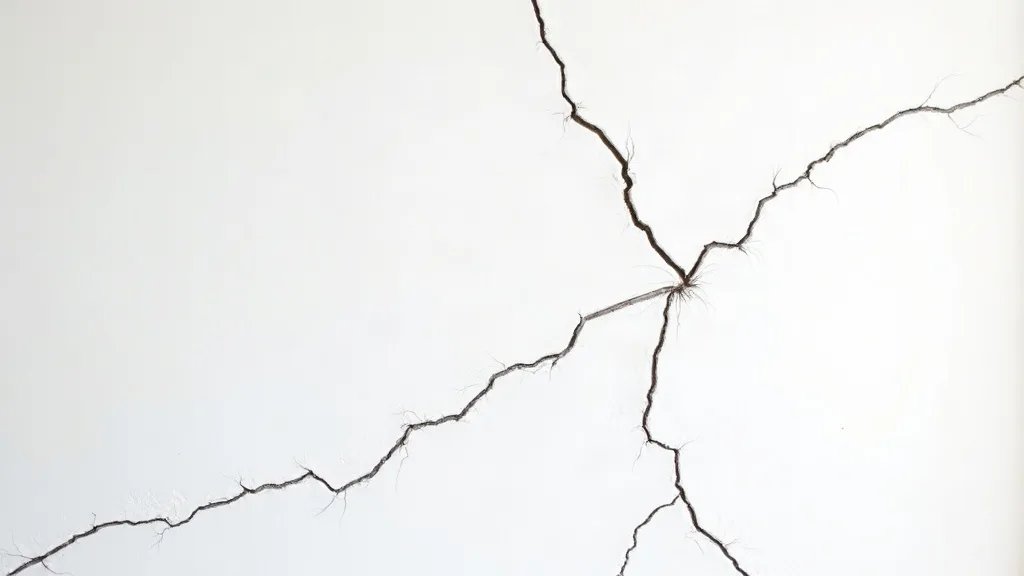
Standard XP P94-090-1 (« Measurement of shrink-swell potential of clay soils ») provides the reference framework for analysing damage linked to differential ground movement. The expert classifies cracks according to width measured with a crack gauge:
- Micro-cracks (< 0.2 mm): superficial, generally limited to the surface finish (render, plaster). No structural impact.
- Fine cracks (0.2 to 2 mm): may indicate slight structural movement; monitoring is required.
- Medium cracks (2 to 5 mm): a sign of significant differential movement. Intervention is recommended to halt progression.
- Wide cracks (> 5 mm): constitute characterised structural damage, with a risk to the building’s stability under Article 1792 of the French Civil Code.
The expert also records the crack pattern: horizontal (settlement, subsidence), vertical (thermal or moisture shrinkage), stepped (following masonry joints, typical of differential settlement), or fanning out at an angle (localised compression). This precise mapping helps identify the primary cause of the damage.
Common causes of cracks in the Alpes-Maritimes and Var
Clay shrink-swell movement
Shrink-swell movement in clay soils is the leading cause of structural cracking in the South-East of France. During drought, clay soil loses moisture and contracts; during rainfall, it absorbs water and swells. These volume changes cause differential movement beneath foundations. The decree of 22 July 2020 requires a preliminary geotechnical study (G1) in moderate or high hazard zones, under Article L. 112-20 of the French Construction and Housing Code and standards NF EN 1997-1 and NF EN 1997-2. Failure to carry out this study constitutes a construction fault engaging the builder’s liability.
Design or execution defects in foundations
Shallow foundations unsuited to the ground conditions, missing horizontal and vertical tie-beams, structural discontinuity (an extension not properly bonded to the existing structure), or undersizing: these faults fall under the builder’s contractual liability (Article 1792 et seq. where structural stability is affected, Article 1792-2 for inseparable fixed equipment).
Water infiltration and inadequate drainage
The absence or poor execution of perimeter drainage leads to water accumulating against the foundations. Local moistening of clay soil causes swelling and, consequently, differential thrust. Standard DTU 20.1 (« Small-element masonry structures — Walls and partitions ») requires drainage to be installed in compliance with DTU 20.12 (« Masonry and associated structures — Fired-clay brick walls »).
Nearby vegetation
Trees with extensive root systems (plane trees, poplars, oaks) located close to foundations draw water from the soil during the growing season, worsening shrinkage. The expert assesses the critical distance based on the species and trunk diameter.
Expertise method: document review, on-site inspection, technical report
Preparatory phase: document review
Before visiting the site, the expert gathers and reviews all available documents: building permit, foundation plans, G2 geotechnical study (if one exists), site reports, as-built records, construction contracts, and insurance documents (ten-year and building-damage policy certificates). This review helps identify the responsible parties and the applicable warranty regime.
On-site inspection
The expert carries out a full inspection of the building, recording every visible crack, inside and out, using a crack gauge. Each crack is systematically recorded: location, orientation, width, length, and depth (assessed by knife probe or localised drilling). Plaster or resin monitoring markers may be installed to track progression objectively over several weeks to several months.
The expert also examines associated damage: floor deformation (measured with a spirit level or theodolite), partition detachment, wall tilt (verticality measurement), sagging thresholds, and malfunctioning doors and windows.
Further investigation where necessary
Depending on the complexity of the case, the expert may recommend a G5-type geotechnical study (« geotechnical diagnosis ») to precisely characterise the soil and define the necessary reinforcement works. Non-destructive testing (infrared thermography, sonic testing) may be carried out to detect voids beneath foundations or masonry defects.
Written report
The expert’s report includes: a technical description of the damage, its mapping, measurement results, a ranked analysis of causes, the legal qualification (ten-year structural warranty, two-year warranty, warranty of perfect completion, hidden defect), an assessment of the risk to the building’s stability, and costed recommendations for repair works. This report is admissible evidence before the competent regional court (Tribunal Judiciaire of Grasse for Antibes, Cannes, Vallauris, Grasse and Mougins; of Nice for Nice and the eastern Alpes-Maritimes; of Toulon for Toulon, Hyères and La Seyne-sur-Mer; of Draguignan for Fréjus, Saint-Raphaël and Draguignan).
Applicable legal framework: statutory warranties and liability
Ten-year structural warranty (Article 1792 of the Civil Code)
« Every builder of a structure is automatically liable to the owner or purchaser of the structure for damage, even resulting from a ground defect, that compromises the structure’s stability or that, by affecting one of its constituent or fixed equipment elements, renders it unfit for its intended purpose. » The warranty runs for ten years from the date the works are accepted. Wide, progressive cracks that compromise the building’s stability fall under this warranty.
Two-year warranty (Article 1792-3 of the Civil Code)
This covers, for two years, equipment elements that can be separated from the structure (for example, a retrofitted drainage system).
Warranty of perfect completion (Article 1792-6 of the Civil Code)
For one year after acceptance of the works, the builder must repair any defect reported by the client, regardless of severity.
Hidden defects (Articles 1641 et seq. of the Civil Code)
If the seller of a property failed to disclose a defect rendering it unfit for its intended use, the buyer has two years from discovery of the defect to bring a claim under the hidden-defects warranty.
General contractual liability (Articles 1103, 1217 and 1231-1 of the Civil Code)
Faults not covered by the ten-year structural warranty (superficial cracks, non-compliance with the technical specifications) engage the contractor’s general contractual liability. The client must prove non-performance or defective performance and the resulting loss.
Technical repair solutions
Underpinning with micropiles or ground beams
Where differential settlement is caused by insufficient soil bearing capacity, underpinning transfers loads down to a stable soil layer at depth. Drilled micropiles (steel or reinforced concrete) pass through compressible layers and anchor into a resistant stratum. This technique is costly but provides a permanent fix.
Expanding resin injection
Injecting expanding polyurethane resin beneath the foundations fills voids, densifies the soil and slightly lifts the foundations. This method suits moderate, localised settlement. It does not remove the need to address the root cause (improved drainage, rainwater management).
Improved drainage and water management
Installing a perimeter drain in compliance with DTU 20.12, combined with a waterproof membrane at the base of the wall, helps carry away infiltrating water and stabilise soil moisture. Rainwater must be collected and directed to an outlet well away from the foundations.
Stitching, bridging and sealing cracks
Once the cause has been treated and progression halted (confirmed by monitoring markers over several months), cracks can be repaired: metal staples to bind the crack edges together, fibreglass mesh bridging embedded in render, or flexible sealant or repair mortar depending on the residual width.
Why choose Cassini Expertise?
Cassini Expertise is an independent firm based in Antibes (22 rue Vauban, 06600), working across the Alpes-Maritimes and Var. The expert applies a rigorous methodology in line with current standards (NF P 94-500 pour la géotechnique, NF P 94-430, DTU 20.1, DTU 20.12), and delivers a detailed written report that can be used in an amicable procedure (negotiation with your insurer, mediation) or in court (before the Tribunal Judiciaire of Grasse, Nice, Toulon or Draguignan, or on appeal before the Court of Appeal of Aix-en-Provence).
Dual expertise in building and topography allows for precision measurements (levelling, verticality) in accordance with standards NF EN ISO 4463-1 and NF EN 13001, providing objective evidence of structural deformation. The firm carries out technical assessments of structural damage and stability diagnostics for buildings.
For any request, contact Cassini Expertise on 04 22 46 06 04.
Frequently asked questions
From what width does a crack need to be assessed by an expert?
Any progressive crack, whatever its width, warrants an expert assessment. Cracks wider than 2 mm, or with a stepped or horizontal pattern, should be treated as suspicious and monitored with markers before undergoing a full technical diagnosis.
What is the deadline for taking action after discovering cracks?
If the works were accepted less than a year ago: warranty of perfect completion (Article 1792-6). Between one and two years: two-year warranty for equipment elements (Article 1792-3). Under ten years, with an impact on stability: ten-year structural warranty (Article 1792). Beyond ten years, only a hidden-defects claim can be brought (Articles 1641 et seq.), within two years of discovering the defect.
How much does a crack expertise assessment cost in the Alpes-Maritimes?
Fees vary depending on the building’s size, the complexity of the damage and whether ongoing monitoring is required. Expect between €800 and €1,500 excluding tax for a standard single-family home. The cost of the assessment may be covered by building-damage insurance or by the builder if their liability is established.
Can the expert be involved in a court case?
Yes. An amicable expert report is admissible evidence before the regional court. If a judge orders a court-appointed expertise, the appointed expert can draw on findings already made. Cassini Expertise appears before the Tribunaux Judiciaires of Grasse, Nice, Toulon and Draguignan, as well as on appeal before the Court of Appeal of Aix-en-Provence.
Cassini Expertise
Expert du bâtiment indépendant — Antibes (06·83·13·40)
📅 Mis à jour le 25/09/2026 — Cassini Expertise, expert bâtiment indépendant (06·83·13·40).