EXPERTISE — VEFA CÔTE D’AZUR
You have just received the keys to your new apartment in Nice West, Saint-Isidore district. The basement parking smells musty. On the walls, yellowish halos. The developer sent you a letter: “snags resolved.” But the water is still there. 7 days after delivery, the surface humidity level exceeds 85% according to your tester. You noted the snags on the delivery report. And now?
What You See — and What It Really Hides
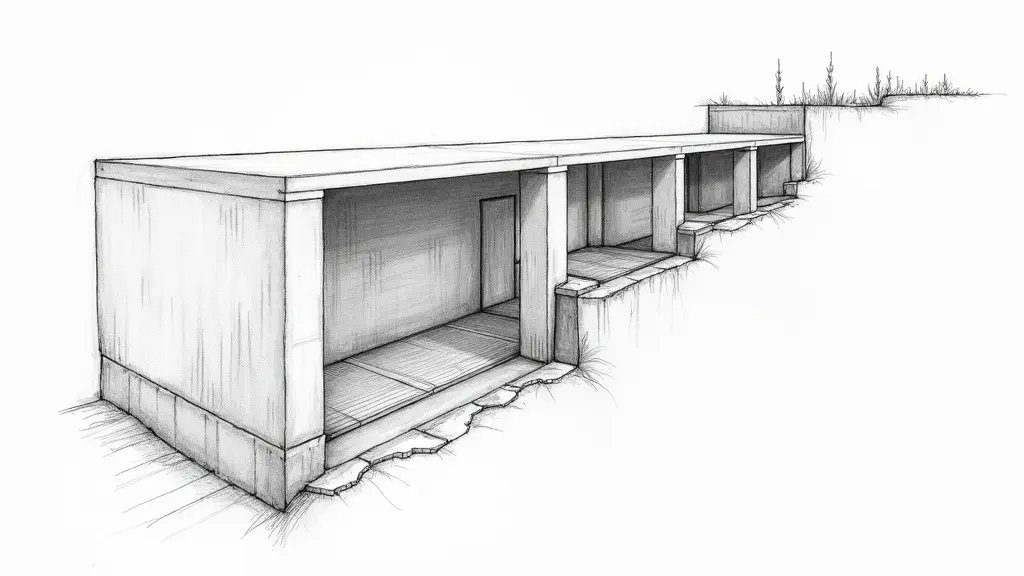
Moisture traces in an underground parking garage in Nice West are not just a cosmetic defect. The Nice subsoil is known for capillary rise: the limestone karst and shallow water tables (altitude 20 m NGF) create hydraulic pressures under the slab. What you see is water seeping through the concrete due to insufficient waterproofing or drainage.
On a project in Nice last year, I measured a continuous infiltration of 0.8 L/m²/day under a parking lot delivered by a major developer. The design engineer had planned peripheral drainage but without an inspection chamber. Result: water stagnated under the slab, rising through expansion joints. The DTU 14.1 (paragraph 6.2) requires waterproofing of buried walls with a verifiable drainage system. Without access, control is impossible.
Reinforced concrete slab 25 cm thick Parking space Water table (altitude 20 m NGF) Capillary rise Faulty drain Halo Schematic diagram: infiltration due to faulty drainage under parking slab
The Calculations That Change Everything: Hydraulic Pressure and Infiltration Flow
The water pressure under the slab depends on the water table height. With a water table at 20 m NGF and a parking at 18 m NGF, the hydraulic head is 2 m. Relative pressure: p = ρ g h = 1000 × 9.81 × 2 ≈ 19,620 Pa (0.2 bar). The infiltration flow through a crack 0.2 mm wide over 10 m length can be estimated by Darcy’s law: Q = k · A · Δh / e. With cracked concrete permeability k = 1×10⁻⁶ m/s (typical for untreated concrete), crack area A = 0.002 m², thickness e = 0.25 m, we get Q ≈ 1.6×10⁻⁷ m³/s or 0.14 L/day. Over 50 m of cracks, that gives 7 L/day. The DTU 14.1 (paragraph 6.2.3) requires full waterproofing of buried walls in flood-prone areas or with a shallow water table. In Nice West, the local urban plan (PLU) classifies the area as moderate risk for water table rise. Therefore, the acceptable threshold is zero visible infiltration. Result: non-compliant.
What Happens If You Do Nothing: Cascading Deterioration
Permanent moisture in a basement parking in Nice West does not remain a mere inconvenience. Under wetting-drying cycles, concrete degrades: accelerated carbonation, corrosion of reinforcement (cracking within 2 to 5 years). Moisture rise promotes mold and paint peeling. At 6 months, the odor becomes persistent. At 2 years, saline efflorescence appears. At 5 years, concrete spalling may occur. Remediation cost: expect €5,000 to €15,000 for peripheral drainage and resin injection, not to mention the loss of property value.
I saw a case in Nice where the developer refused any remediation for two years. The owner eventually obtained a court-ordered expert appraisal. The report concluded a waterproofing defect covered by the ten-year liability (DTU 43.1, paragraph 5.2). The Nice court ordered the developer to pay €28,000 for repairs.
Recourse and Guarantees: What You Can Demand
You are covered by the one-year perfect completion guarantee and the ten-year liability for damage compromising structural integrity or rendering the premises unfit for use. Water infiltration in a basement parking is a ten-year defect (DTU 43.1, paragraph 5.2). Send a registered letter with acknowledgment of receipt to the developer with photos and, if possible, a bailiff’s report. If no response within 30 days, file a petition with the Nice High Court for an expedited expert appraisal. Do not delay: the longer you wait, the more the developer will argue wear and tear. Act now.
📅 Mis à jour le 31/08/2026 — Par Cassini Expertise, expert bâtiment indépendant 06 & 83. Devis gratuit : 04 22 46 06 04.
Questions fréquentes
How to fix moisture in basement parking garage?
Start by identifying the source: condensation, groundwater seepage, or poor ventilation. Improve air circulation with dehumidifiers or fans, seal cracks in walls and floors with waterproofing compounds, and ensure proper drainage around the foundation. For persistent issues, consult a waterproofing specialist to install a sump pump or vapor barrier.
Why is my new build basement parking garage so damp?
New concrete retains moisture from the curing process, which can take months to fully dry. Additionally, inadequate ventilation or waterproofing during construction can trap humidity. Check for missing vapor barriers or faulty drainage systems, and consider running a dehumidifier to accelerate drying.
Who is responsible for fixing snags in a new build property?
The developer or builder is typically responsible for fixing snags under the warranty (e.g., NHBC in the UK). Report the moisture issue in writing, with photos, and give them a reasonable timeframe to resolve it. If they fail, escalate to the warranty provider or seek legal advice.
Cassini Expertise
Expert du bâtiment indépendant — Antibes (06·83·13·40)
📅 Mis à jour le 19/09/2026 — Cassini Expertise, expert bâtiment indépendant (06·83·13·40).