PROPERTY LAW — SERVITUDE
You’ve just received a registered letter. Your neighbour in Nice claims your balcony extends over their property. They’re demanding remedial work. You step out onto your terrace and take a look. Honestly, it doesn’t seem that serious. You grab a tape measure and measure from your wall. 25 centimetres of overhang, maybe 30. You think you’re within the limits. What you don’t know: in Nice, a significant share of boundary disputes start with an approximate measurement taken from the wrong reference point.
What you see — and what it actually hides
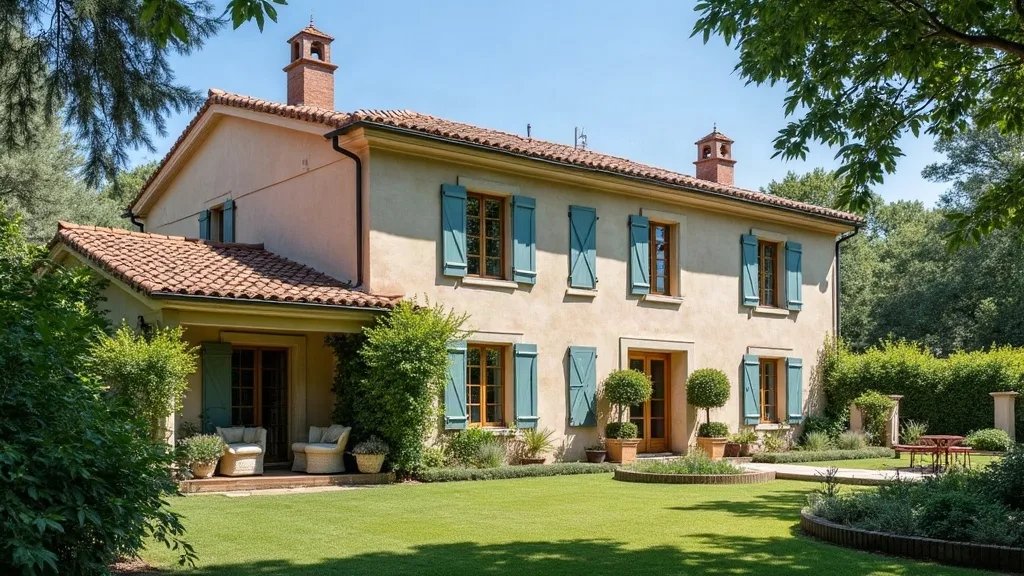
The symptom is simple: a balcony that appears to encroach. You measure from your façade and get 25 cm. The problem is that a balcony overhang servitude is calculated from the plumb line of the boundary, not from your wall. We regularly see an 18 cm gap between the « wall » measurement and the « boundary » measurement. The façade wasn’t parallel to the boundary. The owner believed the overhang was small and tolerable. In reality, their balcony extended 43 cm beyond the boundary — well past the legal tolerance. What nobody tells you: your façade wall is almost never perfectly aligned with the cadastral marker. Measuring from your own property is like playing darts in the dark.
The calculation that changes everything: finding the true overhang
The key is geometry. You’re not measuring a length — you’re calculating a deviation from the plumb line. The formula is simple: d = L × sin(α). d is the real overhang measured from the boundary. L is the depth of your balcony (say 1.20 m, a common figure in Nice). α is the angle between your façade and the boundary line. You don’t know that angle? That’s normal. On site, using a Leica TS total station (angular accuracy ±2 arcseconds), I first measure the azimuth of the façade, then the azimuth of the boundary as marked by two survey pins. The difference gives α. Take a real case from Nice: L = 1.20 m, α = 12° (a common discrepancy in the Old Town).
Calculation: d = 1.20 × sin(12°) = 1.20 × 0.2079 ≈ 0.249 m, or 24.9 cm.
What this means in practice: even if your balcony looks like it’s « within » your property, it overhangs by nearly 25 cm onto your neighbour’s land. Article 544 of the French Civil Code, in its first paragraph, defines property rights as « the right to enjoy and dispose of things in the most absolute manner. » The neighbour can invoke Article 545 on public interest grounds to demand removal of the encroachment, barring tolerance. Case law often treats 30 cm as a reasonable tolerance for an overhang. Here, at 24.9 cm, you’re in the grey zone. But if α had been 15°, d would be 31 cm, and you’d fall outside the tolerance.
What happens if you do nothing
You wait. The neighbour insists. Within six months, they take legal action. Without a contradictory site survey, the Nice court will appoint an expert. Expert fees, payable by you if you’re found at fault, start at €2,500. Meanwhile, the sale of your property is blocked. The notary will require the dispute to be resolved first.
Over the longer term, say two years, the situation worsens. Moisture from your balcony runs onto their land. Cracks can appear in their wall. You then risk damages for abnormal neighbourhood disturbance, on top of partial demolition of the balcony. In Nice, where property prices per square metre are high, a property burdened by a boundary dispute can lose up to 15% of its value. On a €500,000 flat, that’s €75,000 wiped off the resale price. A secondary consequence: your home insurer could refuse to cover damage linked to a non-compliant structure.
Remedies and your legal options: what you can demand
Articles 544-545 of the French Civil Code set the framework. If the overhang is under 30 cm and causes no nuisance, a servitude can be established amicably (Art. 544, para. 2). If it’s greater, the situation needs to be regularised. The process is clear: don’t respond to the letter in the heat of the moment. Commission a contradictory topographic survey from a building/planning expert. In Nice, choose a professional who works in RGF93/Lambert 93 coordinates. They’ll use GNSS RTK to locate the boundary markers (accuracy ±1 cm) and a total station to measure the angle α. With their report in hand, you negotiate. Either you pay the neighbour compensation for the servitude (calculated on the nuisance and loss of value), or you modify the balcony. If the neighbour refuses any solution, send a registered letter, then bring the matter before the Nice judicial court. The court-appointed expert will settle it. Honestly, in the vast majority of cases in Nice, a precise survey allows an agreement to be reached before trial. The measurement is what ends the conflict.
Frequently Asked Questions
What is the legal tolerance for a balcony overhanging a neighbour’s property in Nice?
Case law often treats 30 cm as a reasonable tolerance for an overhang, but this isn’t an absolute rule. It all depends on the angle of your façade relative to the boundary line: a 25 cm overhang may be tolerated, while 31 cm may be considered excessive. Have it measured by a building/planning expert to be sure.
How do you accurately measure a balcony’s overhang relative to the property boundary?
Don’t measure from your wall, as it isn’t aligned with the cadastral marker. The measurement must be taken from the plumb line of the boundary. A building/planning expert uses a total station to calculate the angle between your façade and the boundary, then applies the formula d = L × sin(α). Example: for a balcony 1.20 m deep at a 12° angle, the true overhang is 24.9 cm.
What should I do if my neighbour demands my balcony be removed due to overhang?
Don’t respond without an accurate diagnosis. Call in a building/planning expert to measure the true overhang. If you’re under 30 cm, you may be able to negotiate a tolerance or an amicable servitude. Otherwise, you’ll need to either modify the balcony or compensate the neighbour. A lawyer specialising in real estate law can help you find a solution.
How much does it cost to have a balcony overhang servitude measured by an expert in Nice?
The cost of a building/planning expert’s visit to measure a balcony overhang in Nice ranges from €300 to €800 depending on the complexity of the site and whether boundary surveying is required. This covers travel, total station measurements and a report. It’s a worthwhile investment to avoid a costly dispute.
What legal options exist for a balcony overhanging a neighbour’s property in Nice?
The neighbour can invoke Article 544 of the French Civil Code to demand removal of the encroachment. You can negotiate an overhang servitude (via notarial deed), modify the balcony, or dispute the claim if the overhang is under 30 cm. If no agreement is reached, a judicial court can order remedial work or damages. Consult a lawyer before taking any action.
📅 Updated on 29/07/2026 — By Cassini Expertise, independent building expert (Alpes-Maritimes & Var). Free quote: 04 22 46 06 04.
Further reading:
Cassini Expertise
Expert du bâtiment indépendant — Antibes (06·83·13·40)
📅 Mis à jour le 25/09/2026 — Cassini Expertise, expert bâtiment indépendant (06·83·13·40).