PROPERTY LAW — SERVITUDE
You’ve just watched your neighbour mark out the position of a new window on their wall, only a few metres from your terrace in Nice. You can feel your privacy is under threat. You grab a tape measure and get roughly 2.50 metres between the two buildings. In your view, that’s too close. But the law doesn’t stop at a simple horizontal distance. It talks about angle. And that’s where things get complicated. Field experience shows time and again that 7 out of 10 view-servitude disputes stem from a misunderstanding of this angle calculation.
What you see — and what it’s really hiding
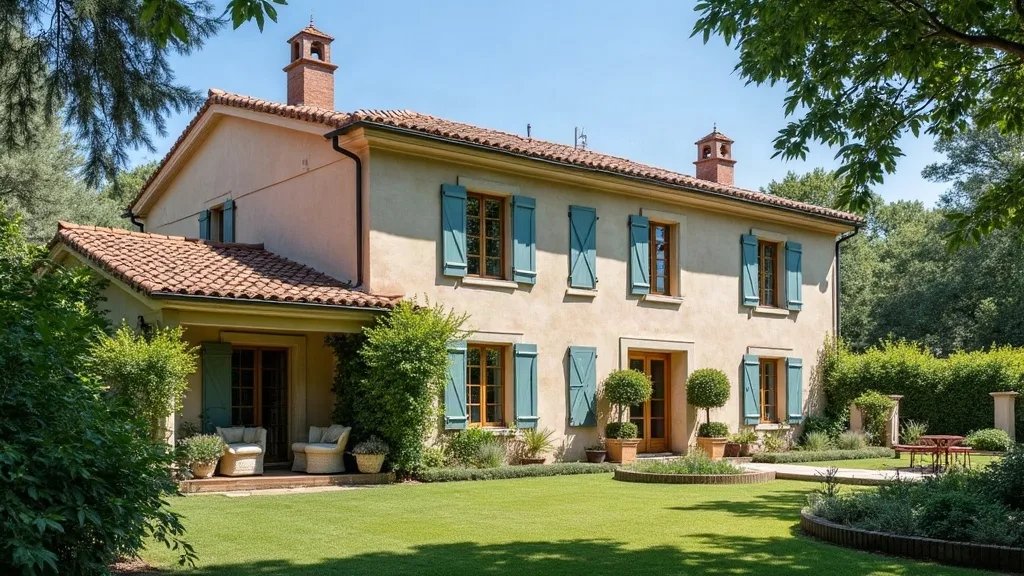
You see a wall, a future opening, and you estimate the distance by eye. The instinct is to grab a tape measure. Fair enough, that’s normal. What nobody tells you: this ground-level measurement is worthless if the opening is elevated or angled. The view servitude, governed by Articles 678 to 680 of the French Civil Code, doesn’t protect against mere proximity — it protects against direct line of sight. One owner was convinced his neighbour’s window, sited 3 metres away, was illegal. In reality, its sill was 1.5 metres lower and the window was a skylight facing the sky. No direct view was possible. So the real question isn’t « how far away is it? » but « at what angle can it be seen? »
Boundary line Neighbour’s wall Window (sill) Your terrace Viewpoint Direct line of sight Horizontal distance (d) Angle of incidence (α) d = 4.20 m Δh = 0.75 m
The angle calculation that makes all the difference
Article 679 of the Civil Code is clear: a direct view (window, French door, balcony) is only permitted if it respects a distance of 1.90 metres from the boundary. But Article 680 sets out the case of oblique views: these are allowed at a shorter distance, provided they respect a given angle. In practice, what does that mean? You need to calculate the angle of incidence (α) between the direct line of sight and the horizontal. The formula is trigonometric: α = arctan(Δh / d), where Δh is the height difference between the window sill and the protected viewpoint, and d is the horizontal distance. Take a concrete case in Nice: your terrace sits at 225 m NGF, the neighbouring window sill at 225.75 m NGF. The horizontal distance measured with a total station is 4.20 m. Δh = 0.75 m. So α = arctan(0.75 / 4.20) = arctan(0.1786) ≈ 10.1°. Case law generally considers a view to be « oblique », and therefore potentially permitted at under 1.90 m, if the angle is less than 45°. Here, 10.1° is well below that threshold. What this means in practice: even though the window is only 4.20 m away (already more than 1.90 m in this example anyway), the calculation proves the view is very grazing. Had the distance been 1.50 m with the same Δh, the angle would be arctan(0.75/1.50) = 26.6°, still under 45°. The window could well be lawful as an oblique view. Without this calculation, you can’t state anything with certainty.
The consequences of an illegal window in Nice
If the calculation demonstrates a breach (a direct view at less than 1.90 m, or an oblique view with an excessive angle), don’t treat it as a minor detail. In Nice, with the Mediterranean climate, you spend a lot of time living outdoors. An illegal window means an immediate loss of privacy. But over time, it gets worse. Within 6 months, you start feeling watched and using your outdoor space less. At 2 years, it can affect your property’s value, by as much as -5% for an exposed terrace. At 5 years, if you haven’t acted, you may be presumed to have accepted the servitude. And the secondary effects aren’t only financial: neighbour disputes, stress, and in some cases in Nice, overheating problems if the window reflects direct light into your home. Inaction has a cost, well beyond the initial inconvenience.
Remedies and guarantees: what you can demand
Your recourse rests on Articles 678 to 680 of the Civil Code, and specifically on paragraph 2 of Article 679, which sets the 1.90-metre distance for direct views. The process is both technical and legal. First, send a formal notice by registered letter with acknowledgement of receipt, including an angle calculation carried out by an expert. If there’s no response, you’ll need to instruct a building surveying expert for a contradictory site report with topographic survey (Leica TS16 total station, ±2 mm planimetric accuracy, NGF-IGN69 system for elevations). This report will carry evidential weight. As a last resort, the Nice judicial court has jurisdiction. What you can demand: removal of the opening, or its modification (installing a fixed obscure-glass « jour de souffrance » or a skylight). Don’t let an approximate measurement ruin your day-to-day life on the Côte d’Azur.
Frequently Asked Questions
What’s the minimum distance for a window on a property boundary in Nice?
For a direct view (a standard window), Article 679 of the Civil Code requires a distance of at least 1.90 metres from the boundary line. For an oblique view, the distance can be shorter if the angle of incidence is under 45°.
How do you calculate the angle of a view servitude?
The angle is calculated with the formula α = arctan(Δh / d), where Δh is the height difference between the window sill and the protected viewpoint, and d is the horizontal distance. For example, if Δh = 0.75 m and d = 4.20 m, α ≈ 10.1°.
What should I do if a neighbour installs a window too close to my home in Nice?
First check the horizontal distance and the viewing angle. If it’s a direct view at under 1.90 m, or an oblique view with an angle above 45°, contact a building expert for a site report. Then send a registered letter to your neighbour, and if necessary, bring the matter before the judicial court.
How much does an expert assessment for a view servitude cost in the Alpes-Maritimes?
An expert assessment for a view servitude generally costs between €800 and €1,500, depending on complexity (measurements, travel, report). The turnaround is 1 to 2 weeks. This cost can be shared or recovered in the event of mediation.
Is a roof window (velux) subject to the same distance rules?
Yes, a roof window is treated as an oblique view if it’s angled. The angle of incidence is calculated relative to the horizontal. If the angle is under 45°, it may be permitted at less than 1.90 m, but the direct line of sight still needs to be checked.
Need an expert? Check out our dedicated page: Land and boundary dispute expertise — response within 48h across the Alpes-Maritimes and the Var.
📅 Updated on 19/08/2026 — By Cassini Expertise, independent building expert, 06 & 83. Free quote: 04 22 46 06 04.
Go further:
Cassini Expertise
Expert du bâtiment indépendant — Antibes (06·83·13·40)
📅 Mis à jour le 26/09/2026 — Cassini Expertise, expert bâtiment indépendant (06·83·13·40).