Legal planting distance: Article 671 of the French Civil Code
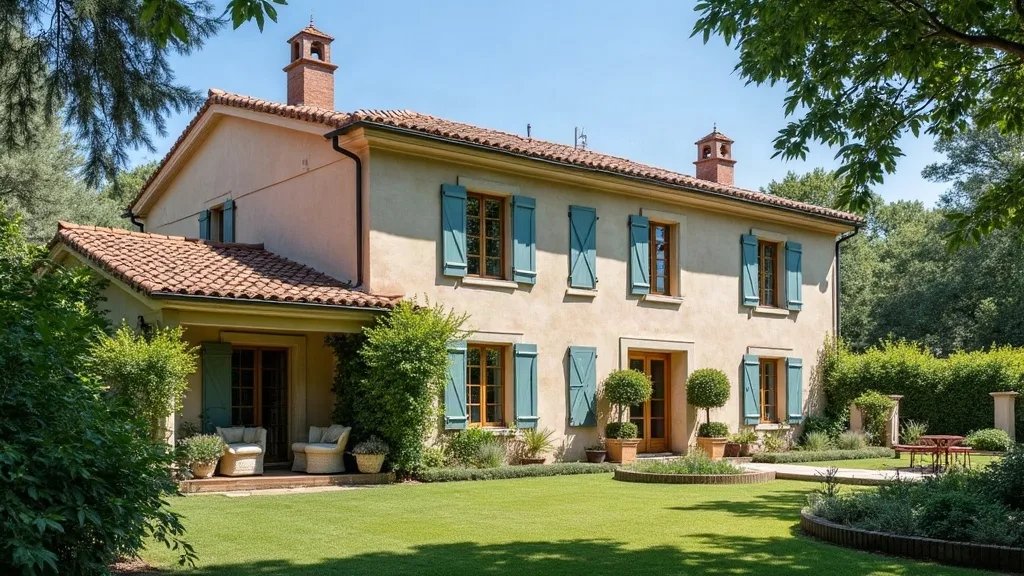
Article 671 of the French Civil Code sets two mandatory thresholds for any planting near a property boundary. If a hedge, tree, or shrub measures, or is intended to measure, more than 2 metres in height, it must be planted at least 2 metres from the boundary line. If its height does not exceed 2 metres, the minimum distance is 0.50 metres.
These distances are measured from the middle of the tree trunk or the base of the hedge to the dividing line between the two properties. They apply in the absence of local custom, a co-ownership regulation, or a title deed stating otherwise. In the Alpes-Maritimes and Var, case law from the Aix-en-Provence Court of Appeal confirms strict application of these thresholds, particularly in residential areas of Antibes, Cannes, Nice, Fréjus, and Toulon.
Failure to comply with Article 671 gives rise to a right to have the offending plantings removed. Legal action can be brought before the competent local court (Grasse for Antibes, Cannes, Vallauris; Nice for the eastern part of the department; Draguignan or Toulon for the Var) as long as the thirty-year limitation period under Article 2272 of the Civil Code has not lapsed. The Aix-en-Provence Court of Appeal has regularly upheld this remedy, even for long-established hedges planted without a title, notably in rulings on disputes in the Alpes-Maritimes.
Maximum hedge height: local planning rules
The Civil Code sets no maximum height for hedges planted at the legal distance. However, local planning regulations — local urban plans (PLU) and municipal by-laws — can impose limits for reasons of landscape integration, road safety, or the preservation of views.
In the Alpes-Maritimes, the PLUs of Nice, Antibes, Cannes, and Grasse often classify residential areas as UD (single-family housing) zones. In these zones, the height of hedge boundaries on the dividing line is frequently capped at 2 metres. Some municipalities in the Var (Hyères, Fréjus, Draguignan) set similar rules, sometimes adjusted according to proximity to public roads.
Exceeding the regulatory height constitutes a breach of planning law, punishable by a fine (Articles L. 480-4 et seq. of the French Planning Code) and may result in a compliance order. The affected neighbour can also bring a claim for abnormal neighbourhood disturbance under Article 1240 of the Civil Code if the excess height causes an unreasonable loss of light or sunlight.
Checking the applicable rules
Before any dispute or planting, it is advisable to consult the PLU regulation of the relevant municipality, available at the town hall or on the Géoportail de l’urbanisme website. In a co-ownership, the co-ownership regulation may also set specific heights. A building expert can check the compliance of an existing hedge on site and produce a report that can be relied upon before a judge. The municipal services of Antibes, Cannes, and neighbouring towns also provide the local requirements applicable to residential zones.
Duty to prune: Article 672 of the French Civil Code
Article 672 of the Civil Code distinguishes two situations. On the one hand, branches overhanging a neighbouring property can be cut back by the owner of the land they overhang, up to the boundary line. On the other hand, roots, brambles, and twigs that extend onto a neighbour’s land may be cut by the neighbour themselves, without prior formal notice.
For branches, the affected neighbour can require the tree’s owner to carry out pruning. If the owner refuses or delays, a formal notice sent by registered letter with acknowledgement of receipt is recommended. If there is no response, the neighbour can bring the matter before the competent local court to obtain a pruning order backed by a daily penalty.
In the case of a shared hedge — that is, one planted jointly on the boundary line or acquired through prescription — maintenance is the responsibility of both owners, split equally (Article 666 of the Civil Code). Each owner may trim their side up to the boundary line. If one of the co-owners refuses to do their share of the maintenance, the other can carry out the necessary work and claim half the cost through legal action.
Precautions before pruning
Before carrying out any work on a boundary hedge or tree, it is wise to check the plantings’ legal status (sole ownership or shared ownership), photograph the initial condition, and notify the neighbour in writing. A prior expert report helps document the encroachment, the species involved, and the pruning costs — useful evidence in the event of proceedings before the local court in Grasse, Nice, Draguignan, or Toulon. This report also provides a basis for an amicable resolution of the dispute before any formal proceedings are launched.
Neighbourhood disputes: procedure and evidence
Disputes over shared hedges fall under the jurisdiction of the local court where the property is located. Antibes, Cannes, Grasse, Mougins, and Vallauris fall under the Grasse local court; Nice, Cagnes-sur-Mer, and Vence under the Nice local court; Toulon, Hyères, and La Seyne-sur-Mer under the Toulon local court; Fréjus, Saint-Raphaël, and Draguignan under the Draguignan local court. Rulings can be appealed before the Aix-en-Provence Court of Appeal.
Proof of a breach of the planting distance rules relies on a joint measurement, ideally carried out by a court-appointed expert or an independent private expert. The report should include a site plan, dated photographs, measurements taken with a tape measure from the cadastral boundary, and, where applicable, an analysis of the title deed or previous boundary survey.
In the absence of a definitive boundary survey, the expert can record the apparent boundaries (fence, low wall, old hedge) and, if necessary, recommend an amicable or court-ordered boundary survey carried out by a licensed land surveyor. Cassini Expertise provides technical support to establish these findings before or during proceedings, but does not carry out boundary surveys itself, as this is reserved for licensed land surveyors.
Expertise method used by Cassini Expertise
Before any site visit, we review the photographs sent by the client, the cadastral plan, and, where available, the PLU regulation. On site, we take precise measurements of the planting distances using a laser tape measure, measure heights, and take photographs from several angles. We check whether the planting is jointly owned or private, look for evidence (old stumps, pruning marks), and research any local customs recorded at the town hall.
The written report summarises the measurements, cites the applicable articles (671, 672, 666 of the Civil Code, PLU provisions), provides a legal assessment of the situation (compliance or non-compliance with distances, private or shared status) and proposes, where applicable, corrective measures (removal, pruning, compliance work). This dated and signed report can be submitted in court or used as the basis for an amicable settlement.
Frequently asked questions
What is the minimum legal distance for planting a hedge on a property boundary in the Alpes-Maritimes or Var?
Article 671 of the Civil Code requires 0.50 metres for plantings under 2 metres in height and 2 metres for those exceeding that height, unless local custom, a co-ownership regulation, or a title deed states otherwise. These rules apply throughout the Alpes-Maritimes and Var.
My neighbour refuses to prune their hedge, which overhangs my property. What can I do?
Send them a formal notice by registered letter with acknowledgement of receipt, citing Article 672 of the Civil Code. If there is no response within fifteen days, bring the matter before the competent local court (Grasse, Nice, Draguignan, or Toulon) to obtain a pruning order backed by a daily penalty.
Can a shared hedge exceed 2 metres in height?
Yes, if the municipality’s PLU allows it and both co-owners agree. In the absence of agreement, or if local regulations limit the height, either co-owner can demand compliance. A refusal justifies legal action before the competent court.
Can I cut back overhanging branches myself?
Article 672 of the Civil Code allows you to cut back, at the boundary line, roots, brambles, and twigs yourself. For branches, you must first require the tree’s owner to carry out the pruning. Only if they persistently refuse, as confirmed by a bailiff or expert, can you bring the matter before a judge.
How can I prove a hedge does not comply with the legal distance?
Through a joint measurement taken from the cadastral boundary or definitive boundary survey. A private or court-ordered expert report, together with dated photographs and a scaled plan, provides the strongest evidence before the local court in Grasse, Nice, Draguignan, or Toulon.
Cassini Expertise, an independent building expert, operates across the Alpes-Maritimes and Var, handling expert assessments for neighbourhood disputes, boundary issues, and plantings. The firm is based in Antibes, 22 rue Vauban, 06600. Phone: 04 22 46 06 04. We produce detailed reports compliant with civil procedure rules, suitable for use in proceedings before the competent court.