CONSTRUCTION — CRACKS
You come home in Nice and discover a stair-step crack on the wall. It wasn’t there last week. You measure it: 2 mm wide, 80 cm long. You type « cracks after drought clay shrinkage BRGM zoning » into Google. In France, 10.4 million homes are built on clay soils sensitive to shrink-swell movement. In Nice, the risk is real, but often underestimated.
What you see — and what it’s really hiding
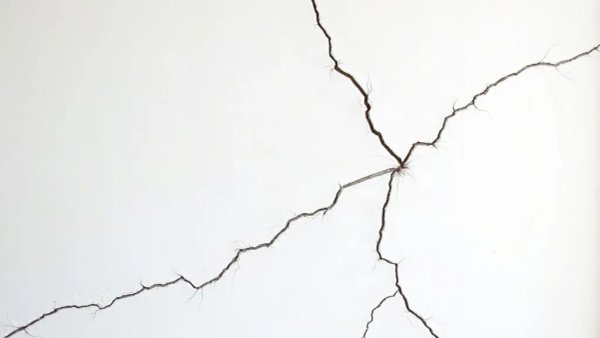
The crack follows the mortar joints, running diagonally between the bricks or concrete blocks. It often starts at the corner of a window or door. You assume it’s a construction defect. In reality, it’s the ground that’s moving. Clay shrinks during drought, as it did this past summer in Nice, where the rainfall deficit exceeded 60%. The foundation drops slightly, and the rigid wall cracks to follow the movement.
What I often see in these cases: homeowners wait for the next rainfall, hoping the crack will close up. Sometimes it shrinks a little. But the cycle repeats. Field experience regularly shows differential settlement of 15 mm between two corners of an 8-metre house. The corresponding crack was 3 mm wide. The clay soil had lost a significant share of its moisture in three months. The real problem isn’t the crack — it’s the ground moving beneath the foundation.
Stair-step crack Initial level Level after settlement Δh = 20 mm Clay soil (shrinkage) Foundation Foundation
Calculating the risk with BRGM zoning and Eurocode 7
The BRGM classifies soils according to their susceptibility to shrink-swell movement. For Nice, the map often shows a moderate to high hazard rating. But that’s not enough — you need to quantify it. Eurocode 7 (§6.6.2) provides the method for calculating potential settlement due to shrinkage. Simplified formula: s = α × Δw × H. Where s is the settlement (mm), α is the clay’s shrinkage coefficient (dimensionless), Δw is the change in water content (%), H is the thickness of the active clay layer (m).
Let’s take a concrete case in Nice. Realistic figures: α = 0.15 (plastic clay), Δw = 12% (typical summer drought), H = 1.5 m (depth of influence of shallow foundations). Calculation: s = 0.15 × 12 × 1.5 = 2.7 mm. Is this settlement uniform? No. If the soil is heterogeneous, one side can settle more than the other. Suppose a differential settlement Δs = 1.5 mm over a span L = 6 m between two foundation points. The angular rotation is θ = Δs / L. That gives θ = 1.5 / 6000 = 0.00025 rad. Eurocode 7 (§6.6.4) sets a tolerable limit for standard buildings at 0.002 rad. Here, θ = 0.00025 rad, so it’s below the limit. But be careful: this calculation assumes a homogeneous soil. If the clay is locally more sensitive (α can rise to 0.3), θ doubles. And if the drought worsens (Δw at 20%), θ triples. At that point, the tolerance threshold is exceeded.
In practical terms: your 2 mm crack in Nice may still correspond to a tolerable differential settlement. But if the soil is classified as high hazard by the BRGM and drought conditions recur, the movement will intensify. The crack will widen. You need to act before θ exceeds 0.002 rad — the threshold beyond which the damage becomes structural.
Do nothing, and it will only get worse
If you do nothing, the crack will keep evolving. In 6 months, after another dry summer in Nice, it could reach 3-4 mm. Rainwater seeps in, freezes in winter, and breaks apart the edges. Within 2 years, water infiltration appears indoors — damp patches, mould. Within 5 years, if the cycles continue, the crack can become structural. Windows and doors start jamming, and floor slabs become uneven.
The cost? A localised foundation repair (resin injection or micropiles) runs from €15,000 to €30,000. Wait too long, and you’ll need to underpin the entire façade: €50,000 and up. That’s before factoring in secondary damage — degraded insulation, falling property value. Frankly, in Nice, where property prices per square metre are high, failing to address a soil problem risks a price discount far greater than the cost of the repairs.
Remedies and warranties: what you’re entitled to demand
The ten-year structural warranty (garantie décennale) covers damage that compromises the soundness of a structure. A crack caused by clay shrinkage can fall under this warranty if it results from a design flaw in the foundations (foundations unsuited to Nice’s clay soil). BRGM zoning is a useful tool, but the project owner is required to commission a geotechnical soil survey (NF P 94-500 standard). If that survey was skipped, liability is engaged.
The process: have a bailiff record the damage (photos, measurements). Then send a registered letter with acknowledgment of receipt to the builder or the decennial insurer, citing the BRGM zoning and Eurocode 7 (§6.6). Request a joint expert assessment. The expert (a surveying and planning expert, as I am) measures the settlement using a precision level or a total station (±1 mm accuracy). He compares it against the tolerances. If the damage is confirmed, you can negotiate compensation or repairs. If not, the case goes to the Nice judicial court. What nobody tells you: insurers often push back, arguing the drought was « exceptional. » But if the soil is mapped as high hazard by the BRGM, the drought is only a triggering factor, not the root cause. The underlying cause is the unsuitable foundation. Several rulings in Nice have upheld this principle. Don’t face the crack alone.
Frequently Asked Questions
My crack is 2 mm wide — is it serious, and should I worry?
A 2 mm crack can signal ground movement caused by clay shrink-swell activity. In Nice, with a moderate-to-high hazard rating, you shouldn’t wait. Even if the crack looks small, differential settlement can worsen with future droughts. Have an expert measure its progression.
What should I do if I discover a stair-step crack on my wall in Nice?
Don’t panic, but act quickly. Take photos with a ruler to measure the width, note the date, and monitor how it develops. Contact a building expert to diagnose the cause (clay shrinkage) and check the BRGM zoning. Then report the claim to your home insurer within 5 business days.
How much does an expert assessment for drought-related cracks cost in Nice?
An on-site assessment by a building expert costs between €800 and €1,500, depending on complexity. This diagnosis is essential for evaluating the settlement and building a solid insurance file. Some experts offer an initial visit for €250 for a quick assessment.
How do I use the BRGM map to find out if my house is in a clay zone?
Go to the Géorisques website, enter your address in Nice, and check the ‘Clay Shrink-Swell’ map. If your plot is rated moderate or high hazard, the risk is real. However, the map only gives a general trend; a soil survey (G12) is needed to quantify the precise risk.
Will my insurance cover repairs for cracks caused by drought?
Yes, if your policy includes the natural disaster warranty (‘cat’nat ») and an interministerial decree recognises a state of natural disaster for your municipality. In Nice, several such decrees have been issued following recent droughts. You must file the claim within 10 days of the decree. The expert assessment is crucial for proving the link between the crack and the drought.
Need an expert? Check out our dedicated page: Land Surveying Expertise and Boundary Disputes — response within 48h across the Alpes-Maritimes and Var.
📅 Updated on 10/08/2026 — By Cassini Expertise, independent building expert covering the 06 & 83 departments. Free quote: 04 22 46 06 04.
To go further:
Cassini Expertise
Expert du bâtiment indépendant — Antibes (06·83·13·40)
📅 Mis à jour le 25/09/2026 — Cassini Expertise, expert bâtiment indépendant (06·83·13·40).