A party wall, built on the boundary line between two properties, is governed by a regime of forced co-ownership set out in Articles 653 to 673 of the French Civil Code. Repairing it, raising its height, or demolishing it raises specific technical and legal questions. Cassini Expertise works across the Alpes-Maritimes and the Var to assess the condition of party walls, identify the causes of defects, and establish liability.
The legal regime governing party walls
The presumption of party wall status
Article 653 of the Civil Code establishes a presumption of party wall status for any wall separating two buildings, two courtyards, or two gardens. This presumption applies up to the top of the wall and can be rebutted by:
- A title deed proving exclusive ownership
- Physical markers indicating sole ownership (corbels, drip mouldings, a single-sided roof slope)
- Acquisition of party wall rights through adverse possession (30 years of peaceful, continuous and unequivocal use)
In the absence of proof to the contrary, the dividing wall is presumed to be jointly owned by both neighbouring property owners, each bearing rights and obligations.
The rights and obligations of co-owners
Article 655 of the Civil Code requires the upkeep and repair of a party wall to be shared jointly, in proportion to each owner’s rights. This obligation covers keeping the wall in its original condition: repointing, treating cracks, and repairing the coping.
Article 658 allows either co-owner to raise the height of the wall at their own expense. The raised section then belongs to them exclusively, but they alone must bear the maintenance costs for that extension and must compensate their neighbour if the extension weakens the existing wall.
Article 662 prohibits leaning a structure against a party wall or embedding beams into it without the co-owner’s consent. Breaching this rule makes the party carrying out the work liable.
Unilateral demolition of a party wall is prohibited: Article 656 allows either co-owner to be released from the maintenance obligation by abandoning their party wall rights, provided the wall does not support a building belonging to them.
Technical defects affecting party walls
Cracks: types and causes
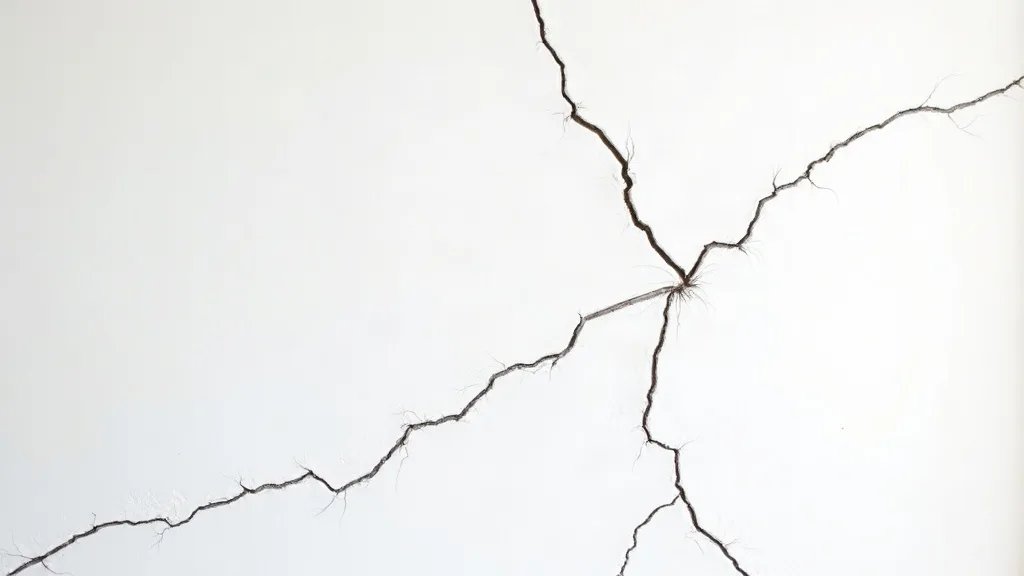
Masonry party walls (rubble stone, solid brick, concrete blocks) are subject to differential stresses depending on the buildings they separate. We commonly observe:
- Vertical cracks along the wall face, indicating differential settlement of the foundations or a lack of proper bonding (standard XP P95-100: crack < 0.2 mm = hairline crazing, between 0.2 and 2 mm = crack, > 2 mm = major crack)
- Horizontal cracks at the base of the wall, revealing faulty underpinning or water infiltration degrading the bedding mortar
- Localised spalling at corroded metal anchors or poorly sized chemical fixings
The technical assessment begins with mapping in line with DTU 20.1: photographic survey, crack-width gauge measurements, and installation of plaster or resin telltales to monitor progression. We then analyse the factors that may explain the pathology: soil type (G5 geotechnical study if available), presence of drains, root growth from vegetation, and asymmetric loading.
Moisture-related defects
A party wall damaged by moisture shows salt efflorescence, render detachment, and moss or lichen growth. The main causes are:
- The absence of a damp-proof course at the base of the wall (DTU 20.1: waterproof course at least 15 cm above finished ground level)
- Faulty rainwater drainage (holed gutters, blocked downpipes)
- Poor ventilation of adjoining rooms, causing internal condensation
We carry out moisture measurements using a carbide bomb (gravimetric method) to quantify the residual moisture content of the masonry. A moisture content above 3% by mass requires drying out before any repair work.
Defects following a wall extension
A poorly executed extension weakens the original wall through additional vertical load or a faulty connection. We commonly find:
- Differential settlement where the foundations were not designed to bear the additional load
- Shearing at the interface between old and new masonry where underpinning or corner posts were not installed
- Water infiltration at the coping where the parapet or capping was not renewed
DTU 20.1 requires the load-bearing capacity of the existing wall to be checked before any extension. Failing this, the party who carried out the work is liable under Article 1240 of the Civil Code (tortious liability) or Article 1231-1 where a project management contract was in place.
Common disputes and how they are resolved
A neighbour refusing to contribute to repairs
When one co-owner refuses to contribute to the cost of repairing a party wall, the other may bring the matter before the competent tribunal judiciaire. For the Alpes-Maritimes, disputes fall under the tribunal judiciaire of Grasse (west and central areas), Nice (east), or Draguignan for the Var, depending on the property’s location.
A preliminary amicable expert assessment makes it possible to:
- Record the condition of the wall (cracks, leaning, coping detachment)
- Identify the causes (age, lack of maintenance, or a specific event attributable to one of the neighbours)
- Cost the repair works in line with DTU 20.1 (masonry repair, repointing, coping renewal)
- Determine the cost-sharing split (50/50 for full party wall status, proportional to respective rights for partial party wall status)
The amicable expert report constitutes evidence that can be relied upon before a judge. If the neighbour continues to refuse, court proceedings will result in the defaulting co-owner being ordered to pay their share, potentially under a daily penalty.
Damage caused by leaning a structure against the wall
Article 662 of the Civil Code prohibits leaning a structure against a party wall or embedding beams into it without agreement. Where this is breached, the affected neighbour can bring a tortious liability claim (Article 1240) for compensation.
Where this prohibition has been breached, the technical assessment must:
- Check the fixing complies with best practice (minimum anchor depth of 15 cm, resin or expanding mortar in line with DTU 20.1)
- Measure the resulting movement (leaning, differential settlement)
- Quantify the loss (cost of remedial works, any resulting drop in property value)
The expert report is submitted to the competent tribunal judiciaire (Grasse, Nice or Draguignan depending on location). The judge may order the removal of improperly fixed elements and order the party responsible for the works to compensate the neighbour.
Consequences of a non-compliant wall extension
An extension carried out without first checking the load-bearing capacity of the original wall makes the person responsible liable. Where the wall shows defects (cracks, settlement, leaning), the assessment must:
- Check that the added load matches the wall’s strength (load calculation under Eurocode 6 for masonry)
- Inspect the condition of the foundations (dynamic penetrometer testing where accessible)
- Recommend reinforcement measures (underpinning, support posts, horizontal and vertical bonding)
The co-owner who raised the wall must bear the full cost of reinforcement and compensate the neighbour for any resulting damage to their property.
Technical and legal expertise for party walls
The amicable expert’s role
Before any litigation, an amicable expert assessment helps secure the situation. We work across the Alpes-Maritimes and the Var to:
- Record the condition of the party wall: crack mapping in line with DTU 20.1, dimensional measurements (leaning, deflection), and material sampling where necessary
- Analyse the causes: review of construction methods (bonding, lintels, damp-proof course), examination of stresses (asymmetric loads, vegetation, infiltration), and verification of compliance with the DTU standards in force at the time of construction
- Cost the repair works: detailed quotes by trade (masonry, waterproofing, render), work schedule, and impact on occupancy
- Establish liability: applying Articles 653 to 673 of the Civil Code, identifying the triggering event (lack of maintenance, defective work, breach of Article 662)
The amicable expert report, delivered within 15 working days, provides the basis for either amicable negotiation or court proceedings.
Court-appointed expert assessment
If the dispute is not settled amicably, the interim relief judge (juge des référés) of the competent tribunal judiciaire may order a court expert assessment under Article 145 of the Code of Civil Procedure (pre-litigation measure) or Article 812 (référé-expertise).
The court-appointed expert follows a similar methodology but within an adversarial framework: parties are summoned, site visit reports are drawn up, and the report is filed with the court registry. Cassini Expertise assists parties as a technical adviser (sapiteur) to verify the accuracy of findings and the soundness of the conclusions.
The court expert report is decisive evidence for allocating liability and setting compensation before the court. On appeal, a counter-expertise may be requested if the first report has methodological shortcomings.
Guarantees applicable to new construction
Where a newly built party wall shows defects, several statutory guarantees may apply:
- The guarantee of perfect completion (Article 1792-6 of the Civil Code): for 1 year from handover, the builder must repair all reported defects, including visible defective work
- The guarantee of proper functioning (Article 1792-3): for 2 years, removable fittings (such as a gate fixed into the party wall) must be repaired or replaced
- The ten-year structural guarantee (Article 1792 et seq.): for 10 years, defects compromising the structure’s soundness or making it unfit for purpose place the builder under strict liability
A party wall with through-cracks over 2 mm wide, a lean exceeding 1 cm per metre of height, or differential settlement compromising stability falls under the ten-year guarantee. The technical assessment must qualify the defect and identify the party or parties responsible (project manager, contractor, inspection body).
Frequently asked questions
How can I prove a wall is a party wall?
The presumption of party wall status applies to any dividing wall between two built properties or two courtyards, unless proven otherwise. This proof may come from a title deed, architectural markers (corbels on one side only, a single-sided roof slope), or thirty years of exclusive possession. Where there is doubt, an expert examines the physical evidence and consults land registry records and notarial deeds.
Who pays to repair a cracked party wall?
If the cracking results from age or lack of maintenance, both co-owners share the cost equally, under Article 655 of the Civil Code. If it results from a specific triggering event (works carried out by one neighbour, a design fault), the party responsible bears the full cost alone. The technical assessment determines the cause and the cost-sharing split.
Can I raise a party wall without my neighbour’s agreement?
Article 658 of the Civil Code allows either co-owner to raise a party wall at their own expense, without prior agreement. However, the extension must not weaken the existing wall. If defects appear (settlement, cracks), you must compensate your neighbour and cover the cost of reinforcement works. A prior technical survey is strongly recommended.
What can I do if my neighbour refuses to contribute to repairs?
You can bring the matter before the competent tribunal judiciaire (Grasse, Nice or Draguignan depending on location) to obtain an order for payment. A preliminary amicable expert assessment strengthens your case by establishing the condition of the wall, the causes, and the cost of works. The judge will order the costs to be shared according to established liability.
Can a party wall be demolished unilaterally?
No, unless the wall supports no building and the co-owner abandons their party wall rights (Article 656). In all other cases, unilateral demolition infringes the neighbour’s rights, making the person responsible liable in tort. The court can order reconstruction at the offending party’s expense.
Have a question about your property?
Honest answer within 24 working hours — independent expert, no works sold.
Cassini Expertise
Expert du bâtiment indépendant — Antibes (06·83·13·40)
📅 Mis à jour le 25/09/2026 — Cassini Expertise, expert bâtiment indépendant (06·83·13·40).