Building on clay soil in the Alpes-Maritimes or the Var requires particular precautions. Failing to follow proper construction standards exposes you to serious problems (cracks, collapse) and costly disputes.
Mandatory soil survey
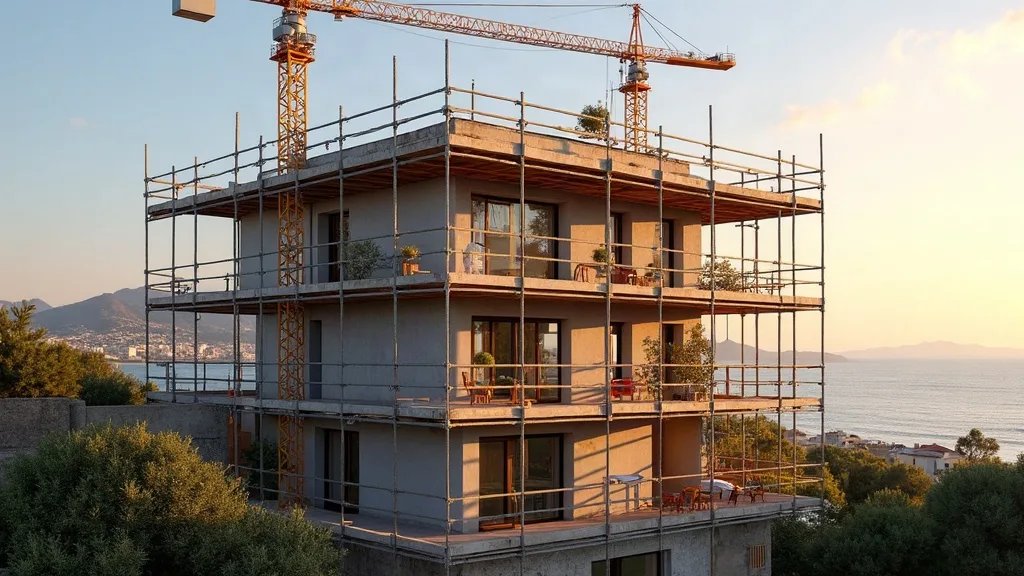
Since 2020, a G1 soil survey has been mandatory for any plot of land classified in a clay shrink-swell risk zone. A G2 survey (design phase) is recommended to correctly size the foundations. In PACA, high to very high risk zones cover most of the region.
Suitable foundations
- Minimum depth: 0.80 m to 1.20 m depending on the region
- Continuous footings or raft foundation: to distribute loads and resist ground movement
- Reinforcement (chaînage): horizontal and vertical reinforcement of load-bearing walls
- Expansion joints: to absorb differential movement
- Drainage: to keep water away from the foundations
Applicable technical standards
DTU 13.11 (shallow foundations) and standard NF P 94-261 set out the design rules. Failure to comply with these standards constitutes a technical fault that engages the liability of the builder.
Recommendations for property owners
- Require a G1 soil survey before purchasing any land
- Check that the builder has accounted for the clay shrink-swell risk
- Have an expert assessment carried out before construction begins
- If in doubt, call in an independent building expert
Cost of a soil survey and return on investment
A G1 survey typically costs between €800 and €1,500 depending on the size and accessibility of the plot; a more detailed G2 survey usually costs between €1,500 and €3,000. This is nothing compared to the cost of underpinning work after clay shrink-swell damage, which can run into tens of thousands of euros depending on the extent of the damage and the technique used (micropiles, expanding resin injection).
Foundation techniques suited to shrink-swell clay
Depending on the available anchoring depth and the level of clay shrink-swell risk, several technical solutions are possible: strip footings anchored below the zone of moisture variation, a rigid raft foundation stiffening the whole structure, or deep pile foundations in the most sensitive cases. The choice is up to the structural engineering firm, based on the soil survey results — a point the building expert systematically checks in the event of a dispute.
Vegetation maintenance: a factor too often overlooked
The roots of trees close to a building (poplars, cypresses, eucalyptus) locally increase soil drying and can worsen clay shrinkage. A planting distance of at least the tree’s mature height from the foundations is generally recommended in high clay shrink-swell risk zones — a point to factor in from the garden design stage, not just the building design.
FAQ
Can an older house be brought up to clay shrink-swell standards? Reinforcing existing foundations (micropiles, ground beams) is possible but costly; a prior diagnosis helps assess whether the investment is justified given the actual level of risk.
Is the soil survey transferable if the land is resold? Yes, and it is strongly recommended to keep it and hand it over to the buyer: it serves as a key technical reference should problems arise later.
Cassini Expertise — Advice on building on clay soil in the 06/83. Get advice →
📅 Updated on 22/08/2026 — By Cassini Expertise, independent building expert for the 06 & 83. Free quote: 04 22 46 06 04.
Read more:
Frequently asked questions about building on clay soil
How do you build on clay soil in PACA?
Carry out a soil survey (mandatory G1, then G2 for design), adapt the foundations (depth of 0.80 to 1.20 m, reinforcement, expansion joints), and ensure effective drainage.
What are the risks for a house on clay soil in the Var?
Clay shrink-swell causes differential settlement and cracking, and can even lead to structural damage during prolonged drought.
Clay shrink-swell risk in PACA: how do I know if I’m affected?
Check the BRGM clay shrink-swell risk map on the Géorisques website to find out the exposure level of your plot.